Key takeaways
- Ceiling fan direction in summer: anticlockwise, so the blades push air down and you feel a breeze. In winter, run it clockwise, which pulls air up and pushes warm air down from the ceiling.
- This comes from the US Department of Energy, a US government source, which says “counterclockwise” in summer and “clockwise” in winter. It does not say from which side: we mean seen from below, looking up at the fan.
- Fantasia, a UK maker, says its winter setting “re-circulates the warm air trapped at ceiling level” and its remotes operate 6 speeds forward and 6 in reverse.
- Check your fan’s manual for how to change direction, and stop the fan before you do.
- Turn the fan off when you leave the room: a fan cools people, not rooms.
The right ceiling fan direction depends on the season, and getting it wrong in summer means you feel almost nothing. This page gives the short answer, then how to tell which way your fan is turning and how to change it. It is part of our guide to cooling fans and follows on from ceiling fans. We have not tested any fan: the answer rests on US government guidance and UK maker pages, with sources at the end.
The short answer
In summer, the US Department of Energy says to use the ceiling fan in a counterclockwise direction to create a wind chill effect. We write anticlockwise, and mean seen from below, looking up at the fan. The blades then push the air down, and the moving air takes heat from your skin faster. In winter, the same guide says to reverse the fan to run clockwise and force warm air down from the ceiling.
The guide is American and written for American homes, and it does not say from which side the direction is judged. So do not rely on the word alone: check by feel, as below. Fantasia, a UK maker, says only that “the winter setting on our fans re-circulates the warm air trapped at ceiling level”. For hot-weather health advice, which belongs with our heatwave pages, see our UK heatwave guide.
How can you tell which way it is turning?
Stand underneath and look up. Watching the blades turn tells you the direction, but the more reliable check is by feel, which is our own suggestion, not a maker’s instruction. In summer mode, switch the fan to a moderate speed and stand under it: you should feel a breeze coming down. If you feel almost nothing, the fan may be in reverse. Check against your manual, because blade pitch and motor design vary between models.
How do you change direction?
The method depends on the fan. Many fans have a reverse control, either a small switch or a button on the remote, and your manual shows which. Fantasia gives no steps on its pages for how to reverse a particular model, but it does say that its Luna and Stellar remotes operate “6 speeds in forward and 6 in reverse”, and that the remote “can also operate the reverse function of the fan”.
- Turn the fan off at the pull cord, wall control or remote.
- Wait until the blades have stopped. This is general good practice, not a Fantasia instruction, so check your manual too.
- Change the direction using the control your manual names: the reverse button on the remote, or the switch on the fan.
- Switch the fan back on and check the direction by feel from below.
If you need to reach a switch on the fan’s housing, switch the fan off first and use a stable step ladder. Opening the fan up or touching its wiring is electrical work: for that, see our ceiling fan remote guide and ceiling fan installation, and use a qualified electrician.
Does reversing save energy?
Possibly, but we have no UK figure. The US Department of Energy says ceiling fans “can allow you to turn up the thermostat a few degrees”, and elsewhere in the same guide that using a ceiling fan allows you to turn up the thermostat about 4°F (about 2C) without any loss in comfort. That is US guidance about air conditioning, not about UK summers. In winter, Fantasia says the reverse setting “re-circulates the warm air trapped at ceiling level”; it gives no figure for how much heating that saves.
The direction itself does not change what the fan draws. Fantasia’s pages give one motor rating for each model, with none by direction. As a guide to cost, the Stellar 40” has a 30 W motor, so at the Great Britain price cap of 26.32p per kWh an hour at top speed costs 0.8p, an eight-hour evening 6.3p, and our standard 350-hour summer (an assumption) £2.76. The Luna (40 W) costs 1.1p an hour. Fantasia does not publish low-speed watts, so we compute no lower figure, and the 22 W LED light adds to the cost when it is on. These figures use the Great Britain price cap. In Northern Ireland, use the unit rate on your own bill.
| Fan | Motor | Per hour (top speed) | Per 8 hours | Price, checked 14 November 2026 |
|---|---|---|---|---|
| Fantasia Stellar 40” | 30 W | 0.8p | 6.3p | £297.00 at Fantasia , out of stock |
| Fantasia Luna 40” | 40 W | 1.1p | 8.4p | £297.00 at Fantasia , out of stock |
Fantasia’s Stellar page gave two different restock dates (late November and early December 2026), so check the listing. For fans with a light and a remote, see ceiling fans with light and remote; for Fantasia’s range, see Fantasia ceiling fans.
Turn it off when you leave the room
The US Department of Energy says to turn off the fan when you are not in the room. A ceiling fan, like any fan, cools you by moving air across your skin. It does not lower the room temperature, so there is no benefit to leaving it on in an empty room, and it costs a little to run. For more on getting the most from a fan, see how to cool down a room with a fan.
Frequently asked questions
Which way should a ceiling fan spin in summer in the UK?
Anticlockwise, seen from below, so it pushes air down. That is the US Department of Energy’s advice (it says counterclockwise), and the same logic applies in the UK. Check by standing underneath: you should feel a breeze.
Which way in winter?
Clockwise, according to the same guide: it forces warm air down from the ceiling. Fantasia says the winter setting on its fans re-circulates the warm air trapped at ceiling level.
Where is the reverse switch on a ceiling fan?
It depends on the model. Some have a button on the remote; Fantasia says its remotes can operate the reverse function. Others have a switch on the fan. Your manual shows where, and we found no single rule to give you.
Does the direction change the running cost?
Not that we can find. Fantasia’s pages give one motor rating per fan, for example 30 W for the Stellar 40”, which costs 0.8p an hour at 26.32p per kWh. Speed and any light matter more than direction.
Sources
- Ofgem: changes to the energy price cap, 1 October to 31 December 2026 (checked 14 November 2026)
- US Department of Energy: Energy Saver Guide 2022 (a US government source: wind chill, counterclockwise in summer, clockwise in winter, thermostat about 4°F higher, turn off when out of the room; checked 14 November 2026)
- Fantasia Ceiling Fans: Titan page with FAQ (winter setting re-circulates the warm air trapped at ceiling level; checked 14 November 2026)
- Fantasia Ceiling Fans: Luna (6 speeds forward and 6 in reverse; checked 14 November 2026)
- Fantasia Ceiling Fans: Stellar 40” (6 speeds forward and reverse, 30 W motor, reverse function; checked 14 November 2026)
Products on this page
Fantasia
Stellar 40" DC ceiling fan with light and remote
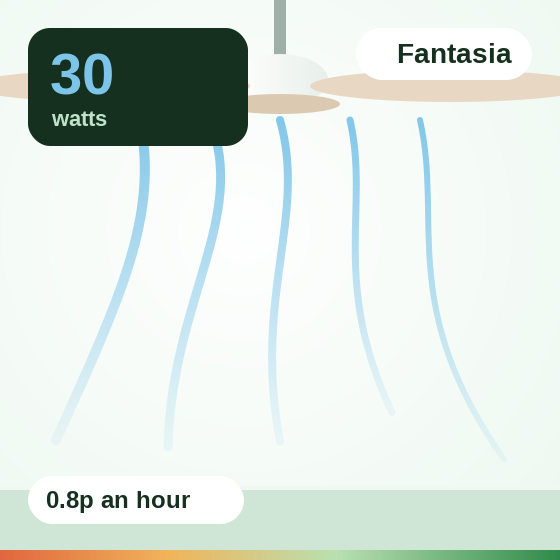
30 watts · 0.8p an hour
£297.00 at Fantasia Ceiling Fans (maker shop), checked 14 Nov 2026
See it at Fantasia Ceiling Fans (maker shop)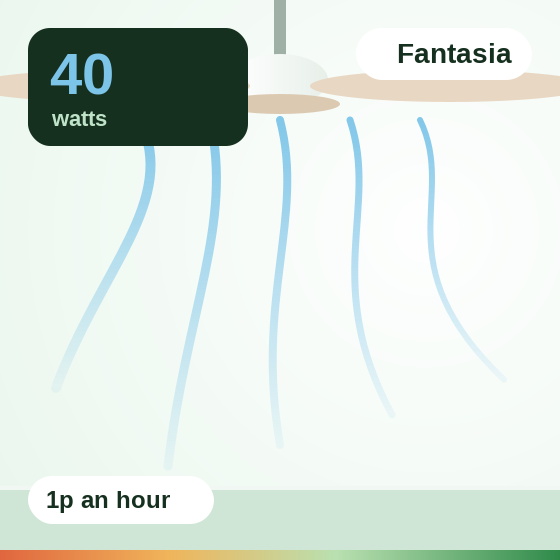
Fantasia
Luna DC ceiling fan with light and remote
40 watts · 1p an hour
£297.00 at Fantasia Ceiling Fans (maker shop), checked 14 Nov 2026
See it at Fantasia Ceiling Fans (maker shop)
Figures from the maker or retailer listing. Cost an hour is our own, at the price cap of 26.32p a kWh.