Key takeaways
- Do I need air conditioning? Many UK homes cope with shade, night ventilation and a fan, and our running costs guide shows what a unit adds to the bill. Air conditioning earns its place in a room that stays hot, for someone at higher risk from heat, and in top-floor flats, lofts and garden offices.
- The official figure for adults is UKHSA’s 26C: people at higher risk “can find it hard to cool themselves efficiently once temperatures rise above 26°C”. It is guidance for care settings in England, not a rule for every home. The NHS gives a separate room figure for babies.
- Fans help only while the air is below 35C, and they do not lower the room temperature.
- Running cost is rarely the barrier. Over our standard 350-hour summer at Ofgem’s 26.32p per kWh (1 October to 31 December 2026), a 1,000 W portable costs £92.12, a 700 W portable £64.48 and an efficient split about £21.93 a year.
Do you need air conditioning?
Do you need air conditioning in the UK? For many homes the answer is “not yet”: shading, opening windows at night and a fan do much of the job at a fraction of the cost. It becomes worth pricing when a room stays hot after you have tried those steps, when someone at higher risk from heat sleeps or spends the day there, or when the room is a top-floor flat, a loft or a garden building.
UKHSA names the homes more likely to overheat: “flats on the top floor because heat rises”, homes with opening windows on just one side, homes with large unshaded east, west or south-facing windows, and some highly insulated homes that “may trap heat inside” (GOV.UK: Beat the heat, keep cool at home checklist). If that describes your home, read on. Our air conditioning running costs guide explains what a unit costs to run.
The checklist
The checklist tool will ask these questions about the room you want to cool. The specification below is for the build; the tool itself is built later.
name: do-i-need-air-conditioning
questions:
  - id: sleep-hot
    text: Does the room you sleep in go above 26C on hot days? (Check with a thermometer.)
    why: 26C is the line UKHSA uses for people at higher risk from heat in its care guidance.
  - id: higher-risk
    text: Does anyone in the home fall into a group at higher risk from heat?
    why: The NHS and UKHSA list older people (65 and over), babies and children aged 5 and under, pregnant people, people with long-term conditions and people who live alone, among others.
  - id: roof-or-glass
    text: Is the room on the top floor, in a loft, a conservatory or a garden building?
    why: UKHSA lists top-floor flats as more likely to overheat because heat rises; lofts, conservatories and garden buildings gather heat the same way.
  - id: sun-facing
    text: Does the room face south or west with large windows?
    why: UKHSA lists large unshaded east, west or south-facing windows as a cause of overheating.
  - id: through-draught
    text: Can you open windows on two sides for a draught at night?
    why: UKHSA lists homes with opening windows on only one side as more likely to overheat; a through draught on a cool night lets heat out.
  - id: tried-free
    text: Have you tried closing curtains by day and using a fan?
    why: These are UKHSA's first steps, and they cost almost nothing.
  - id: want-heating
    text: Do you also want heating in winter?
    why: Many split units and all air-to-air heat pumps heat as well as cool, so price one of those.
  - id: fixed-allowed
    text: Is a fixed unit allowed (renting, leasehold, listed building)?
    why: A fixed unit may need your landlord's or freeholder's permission; check your agreement.
results:
  - try the free steps first (no risk group, free steps not yet tried, or room does not pass 26C)
  - a portable unit for the hottest room (room stays hot after free steps, fixed unit not allowed or not wanted)
  - a fixed system or air-to-air heat pump is worth pricing (room stays hot, higher risk, or heating also wanted, and fixed unit allowed)
rules: no scores; the result is one of the three lines above plus the cost of each option from data/energy.json
no-javascript fallback: list the questions with what each answer means (the "What your answers mean" list below)
Without JavaScript, use this list:
- Yes to the 26C question, or yes to a higher-risk group: a cool room matters. Do the free steps below first, then price a unit.
- Yes to top floor, loft, conservatory, garden building or south or west windows: the room will keep gaining heat, so shading matters most. A unit is more likely to be worth it.
- Yes to a through draught, yes to having tried curtains and a fan, and no to the other questions: you probably do not need air conditioning.
- Yes to wanting heating in winter: price an air-to-air heat pump, which cools and heats.
- No to a fixed unit being allowed: a portable is the option. See planning permission and permission from a landlord.
The tool will give no scores. Its questions will point you towards one of three answers: try the free steps first, a portable unit for the hottest room, or a fixed system or air-to-air heat pump worth pricing.
Who is most at risk from heat
The NHS lists older people, especially those aged 65 and over; babies and young children aged 5 and under; people who are pregnant or have serious long-term conditions; people who live alone and may be unable to care for themselves; people on multiple medicines; and people who work or spend a lot of time outside (NHS: Heatwave, how to cope in hot weather). UKHSA’s care guidance says high-risk groups “can find it hard to cool themselves efficiently once temperatures rise above 26°C” and asks for “a cool room or area (able to be maintained below 26°C)” for them (GOV.UK, updated 8 July 2025).
That guidance is for care settings in England. Apart from the NHS’s 16C to 20C for a baby’s room, it is the only official temperature we can give, and there is no official maximum safe room temperature for adults in the sources we read. For symptoms of heat illness and when to get help, see our UK heatwave guide, and the NHS page above.
Try these first
UKHSA’s advice for staying cool at home (GOV.UK: Beat the heat, updated 21 July 2026) includes:
- Close blinds and curtains on windows exposed to direct sunlight during the day.
- Open windows when it is safe to and the air feels cooler outside than inside, for example at night.
- Move to a cooler part of the house, especially for sleeping.
- Use electric fans if the air temperature is below 35C. Do not aim the fan directly at your body. The NHS says the same: “Electric fans can help if the temperature is below 35 degrees.”
- Turn off lights and electrical equipment you are not using, to reduce the heat made in the home.
A fan moves air over your skin; it does not lower the temperature of the room. A 24 W air circulator costs 0.6p an hour at 26.32p per kWh: see how much a fan costs to run and our cooling fan guide.
If you do need it: portable, split or heat pump?
- Portable. A floor-standing unit with a hose through the window, usable in a rented home, with no installation. It is the dearest to run: a typical class A unit draws 1,000 W. See our portable air conditioner guide.
- Split. An indoor unit on the wall and an outdoor unit joined by pipework, fitted by an engineer. It is the cheapest to run of the three, but costs more to buy and fit. See our split air conditioner guide.
- Air-to-air heat pump. A split-type system that also heats efficiently. Worth pricing if you want cooling and heating from one system: see air-to-air heat pumps.
Use our BTU calculator to check the size for your room before you buy.
What it would cost to run
All at 26.32p per kWh, Ofgem’s Great Britain average for the price cap period 1 October to 31 December 2026, over 350 hours (roughly 8 hours a day for 44 days).
| Model | Type | Per summer |
|---|---|---|
| De’Longhi Pinguino PACEM90K.1 Silent (1,000 W, class A) | Portable | 350 kWh, £92.12 |
| De’Longhi Pinguino PACEX100 Silent (700 W, class A++) | Portable | 245 kWh, £64.48 |
| Mitsubishi Electric MSZ-LN25VG3 (2.5 kW, A+++) | Split | 83.3 kWh, £21.93 a year (formula estimate) |
The working for the first row: 1,000 W is 1 kW; 1 kW for 350 hours is 350 kWh; at 26.32p a kWh that is £92.12. The split’s figure is a formula estimate: cooling capacity 2.5 kW times 350 hours, divided by its SEER of 10.5, gives 83.3 kWh. Those are upper-end figures for the portables, because an inverter unit draws less once the room is cool. These figures use the Great Britain price cap. In Northern Ireland, use the unit rate on your own bill.
The portables are from £529.99 and £759.99 at De’Longhi UK, checked 14 November 2026, when both were out of stock. The split is fitted by an installer and has no retail price. Put in your own hours and rate with the running cost calculator, or see is air conditioning expensive to run?. For setting the thermostat, see the best temperature for air conditioning.
Frequently asked questions
Do I need air conditioning in the UK?
Not in every home. Shading, night ventilation and a fan are enough for many. It is worth considering if a room stays above 26C after those steps, if someone at higher risk from heat sleeps or lives there, or if the room is a top-floor flat, loft or garden building.
Is air conditioning worth it in the UK?
It depends on how many hours you would use it and how hot the room gets. An efficient split costs about £21.93 a year to run over 350 hours at the October to December 2026 cap (a formula estimate), a 1,000 W portable £92.12. Weigh that against the price of buying and fitting the unit and the number of hot days in a typical year in your home.
Can I have air conditioning in a rented home?
It depends on your tenancy agreement and your landlord. A portable unit needs no fitting, but check what your agreement says; for a fixed split, ask the landlord first. See our guide to air conditioning planning permission and landlord permission.
Is a fan enough?
For many people, yes, while the air is below 35C. The NHS says electric fans can help below 35 degrees, and UKHSA’s care guidance says not to use them above 35C as they can raise body temperatures. A fan does not lower the temperature of the room, so it may not be enough in a room that stays very hot or for someone at higher risk.
What temperature is too hot to sleep?
There is no official figure for adults in the NHS, UKHSA or Met Office pages we read. UKHSA says to move to a cooler part of the house for sleeping, and the NHS says to check the temperature of rooms where people at higher risk live and sleep. The only official room temperature we found is for babies: 16C to 20C, from the NHS.
Sources
- GOV.UK (UKHSA): Supporting vulnerable people before and during hot weather, social care managers (8 July 2025) (checked 14 November 2026)
- GOV.UK (UKHSA): Beat the heat, staying safe in hot weather (21 July 2026) (checked 14 November 2026)
- GOV.UK (UKHSA): Beat the heat, keep cool at home checklist (checked 14 November 2026)
- NHS: Heatwave, how to cope in hot weather (checked 14 November 2026)
- Ofgem: Changes to energy price cap between 1 October and 31 December 2026 (checked 14 November 2026)
- De’Longhi UK: Pinguino PACEM90K.1SILENT (checked 14 November 2026)
- De’Longhi UK: Pinguino PACEX100SILENT EX:2 (checked 14 November 2026)
- Mitsubishi Electric UK: MSZ-LN R32 product information sheet, February 2026 (PDF) (checked 14 November 2026)
Products on this page
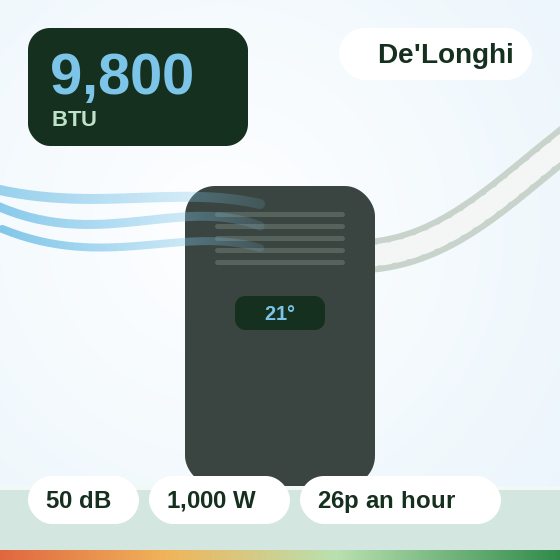
De'Longhi
Pinguino EM Series PACEM90K.1SILENT
9,800 BTU · 50 dB · 1,000 W · 26p an hour
£529.99 at De'Longhi UK (maker shop), checked 14 Nov 2026
See it at De'Longhi UK (maker shop)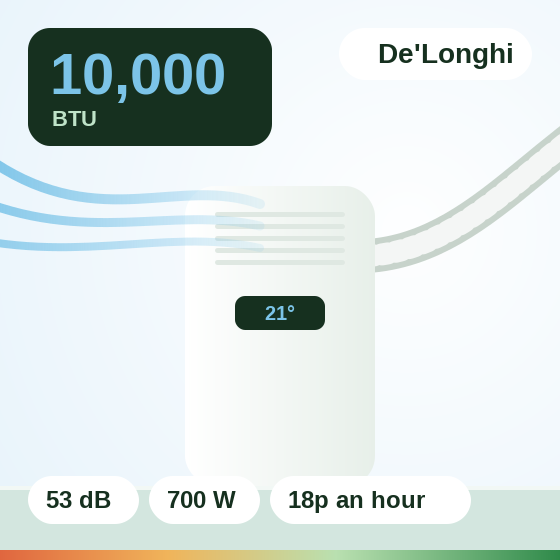
De'Longhi
Pinguino 100 Silent PACEX100SILENT EX:2
10,000 BTU · 53 dB · 700 W · 18p an hour
£759.99 at De'Longhi UK (maker shop), checked 14 Nov 2026
See it at De'Longhi UK (maker shop)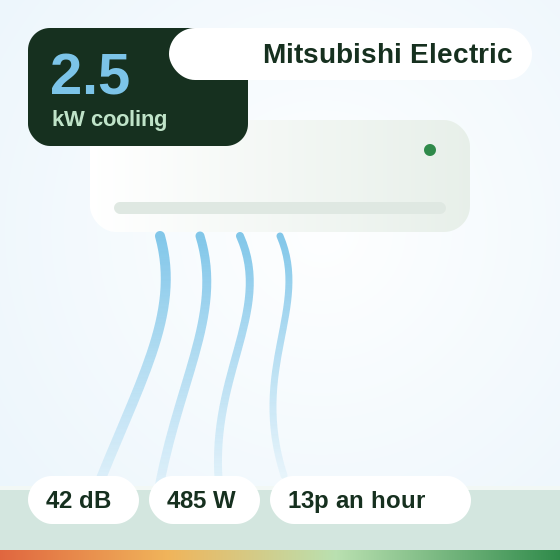
Mitsubishi Electric
MSZ-LN25VG3 (indoor) with MUZ-LN25VG3 (outdoor), 2.5 kW
2.5 kW cooling · 42 dB · 485 W · 13p an hour
No current UK price found
Figures from the maker or retailer listing. Cost an hour is our own, at the price cap of 26.32p a kWh.