Key takeaways
- The best temperature for air conditioning is not set by any UK government or health body. Our air conditioning running costs guide covers the cost side; the nearest maker figure is Daikin’s: in its user guide for the Perfera FTXM-A, 26 to 28C for cooling “to save energy”. That is one maker’s advice, not official guidance.
- The nearest official figure for adults is UKHSA’s 26C, from its guidance for care settings in England: people at higher risk of harm from heat “can find it hard to cool themselves efficiently once temperatures rise above 26°C”. The NHS gives a separate room figure for babies.
- Midea says a lower setting does not make the room cool faster; it makes the compressor run longer to reach the target. That is one maker’s guide, for window units; Daikin’s manual says nothing either way.
- Running cost is the ceiling: 26.3p an hour for a 1,000 W portable, 18.4p for a 700 W portable and 12.8p for the efficient split at full power, at the Ofgem price cap for 1 October to 31 December 2026.
What temperature should you set your air conditioning to?
The best temperature for air conditioning in a UK home is the warmest one at which you are comfortable, and 26 to 28C is the range one major maker gives. Daikin’s user guide for its Perfera FTXM-A split units says to “operate the system within the recommended temperature range (2628°C for cooling and 2024°C for heating) to save energy” (Daikin user reference guide, June 2023). It also says to “be careful NOT to cool or heat too much” and to keep the setting “at a moderate level”.
Three points about that figure:
- It is a maker’s recommendation, not official advice. We found no UK government, NHS or UKHSA page that recommends a setting for air conditioning at home. Search results that give “24 to 26C” mostly repeat each other, and we have not been able to check the original source, so we do not use it.
- It is one maker’s. We have not found the same wording in the De’Longhi UK pages for the portables on this site, which do not state a recommended setting. Check your own manual.
- It sits on the health marker. UKHSA’s guidance for care settings in England says people at higher risk “can find it hard to cool themselves efficiently once temperatures rise above 26°C”, and asks for a cool room “able to be maintained below 26°C” (GOV.UK: supporting vulnerable people before and during hot weather, updated 8 July 2025). That is guidance for care managers about vulnerable people, not a target for every home.
If nobody in the home is at higher risk, pick the warmest setting that feels comfortable and move it up a degree at a time. If someone is, use 26C or below for the room they use, and see do I need air conditioning? and our UK heatwave guide. For the full cost picture, see air conditioning running costs.
Why a lower setting does not cool faster
The set temperature is where the unit stops, not how hard it works on the way. Daikin’s guide describes cooling mode as one where the system “cools down a room to the temperature setpoint”, and warns that “it may take some time for the room temperature to reach the set temperature”. It does not say whether a lower setting speeds this up. Midea, in its guide to window air conditioners, says a unit cools at a constant rate, and that a lower setting makes the compressor run longer to reach the target “without speeding up the initial cooling process” (Midea). That is one maker’s guide, written about window units; we have not found a manual for an inverter split that says either way. If a unit cannot reach the set temperature at all, the cause may be the wrong size for the room or a fault rather than the setting. Use our BTU calculator to check size, and see air conditioning repair and servicing.
How the setting affects the cost
A setting close to the outside temperature means the unit spends less time working hard. A very low setting means a bigger gap to hold, so it runs for more of the hour. We have not found a primary source for a “per degree” saving, so we give no percentage.
What we can give is the ceiling. These are the costs at full rated power, from the makers’ own figures, at Ofgem’s Great Britain average unit rate of 26.32p per kWh (price cap, 1 October to 31 December 2026):
| Model | Rated input | Per hour at full power | Per 8-hour night at full power |
|---|---|---|---|
| De’Longhi Pinguino PACEM90K.1 Silent (portable, A) | 1,000 W | 26.3p | £2.11 |
| De’Longhi Pinguino PACEX100 Silent (portable, A++) | 700 W | 18.4p | £1.47 |
| Mitsubishi Electric MSZ-LN25VG3 (split, A+++) | 485 W | 12.8p | £1.02 |
The working: 1,000 W is 1 kW, and 1 kW for an hour is 1 kWh, which costs 26.32p, so 26.3p an hour; eight hours is £2.11. The split’s 485 W is 0.485 kW, so 12.8p an hour. These figures are what the unit costs while running flat out. In practice a unit with a set temperature close to the outside temperature runs below that for much of the night, and an inverter slows down once the room is cool. Averaged over a 350-hour summer, the split works out at about 6.3p an hour (a formula estimate from its SEER), against 12.8p at full power.
These figures use the Great Britain price cap. In Northern Ireland, use the unit rate on your own bill, or put your own rate into the running cost calculator. For the bigger picture, see is air conditioning expensive to run?
Best setting for sleeping
No NHS, UKHSA or Met Office page we read gives a recommended air conditioning setting for adults sleeping. What UKHSA does say is to “move to a cooler part of the house, especially for sleeping”, and to open windows when the air feels cooler outside than inside, “for example at night” (GOV.UK: Beat the heat, updated 21 July 2026).
Some practical points from the makers:
- Use the timer or a sleep mode. Daikin’s guide describes a “night set mode”: when the off timer is set, the unit raises the cooling setting by 0.5C to avoid cooling too much while you sleep. It is one maker’s feature and other makers differ, so check your manual.
- For babies, the only official room figure is for them. The NHS says “your baby will sleep most comfortably when their room is between 16C and 20C” (NHS: Safety in the sun), so do not use an adult setting. Keep any airflow away from the child: the NHS says not to aim a fan directly at them.
Our guide to the best air conditioners for a bedroom covers noise and sleep modes by model.
Babies, older people and health conditions
The NHS lists people at higher risk from heat as older people, especially those aged 65 and over; babies and young children aged 5 and under; people who are pregnant or have serious long-term conditions; people who live alone; and people on multiple medicines (NHS: Heatwave, how to cope in hot weather). It says to “check the temperature of rooms, especially where people at higher risk live and sleep”.
For these groups, treat 26C as the line not to go above in the room they use, as UKHSA’s care guidance does for vulnerable people. Fans help only while the air is below 35C: the NHS says “electric fans can help if the temperature is below 35 degrees”, and UKHSA’s care guidance says not to use them above 35C as they can raise body temperatures. For heat illness symptoms and when to get help, see our UK heatwave guide.
Getting more from each degree
- Close curtains and blinds on sunny windows before you start. Daikin’s guide says to “prevent direct sunlight from entering a room during cooling operation by using curtains or blinds”, and UKHSA says the same for windows in direct sunlight during the day.
- Shut doors and windows. Daikin’s guide says that if doors and windows remain open, air flows out and the cooling effect falls.
- Pick a setting you can live with, then leave it. Changing it every few minutes does not speed anything up.
- Use a timer. Set it to switch off after you are asleep, or to start shortly before you are home.
- Use the right mode. Cool mode lowers the temperature to the set point. Daikin says its fan-only mode “does NOT control the temperature”, and its drying mode is for lowering humidity, so neither is a way to cool the room quicker.
- Clean the filter. Daikin says to clean the air filters every 2 weeks and warns that running the unit with dirty filters reduces performance. Check your own manual for the interval.
- Keep the area around the unit clear. Daikin says never to place objects near the air inlet or outlet, as this can reduce the cooling effect.
Frequently asked questions
Is 18C too cold for air conditioning?
It is the bottom of the range for many units, and a poor choice for most people. Daikin’s guide gives 18 to 32C as the setting range in cool mode, and recommends 26 to 28C for cooling. Midea’s guide says a setting such as 18C does not cool a room faster and only makes the compressor run longer, and Daikin’s manual does not say a lower setting cools faster either.
What is the best temperature for air conditioning at night?
There is no official figure. UKHSA says to sleep in the coolest part of the home. Use a setting at which you can sleep without feeling cold, a timer or sleep mode, and keep any room with a baby between 16C and 20C, which is the NHS figure for babies.
Is it cheaper to leave air conditioning on all day?
We have found no primary source that says it is. A unit costs up to its hourly figure for every hour it runs. At full power that is 26.3p an hour for a 1,000 W portable, or £6.32 for 24 hours. Running it only when someone is in the room, with a timer, means fewer hours.
What temperature is too hot for a house?
There is no official maximum for adults in the sources we read. UKHSA’s care guidance says people at higher risk can find it hard to cool themselves above 26C, and asks for a room that can be kept below 26C. That is guidance for people who are vulnerable to heat, not a limit for every home.
Should I use dry mode or cool mode?
Use cool mode to lower the temperature. Daikin describes drying mode as lowering the humidity, and in its guide the temperature cannot be adjusted in it. Dry mode can make a muggy room feel less sticky but it is not a way to cool a hot one. Our guide on how air conditioning works explains the modes.
Does the fan setting save money?
Not as a rule we can quantify. Daikin’s guide says fan-only mode controls airflow, not temperature, so it cools nothing. The makers’ documents we read give no saving for a lower fan speed in cool mode, so we quote none.
Sources
- Daikin: user reference guide, CTXM-A and FTXM-A room air conditioners (June 2023) (checked 14 November 2026)
- GOV.UK (UKHSA): Supporting vulnerable people before and during hot weather, social care managers (checked 14 November 2026)
- GOV.UK (UKHSA): Beat the heat, staying safe in hot weather (checked 14 November 2026)
- NHS: Heatwave, how to cope in hot weather (checked 14 November 2026)
- NHS: Safety in the sun, babies and children (checked 14 November 2026)
- Ofgem: Changes to energy price cap between 1 October and 31 December 2026 (checked 14 November 2026)
- De’Longhi UK: Pinguino PACEM90K.1SILENT (checked 14 November 2026)
- De’Longhi UK: Pinguino PACEX100SILENT EX:2 (checked 14 November 2026)
- Mitsubishi Electric UK: MSZ-LN R32 product information sheet, February 2026 (PDF) (checked 14 November 2026)
- Midea: Window AC, what setting cools the most? (9 July 2026) (checked 14 November 2026)
Products on this page
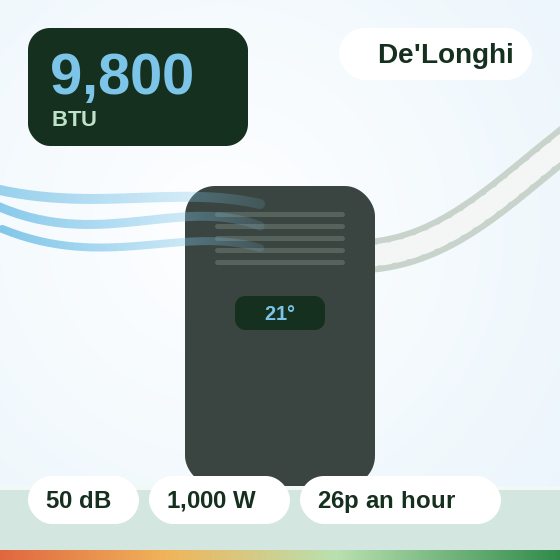
De'Longhi
Pinguino EM Series PACEM90K.1SILENT
9,800 BTU · 50 dB · 1,000 W · 26p an hour
£529.99 at De'Longhi UK (maker shop), checked 14 Nov 2026
See it at De'Longhi UK (maker shop)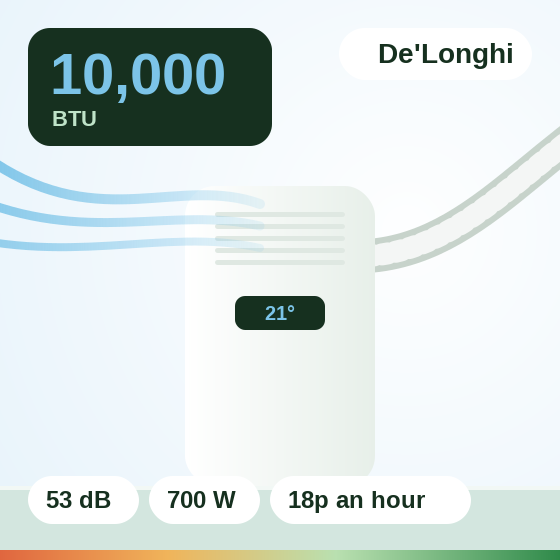
De'Longhi
Pinguino 100 Silent PACEX100SILENT EX:2
10,000 BTU · 53 dB · 700 W · 18p an hour
£759.99 at De'Longhi UK (maker shop), checked 14 Nov 2026
See it at De'Longhi UK (maker shop)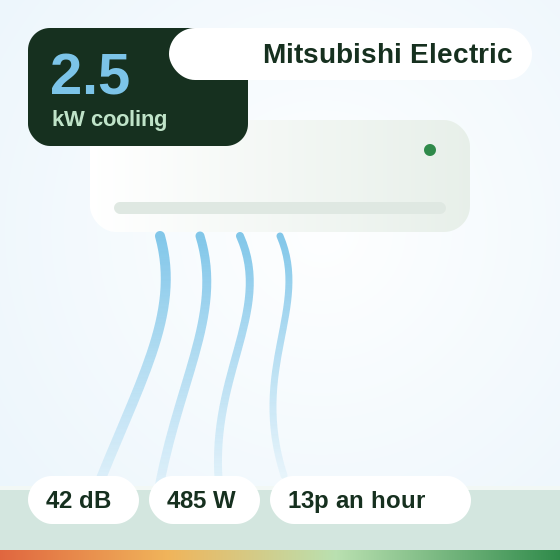
Mitsubishi Electric
MSZ-LN25VG3 (indoor) with MUZ-LN25VG3 (outdoor), 2.5 kW
2.5 kW cooling · 42 dB · 485 W · 13p an hour
No current UK price found
Figures from the maker or retailer listing. Cost an hour is our own, at the price cap of 26.32p a kWh.