Key takeaways
- You do not need a special solar powered air conditioner: home solar panels feed your normal wiring, so an ordinary air conditioner uses the solar power first and buys the rest from the grid.
- Every kWh your panels supply instead of the grid saves 26.32p at the Ofgem price cap for 1 October to 31 December 2026. If you would otherwise have exported it, the gain is that figure less your export rate.
- If panels covered every hour, a 700 W portable would save up to 18.4p an hour and £64.48 over our standard 350-hour summer; a 1,000 W portable up to 26.3p and £92.12. These are upper limits.
- Feed-in Tariff solar systems had a median load factor of 9.2% in 2024/25, a year of low sun hours: about 806 kWh per 1 kW of panels. It is a median, not a forecast for your roof.
- Solar cannot help after sunset unless you have a battery, so evening and night cooling still comes from the grid.
Can solar panels run an air conditioner?
Yes. A solar powered air conditioner, in most UK homes, is simply a normal air conditioner plugged into a house that has solar panels. The panels feed the home’s wiring, so whatever is running when the sun shines, the air conditioner included, uses the solar power first and takes any shortfall from the grid. You do not switch anything over.
The question that matters is how much of the unit’s power the panels can cover, and what that is worth. Our air conditioning running costs guide gives the full cost of running each type; this page works out how much of that solar can take off.
How we work it out, in short: we use Ofgem’s average unit rate of 26.32p per kWh for Great Britain, for the price cap period 1 October to 31 December 2026; Ofgem says that rate does not include VAT (Ofgem). Separately, HMRC’s temporary zero rate of VAT on household electricity in Great Britain runs to 30 June 2027 (HMRC); Ofgem’s pages, written before Budget 2026 extended it, say 31 March 2027. We assume 350 hours of cooling a summer and 8 hours a night. The energy label uses 350 hours for split units; for portables, our standard summer of 350 hours is an assumption. These figures use the Great Britain price cap. In Northern Ireland, use the unit rate on your own bill.
How a home solar system powers air conditioning
Grid-tied panels (the usual UK set-up)
Most home systems are connected to the grid. During the day the panels supply the house; anything the house is not using at that moment flows out to the grid. That spare electricity can be paid for under the Smart Export Guarantee: suppliers set the rate, contract length and terms, the rate must always be above zero, payments are worked out from export meter readings, and the installation must be in Great Britain (Ofgem: Smart Export Guarantee).
So running an air conditioner on a sunny afternoon uses power you would otherwise have exported. That is still a saving, but a smaller one than the full unit rate (see “What it saves” below).
Batteries and evenings
Panels make nothing after dark. A home battery can store spare daytime solar for the evening, so a unit running at night draws on the battery until it is empty and then on the grid. How far a battery stretches depends on its usable capacity and what else the house is running; the unit’s kWh figures below are what to set against it.
If you are thinking of adding panels or a battery, the VAT on installing them is a separate relief from the zero VAT on your electricity bill. HMRC zero-rates the installation of solar panels in homes from 1 May 2023 to 31 March 2027, and home batteries from 1 February 2024, with the rate going back to 5% from 1 April 2027 (HMRC: VAT Notice 708/6).
Off-grid and DC “solar air conditioners”
Online marketplaces also sell units described as “solar air conditioners”, designed to run straight from panels and batteries rather than from a mains socket. They are aimed at places with no mains supply, such as cabins and some garden offices. Before buying one, look for the maker’s own specification sheet with the rated input power and cooling capacity, and ask an electrician to check any connection to panels, batteries or your home’s wiring. For a home already on the grid, an ordinary unit on your existing panels does the same job.
How much power does an air conditioner need from the panels?
The unit’s rated input power is what the panels would have to supply, at that moment, to cover it completely.
| Model | Type | Power or average draw | kWh in a 350-hour summer |
|---|---|---|---|
| De’Longhi Pinguino PACEX100 Silent | Portable, class A++ | 700 W | 245 kWh |
| De’Longhi Pinguino PACEM90K.1 Silent | Portable, class A | 1,000 W | 350 kWh |
| Mitsubishi Electric MSZ-LN25VG3 | Split, 2.5 kW, A+++ | about 0.24 kW on average | 83.3 kWh (formula estimate) |
The De’Longhi figures are from De’Longhi UK’s product pages (PACEX100 Silent, PACEM90K.1 Silent). Rated input power is the full-power draw under the standard test conditions (Regulation 626/2011, Annex VII), so it is an upper estimate for units that slow down once the room is cool.
The Mitsubishi sheet gives a SEER of 10.5 for the 2.5 kW unit but no yearly kWh (Mitsubishi Electric UK product information sheet, February 2026), so we use the energy label’s formula: 2.5 kW times 350 hours, divided by 10.5, is 83.3 kWh, a formula estimate that assumes the room needs the unit’s full rated capacity. Spread over 350 hours, that is about 0.24 kW. A split’s draw rises and falls through the day, so the average is a guide, not a steady load.
What UK panels actually produce
A panel system’s rated size (1 kW, 4 kW and so on) is its maximum output, which it reaches only in strong sun. The Department for Energy Security and Net Zero measures how much small-scale solar systems on the Feed-in Tariff scheme really produce, as a load factor: the electricity generated as a share of the most the system could have made (DESNZ: Feed-in Tariff load factor analysis, December 2025). For 2024/25 (April 2024 to March 2025), across about 282,000 solar installations:
- the median load factor was 9.2%, the lowest in the series, because sun hours were down;
- April to June 2024 was the best quarter, at 13.6%;
- October to December 2024 was the worst, at 4.7%.
Our working: a year is 8,760 hours, so 1 kW of panels at the median 9.2% made about 806 kWh (805.9 kWh) over the year. April to June has 91 days, or 2,184 hours, so at 13.6% each 1 kW of panels made about 297 kWh in that quarter. That is an average of 0.136 kW for every 1 kW of panels, across every hour of day and night: midday output is higher, night output is zero.
Set the unit’s kWh against those numbers. The 700 W portable’s whole 350-hour summer is 245 kWh, a little less than the 297 kWh that 1 kW of panels made in the best quarter of 2024/25; the 1,000 W portable’s 350 kWh is a little more. But a unit only uses solar while the sun is out; any hours it runs in the evening still come from the grid or a battery.
What it saves
Every kWh the panels supply instead of the grid saves the unit rate: 26.32p at the October to December 2026 price cap. If the panels fully covered each unit:
| Model | Saving per hour | Saving per 350-hour summer |
|---|---|---|
| De’Longhi PACEX100 Silent (700 W) | 18.4p | £64.48 |
| De’Longhi PACEM90K.1 Silent (1,000 W) | 26.3p | £92.12 |
| Mitsubishi Electric MSZ-LN25VG3 (split) | about 6.3p on average | £21.93 (formula estimate) |
All at 26.32p per kWh, Great Britain average, price cap 1 October to 31 December 2026. These are upper limits: they assume the panels covered every hour the unit ran, which they will not after sunset or on dull days.
If that solar would otherwise have been exported, the real gain is the unit rate minus your export rate. As an example from a named supplier, Octopus Energy’s Outgoing Octopus tariff paid 12p per kWh when we checked on 14 November 2026; it is a variable rate and you need an Octopus import tariff and a smart meter that sends half-hourly export readings (Octopus Energy: Outgoing Octopus). At that rate, each kWh used instead of exported is worth 26.32p minus 12p, or 14.3p. For the 1,000 W portable that is 14.3p an hour; for the 700 W portable, 10.0p an hour. Check your own export rate; it is set by your supplier.
The simplest way to cut what solar has to cover is a more efficient unit: see our best energy efficient air conditioners.
Do cooling and solar line up?
Partly. The hottest days are usually sunny, and the government’s figures show solar output is highest from April to June, with the sun’s strength at its peak in June (DESNZ). But rooms often stay hot into the evening, after panel output has fallen, and a bedroom unit used overnight gets nothing from the panels. We found no UK source measuring how often cooling demand and panel output peak at the same time, so we give no figure.
Two things help: running the unit in the afternoon to cool the room before the sun goes, and keeping the sun off the windows. Government heat advice says to close blinds and curtains on windows in direct sunlight during the day (GOV.UK: Beat the heat).
Solar powered portables and air coolers
A portable air conditioner can run on solar in exactly the same way as a split: plug it into a socket in a house with panels. Rechargeable and solar-ready air coolers and fans use far less power, but they do a different job. Our list of best solar powered air coolers and air conditioners covers the products; this page stays with the running cost. For the types themselves, see our guides to portable air conditioners and split air conditioners. If you are also thinking of using a unit for heating in winter, when panels make least, see air-to-air heat pumps.
To work out your own figures, use our air conditioning running cost calculator with your unit’s wattage and your own hours, or see is air conditioning expensive to run? for how the costs compare with a typical bill.
Frequently asked questions
Can I run an air conditioner on solar panels?
Yes. With a normal grid-connected system the panels feed your home’s wiring, so an ordinary air conditioner uses the solar power first and the grid for the rest. No special unit is needed.
How many solar panels do I need to run an air conditioner?
Divide the unit’s rated input power by your panels’ rated output in watts (it is on the panel’s datasheet) to see how many would cover it in full sun. In practice panels give much less than their rating on average: solar systems on the Feed-in Tariff scheme had a median load factor of 9.2% in 2024/25, a year of low sun hours, or about 806 kWh a year per 1 kW of panels (DESNZ). Compare that with the unit’s kWh: 245 kWh for a 700 W portable over 350 hours.
Can I run air conditioning on solar at night?
Only from a home battery. Panels make nothing after dark, so without a battery all night-time cooling comes from the grid: £1.47 for an eight-hour night with a 700 W portable at 26.32p per kWh.
Are solar powered air conditioners worth it in the UK?
Running an ordinary unit on panels you already have is worth it: every kWh of solar it uses saves you buying one at 26.32p (or, if you would have exported it, the difference between that and your export rate). Buying panels just to run air conditioning is a different question, because the unit runs for a few hundred hours a year at most.
Do I lose my export payment if I use the solar myself?
You are not paid for solar you use yourself, only for what is exported, measured by your export meter (Ofgem). Using it is still usually worth more: at Octopus Energy’s 12p Outgoing rate (checked 14 November 2026), each kWh used saves 26.32p and gives up 12p, a gain of 14.3p.
Can a portable air conditioner run on solar?
Yes, plugged into a socket in a house with panels, like any appliance. A 700 W portable needs 700 W from the panels to be fully covered at that moment; at less, the grid makes up the rest.
Sources
- Ofgem: Changes to energy price cap between 1 October and 31 December 2026 (checked 14 November 2026)
- Ofgem: Energy price cap unit rates and standing charges (checked 14 November 2026)
- HMRC: VAT on fuel and power (VAT Notice 701/19) (checked 14 November 2026)
- HMRC: VAT on energy-saving materials and heating equipment (VAT Notice 708/6) (checked 14 November 2026)
- Ofgem: Smart Export Guarantee (SEG) (checked 14 November 2026)
- Department for Energy Security and Net Zero: Feed-in Tariff load factor analysis, Energy Trends, 18 December 2025 (PDF) (checked 14 November 2026)
- Octopus Energy: Outgoing Octopus export tariff (checked 14 November 2026)
- legislation.gov.uk: Regulation (EU) No 626/2011, Annex VII, measurements and calculations (checked 14 November 2026)
- De’Longhi UK: Pinguino PACEX100SILENT EX:2 (checked 14 November 2026)
- De’Longhi UK: Pinguino PACEM90K.1SILENT (checked 14 November 2026)
- Mitsubishi Electric UK: MSZ-LN R32 product information sheet, February 2026 (PDF) (checked 14 November 2026)
- GOV.UK: Beat the heat: staying safe in hot weather (checked 14 November 2026)
Products on this page
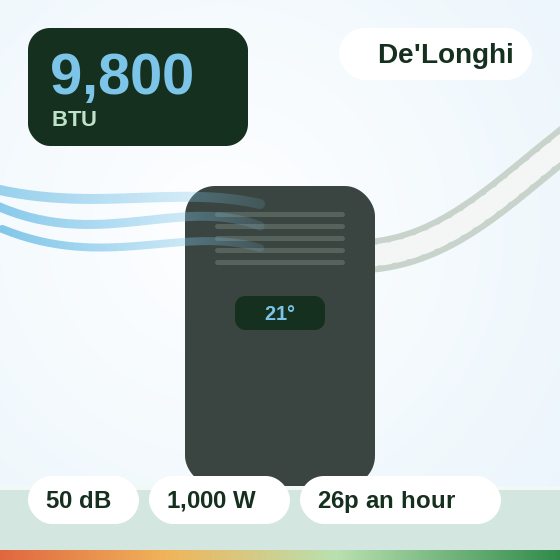
De'Longhi
Pinguino EM Series PACEM90K.1SILENT
9,800 BTU · 50 dB · 1,000 W · 26p an hour
£529.99 at De'Longhi UK (maker shop), checked 14 Nov 2026
See it at De'Longhi UK (maker shop)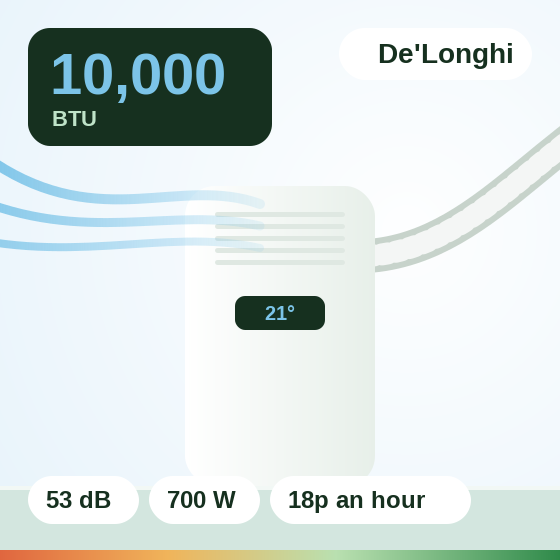
De'Longhi
Pinguino 100 Silent PACEX100SILENT EX:2
10,000 BTU · 53 dB · 700 W · 18p an hour
£759.99 at De'Longhi UK (maker shop), checked 14 Nov 2026
See it at De'Longhi UK (maker shop)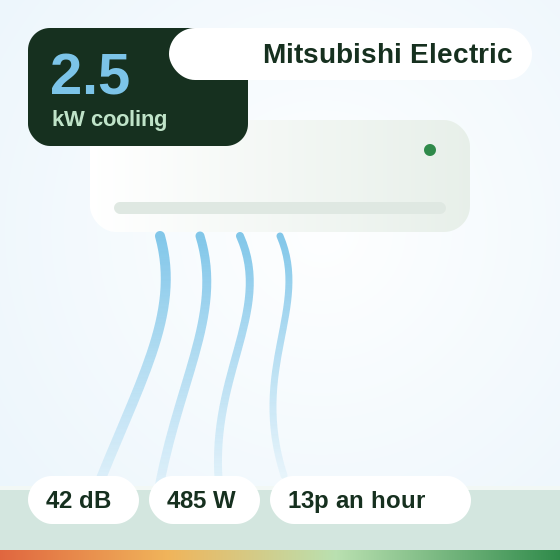
Mitsubishi Electric
MSZ-LN25VG3 (indoor) with MUZ-LN25VG3 (outdoor), 2.5 kW
2.5 kW cooling · 42 dB · 485 W · 13p an hour
No current UK price found
Figures from the maker or retailer listing. Cost an hour is our own, at the price cap of 26.32p a kWh.