Key takeaways
- The De’Longhi Pinguino PAC EX100 Silent is a single-hose portable air conditioner. De’Longhi UK prints its input power as 700 W, EER 3.6 and energy class A++, the lowest printed input power of any Pinguino De’Longhi UK listed on 14 November 2026 (two listings printed no wattage).
- At 26.32p per kWh that is 18.4p an hour at full power, £1.47 for an 8-hour night, or £64.48 over our standard summer of 350 hours (an assumption).
- De’Longhi prints the cooling capacity as “10 000” with no unit and gives no room size. By our rule, 2.52 kW of cooling (EER 3.6 x 0.7 kW, our calculation) covers about 25.2 square metres.
- De’Longhi UK listed it at £759.99 (shown as 20% off £949.99) on 14 November 2026, out of stock with a “Notify me” button.
This page covers the Pinguino 100 Silent, code PACEX100 Silent EX:2, from De’Longhi’s own page. It is one model in the De’Longhi Pinguino range guide, which compares every Pinguino De’Longhi UK lists. We have not tested the unit and give no score: everything below is De’Longhi’s published figure or our own arithmetic, and we say which.
Who is the Pinguino 100 Silent for?
It suits a living room or large bedroom of up to about 25 square metres by our sizing rule, where the buyer wants the lowest full-power running cost in the Pinguino range.
It does not suit a room bigger than our rule allows, anyone who needs the quietest unit on De’Longhi’s own figures (the Extreme prints 42/46 against this unit’s 49-53), or anyone with no window or door to vent through. Our guide to the 10,000 BTU class covers the size more widely.
Pinguino 100 Silent specification (De’Longhi UK figures)
De’Longhi UK prints most figures as bare numbers. The units in brackets are the field labels De’Longhi uses, not units printed beside the numbers.
| Item | As De’Longhi UK prints it |
|---|---|
| Cooling capacity | “10 000”, no unit; kW not stated by the maker |
| Input power | 700 W |
| EER and class | 3.6, A++ |
| Noise | “Noise pressure level min max” 49-53, no unit |
| Airflow | 250-310-350, no unit; 3 fan speeds |
| Refrigerant | R290 |
| Dehumidification | 32 litres a day |
| Stand-by power | under 1 W |
| Venting hose | length “1 200”, diameter “130”, no units |
| Dimensions | “440x387x806”, no unit |
| Weight | 30 (the field is labelled kg) |
| Warranty | “2-year warranty” in the feature list; “Full manufacturer warranty” in the highlights |
| Functions | Room thermostat, auto diagnosis, castors, handles, condensate recycling system, remote control; Eco Real Feel and Silent Technology |
| App | Not stated by the maker |
| Room size | Not stated by the maker |
The page does not say whether the unit is an inverter. It does not give a floor area or room volume. Eco Real Feel is a comfort function, not an app.
How does it compare with the PACEX105 A+++?
The PACEX105 A+++ is a different model on De’Longhi’s international site, not on De’Longhi UK’s category list on 14 November 2026: UK sale not confirmed. Its page prints 610 W, EER 4.1, class A+++, noise 45-48, 2.5 kW (beside “BTU/H 10,000”), rooms up to 100 m3 and 56 litres a day of dehumidifying. It showed “Out of stock” with no price. We do not recommend it. Its figures are here only so you do not confuse the two codes.
What does the EX:2 on the name mean?
De’Longhi UK’s page calls this unit “PACEX100 Silent EX:2”. De’Longhi does not explain the suffix on the pages we read, and its UK support page for the PACEX120 Silent names an EX:1 version. We do not guess: match the full code on your unit’s rating plate when you look for a manual or spares.
What does it cost to run?
Our working: 700 W is 0.7 kW. 0.7 kW x 26.32p per kWh = 18.4p for an hour at full power. Eight hours, a night, is £1.47. Our standard summer of 350 hours is an assumption (the energy label does not apply 350 hours to single-duct portables): 0.7 kW x 350 hours = 245 kWh, which at 26.32p is £64.48.
The 26.32p is Ofgem’s Great Britain average unit rate for 1 October to 31 December 2026 (Direct Debit). It carries no VAT (0%) for this period and leaves out the standing charge. In Northern Ireland, or for your own figure, use the rate on your bill. Rated input power is the full-power figure; De’Longhi does not say this is an inverter, so we treat 18.4p as the figure to plan on and note that any unit that slows its compressor may draw less once the room is cool.
For comparison, the PACEM90K.1 Silent prints 1,000 W, which is 26.3p an hour, so over 350 hours the EX100 costs about £28 a summer less (£64.48 against £92.12), on De’Longhi’s figures. Try your own tariff in the running cost calculator, or see air conditioning running costs.
Will it cool your room?
Our sizing rule is 100 W of cooling per square metre of floor at a 2.4 m ceiling. As the De’Longhi range guide explains, De’Longhi’s bare “10 000” does not agree with its own EER and input power, so we use kilowatts: EER 3.6 x 0.7 kW = 2.52 kW, our calculation, which gives about 25.2 square metres with no adjustments. De’Longhi gives no room size of its own for this model, so there is no claim to set against ours.
A single-hose unit is rated with 35C air on both sides and the rating does not count the warm air that leaks in to replace the air the hose blows out, so it cools a room less than its rating suggests. No UK or EU document gives a figure for the gap, so we apply none: if your room is bigger than our figure, or has large sunny windows or sits under a roof, look at a larger unit. The sizing guide and room size calculator add the adjustments.
Setup and venting
This comes from De’Longhi’s instructions for use, which De’Longhi UK links from the 100 Silent’s support page. The instructions do not print a model name, so check yours. For a sash window they describe a crosspiece with a grille the hose fits into; for a double casement window or French door, a window outlet. For a semi-permanent set-up they describe a 134 mm hole through an outside wall or window glass with a flange and cap, and say to limit “the length and curves” of the hose. They do not mention extending it. Dehumidifier mode needs the hose fitted; fan mode does not. The unit has an auto-evaporation feature, and at the end of the season you drain it by removing the cap on the drainage hose. Working room temperature is given as 18C to 35C, and the instructions say to wait 6 hours (24 recommended) if the unit has been on its side. They say nothing about running it unattended or overnight. See our guides to venting, hoses and window kits.
How loud is it?
De’Longhi UK prints “Noise pressure level min max” as 49-53, with no unit and no mode. We read it as a sound pressure figure because of the label, but De’Longhi does not give units, and no UK page gives a sound power figure, so do not set it against another maker’s sound power number. On De’Longhi’s own printouts it is higher than the Extreme (42/46), the GentleJet Inverter (43-50) and the EM Series (47/50). The unit has a Silent Technology feature and the instructions describe a minimum fan speed for “silent operation”. Other makers’ figures are in our quietest portable air conditioners.
Alternatives
- Pinguino PAC EX120 Silent: 1,050 W on De’Longhi’s international site, so a higher running cost (27.6p an hour); UK sale not confirmed.
- GentleJet Inverter: the one Pinguino that says it is an inverter, at 1,035 W and £999.99 on De’Longhi UK.
- De’Longhi on our brand page for the rest of the range.
Price, stock and where to buy
Pinguino 100 Silent PACEX100SILENT EX:2: from £759.99 at De’Longhi UK, checked 14 November 2026, out of stock that day . The page showed it as 20% off an original £949.99. Pinguino PACEX105 A+++: no price found, UK sale not confirmed. Stock is seasonal; our stock tracker follows it, and the best portable air conditioners compares other makers.
Frequently asked questions
How much does the De’Longhi Pinguino EX100 cost to run?
At full power, 18.4p an hour, £1.47 for an 8-hour night and £64.48 over our assumed 350-hour summer, using 700 W and 26.32p per kWh, the Great Britain average price cap for October to December 2026. Use the rate on your own bill for a personal figure.
How loud is the Pinguino EX100 Silent?
De’Longhi UK prints “Noise pressure level min max” as 49-53, with no unit and no mode. It is higher than the printed figures for the Extreme, GentleJet Inverter and EM Series.
Is the Pinguino EX100 an inverter?
De’Longhi’s page does not say. Only the GentleJet Inverter among the UK Pinguinos says it is an inverter, so treat the running costs here as full-power figures.
How big a room does the EX100 cool?
De’Longhi gives no room size. By our rule, 2.52 kW (our calculation from EER and input power) covers about 25.2 square metres at a 2.4 m ceiling, and a single-hose unit cools less than its rating suggests.
Why is the EX100 out of stock?
De’Longhi does not say. On 14 November 2026 its UK page showed “Out of stock” with a “Notify me” option, as did every other Pinguino on De’Longhi UK’s list.
EX100 or EX120?
The EX100 prints 700 W and the EX120 Silent 1,050 W, so the EX100 costs less to run (18.4p against 27.6p an hour). The EX100 is on De’Longhi UK’s list; the EX120 is not, so its UK sale is not confirmed.
Sources
- De’Longhi UK: Pinguino 100 Silent PACEX100SILENT EX:2 (checked 14 November 2026)
- De’Longhi: Instructions for use, linked from the PACEX100 Silent EX:2 support page (PDF) (checked 14 November 2026)
- De’Longhi international: Pinguino PACEX105 A+++ (checked 14 November 2026)
- Ofgem: Changes to energy price cap between 1 October and 31 December 2026 (checked 14 November 2026)
Other products mentioned
De'Longhi
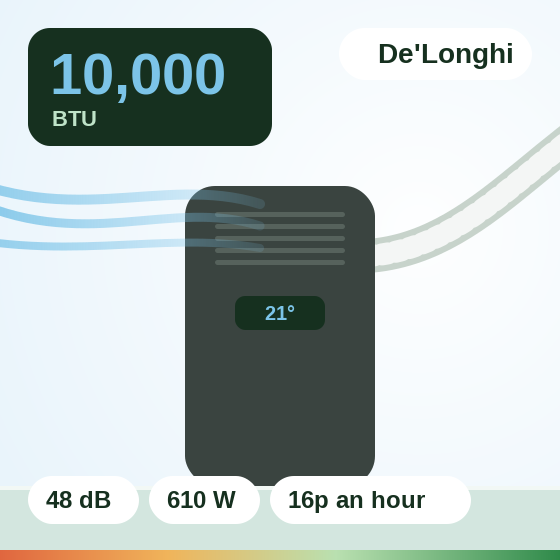
Pinguino PACEX105A+++
10,000 BTU · 48 dB · 610 W · 16p an hour
No current UK price found
Figures from the maker or retailer listing. Cost an hour is our own, at the price cap of 26.32p a kWh.