Key takeaways
- How to sleep in the heat starts with where you sleep: UKHSA says move to a cooler part of the house, “especially for sleeping if possible”.
- Keep the bedroom shut and shaded by day, and ventilated at night: the Met Office says “Night cooling is important as it allows the body to recuperate.”
- Before bed: a cool shower, cold drinks, and no alcohol, tea or coffee in the 6 hours before (NHS).
- Fans help while the air is below 35C (NHS, UKHSA). Do not aim one directly at your body. A 20 W fan costs about 4.2p a night.
- There is no official ideal bedroom temperature for adults. For babies it is 16C to 20C (NHS, Lullaby Trust).
No NHS, UKHSA or Met Office page sets out how to sleep in the heat step by step, but their advice on hot weather and on sleep fits together. This page puts it in order: where to sleep, the room, before bed, and when to see a GP. For the wider picture, see our UK heatwave guide. Most of the NHS and UKHSA guidance linked here is written for England; in Wales, Scotland and Northern Ireland, use your own nation’s NHS service.
When to get help
Heatstroke is a medical emergency (NHS).
Call 999 if you or someone else have signs of heatstroke, including (NHS):
- “still being unwell after 30 minutes of resting in a cool place, being cooled and drinking fluids”
- “a very high temperature”
- “hot skin that’s not sweating and might look red”
- “a fast heartbeat”
- “fast breathing or shortness of breath”
- “confusion and lack of coordination”
- “a seizure or fit”
- “loss of consciousness”
“Do not drive yourself to A&E.” (NHS)
UKHSA: “If you think someone has heatstroke you should dial 999 and then try to cool them down.”
Call 111 (NHS) if “you or someone else have symptoms of heat exhaustion that you’re struggling to treat or you need advice about”.
For a baby or child under 5, call 999 or go to A&E if your baby or child (NHS):
- “has swollen lips, tongue or throat with difficulty swallowing or talking”
- “is breathing very fast or has difficulty breathing”
- “has blue, grey, pale or blotchy (mottled) skin, lips or tongue”
- “has skin that feels cold or damp (clammy) to touch”
- “has a rash that does not fade when you press it”
- has a very high temperature: 38C or higher in babies under 3 months old, or 39C or higher in babies 3 to 6 months old
- has a very low temperature (less than 36C), or feels cold to touch or is shivery
- “has a weak, high-pitched or continuous cry”
- “has fainted, is difficult to wake, or cannot be woken”
- “has not had a pee in the past 12 hours”
- “is having a seizure (fit)”
Call NHS 111 if “you’re worried about any of your child’s symptoms or do not know what to do” (NHS). The list is on the NHS page Is your baby or toddler seriously ill?; more in our guide to keeping a newborn cool.
While you wait, the NHS says to move the person to a cool place, take off clothing they do not need, give them plenty of water to drink, and cool their skin by spraying or sponging it with cool water and fanning them.
Choose the coolest place to sleep
UKHSA’s advice is direct: “Move to a cooler part of the house, especially for sleeping if possible.” UKHSA lists “flats on the top floor because heat rises” among the homes more likely to overheat. A thermometer shows which room is coolest by bedtime.
The NHS also asks you to “Check the temperature of rooms, especially where people at higher risk live and sleep”, so check the bedrooms of older relatives and anyone living alone. More on the room itself in how to keep a bedroom cool.
Keep the sleeping area ventilated
By day, keep windows, curtains and blinds shut on the sunny side; open windows when the air outside feels cooler than inside, usually in the evening and at night, if it is safe to. The Met Office says “Try to keep your house cool, closing blinds or curtains can help.” At night it says: “At night, keep your sleeping area well ventilated. Night cooling is important as it allows the body to recuperate.” The full evening routine is in how to keep cool at night.
Before bed: cool down
From the NHS hot weather advice:
- “Have a cool shower or put cool water on your skin or clothes.”
- “Have cold food and regular cold drinks.”
- Drink extra fluids, but “avoid alcohol, caffeine and hot drinks”.
The Met Office adds “Drink plenty of fluids, but not alcohol, which dehydrates the body.”
Sleep habits that help
The NHS insomnia page lists “a room that’s too hot or cold” among the causes of poor sleep. Its self-help advice still applies in hot weather:
- Make sure your bedroom is dark and quiet.
- Go to bed when you feel sleepy, and get up at the same time each day.
- Do not smoke or drink alcohol, tea or coffee for at least 6 hours before going to bed.
- Do not exercise within 4 hours of bedtime.
- Do not nap during the day.
- Avoid screens just before bed, and do not eat a big meal late at night.
Using a fan at night
Fans help while the air is below 35C (NHS, UKHSA). Do not aim one directly at your body: UKHSA says that “can lead to dehydration”. Read the safety instructions in its manual before leaving it on while you sleep: some rule it out (Pro Breeze’s 30 inch tower fan manual says “Do not use the appliance while sleeping or place it near a person who is sleeping”), while Meaco’s Sefte 19 manual carries no such warning. A fan cools you, not the room.
Two quiet tower fans from our product library:
| Fan | Rated power | Per 8 hours (a measure of cost) | Noise (maker or listing) | Price, as listed |
|---|---|---|---|---|
| Meaco Sefte 19 in tower fan | 20 W | 4.2p | “from 19 dB” (Meaco) | from £69.99 at Meaco , checked 14 November 2026 |
| Russell Hobbs RHBLDL12 bladeless tower fan | 22 W | 4.6p | Not stated by the maker | out of stock at B&Q with no price shown, checked 14 November 2026 |
How we worked it out. The Sefte 19 is rated at 20 W, so an hour uses 0.02 kWh: 0.5p at 26.32p per kWh, and eight hours 4.2p. The Russell Hobbs is listed at 22 W: 0.6p an hour and 4.6p for eight hours; we have not read its manual, so check its safety instructions before running it overnight. The unit rate is Ofgem’s price cap average for electricity in Great Britain, by Direct Debit, 1 October to 31 December 2026, with no VAT (0%) for that period and the standing charge left out. These figures use the Great Britain price cap. In Northern Ireland, use the unit rate on your own bill. A lower speed uses less, so treat these as upper estimates.
For more choice, see the quietest fans for a bedroom, air coolers for a bedroom and air conditioners for a bedroom.
Babies and children
The NHS says “Your baby will sleep most comfortably when their room is between 16C and 20C”, and the Lullaby Trust gives the same range. Light bedding, minimal nightwear, a cool bath before bed and a fan that is never aimed at the baby all help: see keeping a newborn cool in hot weather.
When poor sleep in the heat needs help
The NHS says to see a GP if changing your sleeping habits has not helped, if you have had trouble sleeping for months, or if poor sleep is making daily life hard to manage. If you feel unwell in the heat, use the help box at the top of this page. For a quick plan when you are lying awake, see too hot to sleep; for a full evening routine, see how to keep cool at night.
Frequently asked questions
What is the best temperature to sleep in?
For babies, the NHS and the Lullaby Trust say 16C to 20C. The NHS gives no figure for adults; its insomnia page says only that “a room that’s too hot or cold” can cause poor sleep. We do not quote a figure that the official sources do not give.
Is it better to sleep with a fan on or off?
No NHS or UKHSA page we read answers that directly. Fans help while the air is below 35C: the NHS says “Electric fans can help if the temperature is below 35 degrees”, and UKHSA says “use electric fans if the air temperature is below 35°C” and “do not aim the fan directly at your body as this can lead to dehydration”. On running a fan while you sleep, check your fan’s manual: Pro Breeze’s 30 inch tower fan manual says “Do not use the appliance while sleeping or place it near a person who is sleeping”, while Meaco’s Sefte 19 manual carries no warning about sleeping.
Should I have a cold shower before bed in a heatwave?
The NHS advice is a cool shower, not a cold one: “Have a cool shower or put cool water on your skin or clothes.” The Met Office also suggests cool showers or baths.
Does sleeping downstairs help in hot weather?
The official guidance does not say downstairs is cooler. UKHSA says “Move to a cooler part of the house, especially for sleeping if possible”, and lists top-floor flats among the homes more likely to overheat “because heat rises”. Check with a thermometer which room is coolest at bedtime, and sleep there.
Why can’t I sleep when it’s hot?
The NHS lists “a room that’s too hot or cold” among the causes of insomnia. The Met Office says night cooling “allows the body to recuperate”, so a room that stays hot overnight makes that harder.
Sources
- UKHSA: Beat the heat, keep cool at home checklist (updated 21 July 2026, England) (checked 15 November 2026)
- Met Office: Hot weather and its impacts (checked 15 November 2026)
- NHS: Heatwave, how to cope in hot weather (reviewed 12 June 2026) (checked 15 November 2026)
- NHS: Insomnia (reviewed 19 March 2024) (checked 15 November 2026)
- NHS: Safety in the sun, babies and children (reviewed 27 September 2024) (checked 15 November 2026)
- The Lullaby Trust: Baby room temperature (updated 30 April 2026) (checked 15 November 2026)
- UKHSA: Beat the heat, staying safe in hot weather (updated 21 July 2026, England) (checked 15 November 2026)
- NHS: Heat exhaustion and heatstroke (reviewed 28 May 2026) (checked 25 November 2026)
- NHS: Is your baby or toddler seriously ill? (reviewed 6 August 2026) (checked 25 November 2026)
- Ofgem: Changes to energy price cap between 1 October and 31 December 2026 (checked 14 November 2026)
- Meaco: Sefte 19 in tower fan, specification (checked 14 November 2026)
- B&Q: Russell Hobbs RHBLDL12 bladeless tower fan, 22 W (checked 14 November 2026)
- Meaco: Sefte 19 in tower fan manual (EN01 v1.1) (checked 15 November 2026)
- Pro Breeze: PB-F-23 30 inch tower fan instruction manual (December 2023), safety instructions (checked 15 November 2026)
Products on this page
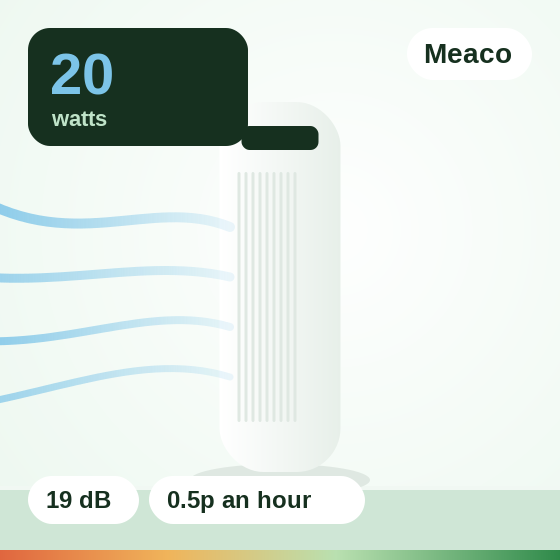
Meaco
Sefte 19" Tower Fan
20 watts · 19 dB · 0.5p an hour
£69.99 at Meaco (maker shop), checked 14 Nov 2026
See it at Meaco (maker shop)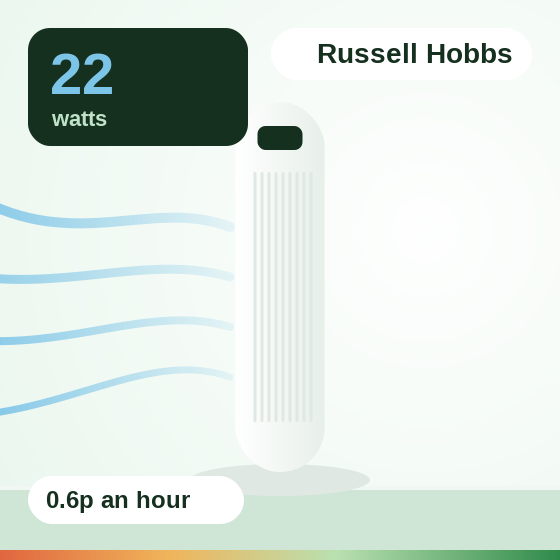
Russell Hobbs
Bladeless Tower Fan RHBLDL12
22 watts · 0.6p an hour
No current UK price found
Figures from the maker or retailer listing. Cost an hour is our own, at the price cap of 26.32p a kWh.