Key takeaways
- A water cooled air conditioner does not get rid of the vent. Two different things share the name, and both still have to move heat outside.
- Home units that use water on the condenser count as air conditioners only if they also work on air alone, so they still vent through a hose.
- A commercial water-cooled split, such as the Broughton MCSe7.3, sends heat by water through a hose to an outdoor heat exchanger that blows it into the air. Its manual allows up to 35 m of connection hose.
- Neither is an evaporative air cooler, which is not an air conditioner under the regulation’s definition.
- The one we describe is no longer available at Appliances Direct, and it is a commercial machine: hire is the likelier route.
A water cooled air conditioner is not a hose-free air conditioner. If you hoped “water cooled” meant no vent, it does not: the heat still has to leave the room. This page explains the two meanings, using the maker’s own manual for the commercial kind. It is part of our guide to how to vent a portable air conditioner; we have not tested any of these machines.
What “water cooled” means
The regulation that sets UK energy labels (Regulation (EU) No 626/2011, as it applies in Great Britain) defines an air conditioner as a device “using a vapour compression cycle driven by an electric compressor”. It says this includes appliances “that may use water (either condensate water that is formed on the evaporator side or externally added water) for evaporation on the condensor, provided that the device is also able to function without the use of additional water, using air only”.
In plain words: a home unit that uses water to help cool its hot coil is still an air conditioner only if it can also run on air alone. So a home “water cooled” unit does not replace the vent. A device that cools by evaporating water, without that cycle, falls outside the definition (our reading; the regulation does not name air coolers).
Commercial water-cooled split portables
The Broughton MCSe7.3 is the example we can document from the maker’s manual. It is “a watercooled split portable air conditioning unit” with three parts: a main indoor cooling unit, an external heat exchanger and a connecting hose assembly. The manual says the system “uses water as a medium to remove heat generated during the cooling process to the external heat exchanger and then to the air”. So the heat still goes outside, by a water hose rather than a duct.
What the manual says:
- Reach. It “can run up to a maximum of 35m of connection hose”, with the external heat exchanger never more than 5 m vertically above the main unit. A home single hose portable such as Meaco’s has a 1.8 m duct that Meaco says cannot be extended, so the Broughton reaches about 19 times as far (35 / 1.8 = 19.4; our arithmetic). The connection hose carries water, not air.
- Fluid. About 10 litres of fluid with a single 5 m hose assembly, and each extra 5 m of hose holds about 2.8 litres of water. Broughton recommends a 25% glycol to 75% water mix, so the 10 litres is about 2.5 litres of glycol and 7.5 litres of water (our arithmetic from the manual’s 25%). The machine is supplied with a water-only test charge, and the manual says glycol must be added before use; not adding it invalidates the warranty.
- Condensate. It is pumped away along a flexible line, so there is no tank to empty.
- Electrics. It plugs into a 13 amp 230 V supply with a fused UK plug, and Broughton recommends a 30 mA RCD.
- Siting. The heat exchanger must not be sited in the same area as the main unit. The manual gives an operating range of 15 to 35 degrees C.
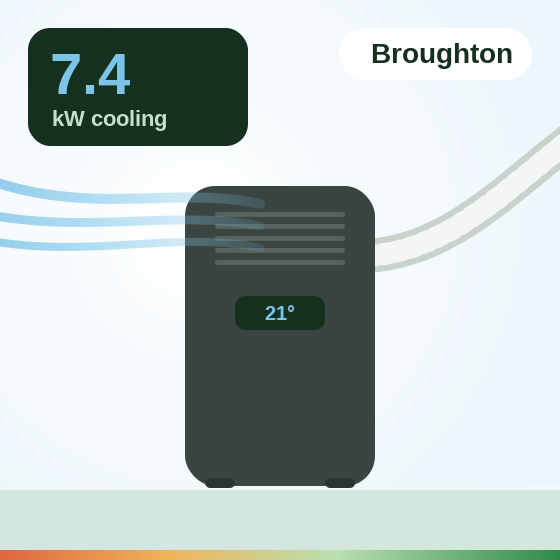
The listing at Appliances Direct says “This product is no longer available” and describes the unit as aimed at server rooms and data centres, with up to 7.4 kW of cooling “without the need for ducting” (that is the seller’s wording; the heat still leaves through the heat exchanger). We give this as an explanation of the type, not a recommendation, and we have no price for it.
Home units that use water
Some home portables use their own condensate water, or water you add, on the hot coil. They are covered by the regulation’s definition above and they still vent through a hose. When we checked in November 2026 we did not find a current UK maker listing for a home water cooled portable to point you to, so we do not recommend one. Meaco’s manual for its 12,000 BTU portable says the unit “needs to be vented to the outside in order to remove hot air”, and De’Longhi, asked whether its portables work without the hose, answers “No.”
Do not confuse any of this with a self evaporating unit, which sends its collected water out with the exhaust air and still has a hose: see self evaporating portable air conditioners.
Water cooled against evaporative air coolers
An evaporative air cooler cools by evaporating water; it is not an air conditioner under the regulation’s vapour compression definition (our reading; the regulation does not name air coolers). A water cooled air conditioner does use one. We cover coolers in our air cooler guide and evaporative cooler against air conditioner; we make no claims here about how well coolers work. See also portables without a hose and ventless air conditioners.
Who should consider one
A water-cooled split suits a room where an exhaust duct cannot reach the outside, such as a server room or an events space, and where the outdoor heat exchanger can sit far away. For a short stay these are usually hired rather than bought: see our portable air conditioner hire costs, commercial portable air conditioners and industrial portable air conditioners. For understanding how a portable works at home, see how portable air conditioners work.
Frequently asked questions
Does a water cooled air conditioner need a hose?
Yes, in a different form. A home unit still has an exhaust hose. A water-cooled split such as the Broughton MCSe7.3 has a water connection hose (up to 35 m) to an external heat exchanger instead of an air duct.
Is a water cooled air conditioner the same as an air cooler?
No. An air conditioner uses a vapour compression cycle driven by a compressor; an evaporative air cooler does not, by that definition. Under the regulation’s definition an air cooler is not an air conditioner.
Can I buy a water cooled portable air conditioner for home use?
We did not find one in a current UK listing in November 2026. The Broughton we describe is commercial and no longer available at Appliances Direct. Hire is the likelier route.
How far away can the outdoor part of a water-cooled split go?
For the Broughton MCSe7.3, up to 35 m of connection hose, with the heat exchanger never more than 5 m vertically above the main unit. Other makes differ.
Do water cooled air conditioners need filling with water?
The Broughton does: it is supplied with a water-only test charge and the manual says glycol must be added before first use, at about 25% glycol to 75% water. Condensate is pumped away, so there is no tank to empty.
Sources
- Meaco: MeacoCool Pro 12,000 BTU and 12,000CH BTU portable air conditioner, instruction manual (PDF hosted by Air Conditioning Centre) (checked 14 November 2026)
- De’Longhi UK: Do portable air conditioners work without the hose? (checked 14 November 2026)
- legislation.gov.uk: Regulation (EU) No 626/2011, Article 2, definitions (checked 14 November 2026)
- Broughton: MCSe7.3-21 portable water cooled air conditioner product manual (PDF hosted by Appliances Direct) (checked 14 November 2026)
- Appliances Direct: Broughton MCSe7.3-230V listing (checked 14 November 2026)
Products on this page
Broughton
MCSe7.3 Portable Water Cooled Split Air Conditioner (230V)
7.4 kW cooling
No current UK price found
Meaco
Cirro 12000 BTU Super Quiet Smart Portable Air Conditioner & Heater (A-Cirro-12K-CH)
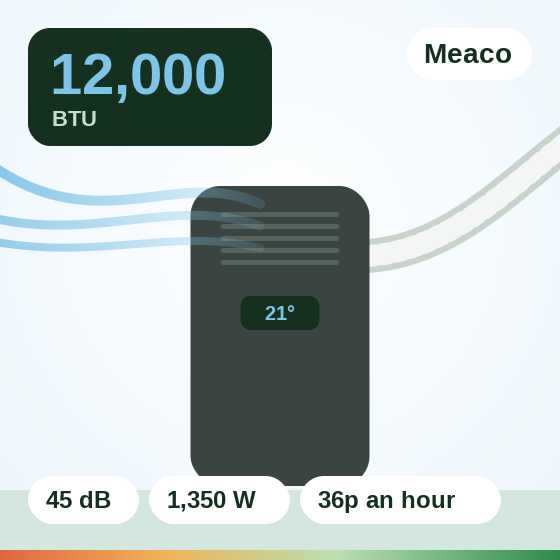
12,000 BTU · 45 dB · 1,350 W · 36p an hour
£539.99 at Meaco (maker shop), checked 13 Nov 2026
See it at Meaco (maker shop)
Figures from the maker or retailer listing. Cost an hour is our own, at the price cap of 26.32p a kWh.