Key takeaways
- How does a dehumidifier work? A compressor dehumidifier pulls room air over a cold coil so water condenses and drips into a tank, then blows the air back out. A desiccant dehumidifier passes air through a moisture-absorbing wheel instead.
- Both types give out slightly warmer air than they take in. Neither is an air conditioner and neither cools a room.
- A compressor unit removes much less water in a cold room. Meaco’s own table gives its Arete Two 20L 3.35 litres a day at 10C and 60% humidity against 8.50 litres at 20C and 60%, about 39%. Its desiccant DD8L Pro keeps about 86%.
- Desiccant units draw more power. At 20C and 60%, Meaco’s figures work out at 18.2p a litre for the Arete One 12L and 49.4p a litre for the DD8L Pro at full power, at 26.32p per kWh.
The short answer
A dehumidifier takes moisture out of the air in a room and collects it as water. A compressor unit does it by chilling the air; a desiccant unit does it with an absorbent material. For the settings and placement that follow from this, see our guide to using a dehumidifier. We have not tested any product; figures come from the makers’ documents.
How a compressor dehumidifier works
Appliances Direct’s buying guide says a compressor unit “condenses moisture on a cold coil”. Air from the room is drawn across the cold coil, water on the air turns to liquid on the coil and drips into the tank, and the air goes back into the room. Meaco’s Arete One manual (UK edition, February 2023) says the dried air “is passed over heating coils before it is blown into the room”, which is why the air coming out is warmer. De’Longhi’s UK FAQ says a working dehumidifier “releases slightly warmer air than the room temperature”, and that it is not an air conditioner.
The control is a humidity sensor. Meaco’s manual says that once the room reaches the target (less 3%), the unit stops; every 30 minutes the fan runs to check, and the compressor starts again if humidity has risen more than 3% above the target. Pro Breeze’s PB-D-26 manual says its compressor turns off when humidity is 3% below the target and back on when it is above it.
The compressor models whose manuals we read for this page use R290 refrigerant. Meaco’s manual says its Arete One uses about 35 g (10L) or 45 g (12L) of R290, which it describes as flammable, in “a sealed system” that “must only be serviced by a trained Meaco engineer”. Both Meaco and Pro Breeze say not to use or store such a unit in a room smaller than 4 m2.
How a desiccant dehumidifier works
Appliances Direct says a desiccant unit “uses a moisture-absorbing wheel instead” of a cold coil. Its guide says performance “barely drops in the cold”, that the unit “returns around 10°C of gentle warmth to the room as a side effect”, and that “Desiccant models draw more power but return heat to the room.” Meaco’s pages, as recorded in our files on 14 November 2026, describe the same thing for its DD8L Pro; we could not open Meaco’s site again, so follow your own manual for detail.
Power is the catch. Meaco’s DD8L Pro lists 231 W in its specification table, which is its lowest setting; Meaco measured 623 W at fan speed 3 for its 20C figures, and its blog says the manual settings are 230, 440 and 630 W (all as recorded on 14 November 2026). The EcoAir DD1 Classic MK6 lists 300 W on low and 580 W on high (EcoAir’s page, as recorded on 14 November 2026). No refrigerant is involved, so a desiccant unit has no R290; our product file for the DD8L Pro records it as having no refrigerant.
For a head-to-head on which to buy, see desiccant against compressor dehumidifiers and our best desiccant dehumidifiers.
Why the air feels warm
Warm air comes out because the dried air passes over heating coils (compressor, per Meaco’s manual) or because a desiccant unit, in Appliances Direct’s words, “returns around 10°C of gentle warmth to the room as a side effect”. It does not cool a room. Meaco’s manual says if the air feels cool, “the air may feel cooler because it is moving in the same way as the air from a fan in the summer feels cooler”. See does a dehumidifier cool a room and dehumidifier against air conditioner.
How cold changes things
Appliances Direct says a compressor unit needs a room warmer than its cold coil, “roughly 15°C and above”, and that below that a compressor model “struggles”. Meaco’s own tables show it:
| Unit (maker’s test) | At 10C and 60% RH | At 20C and 60% RH | 10C as a share of 20C |
|---|---|---|---|
| Meaco Arete Two 20L (compressor) | 3.35 litres a day at 176 W | 8.50 litres a day at 207 W | 39% |
| Meaco DD8L Pro (desiccant, fan 3) | 6.89 litres a day at 630 W | 7.97 litres a day at 623 W | 86% |
The Arete Two 20L figures are from Meaco’s product page and the DD8L Pro’s from the same, both as recorded in our product files on 14 November 2026. Meaco’s working range for its Arete One is 5C to 35C (manual). Pro Breeze’s PB-D-26 manual says that in automatic mode, below 5C “the compressor will automatically turn off”, and that it may defrost for up to 5 minutes below 23C.
What the litres per day on the box mean
Makers rate extraction at test conditions, not in your room. Meaco rates its Arete One 12L at 12 litres a day at 30C and 80% humidity, and 7.5 litres at 27C and 60%. Its own table gives 5.23 litres a day at 20C and 60%, closer to a heated British room in winter. Meaco publishes tables at several conditions, including 20C and 60%, which is why we use its figures here. Ebac says quoted rates from all makers “can be misleading” and “generally refer to water extraction in conditions not found in the UK”, which is Ebac’s view with no study cited. Compare litres only at the same conditions.
What it costs to run each type
How we work it out. Litres per kWh is litres a day divided by (watts multiplied by 24, divided by 1,000), using the power Meaco measured at the same test condition. Cost per litre is kWh multiplied by 26.32p, divided by the litres. For the Arete One 12L at 20C and 60%: 5.23 litres at 151 W (Meaco’s product page, as our product file records it on 14 November 2026) is 3.624 kWh a day, 95.4p at 26.32p per kWh (Ofgem’s Great Britain average price cap for 1 October to 31 December 2026, no VAT, 0%), so 1.44 litres per kWh and 18.2p a litre. Meaco’s manual (UK edition, February 2023) lists 165 W for the 12L, which would be 4.3p an hour and 19.9p a litre.
| Unit at 20C and 60% RH | Litres a day | Power | Litres per kWh | Cost per litre |
|---|---|---|---|---|
| Meaco Arete One 12L | 5.23 | 151 W (measured) | 1.44 | 18.2p |
| Meaco Arete Two 12L | 5.40 | 136 W (measured) | 1.65 | 15.9p |
| Meaco DD8L Pro, fan 3 (desiccant) | 7.97 | 623 W (measured) | 0.53 | 49.4p |
All three are Meaco’s own measurements at one condition, so they compare like with like. The figures assume the unit runs for 24 hours, which a compressor unit with a humidistat will not do; they are costs per litre at a steady rate. These figures use the Great Britain price cap. In Northern Ireland, use the unit rate on your own bill. More in how much a dehumidifier costs to run. For choosing, see how to choose a dehumidifier and where to put a dehumidifier.
What a dehumidifier cannot do
It cannot cool a room, and it cannot remove the source of the moisture. GOV.UK’s guidance for England on damp and mould says condensation is “the most common form of damp” and that “Simply removing surface mould will not prevent the damp and mould from reappearing.” It also lists ventilation steps for tenants. For the dehumidifier set, see our dehumidifier hub.
Frequently asked questions
How does a dehumidifier remove water from the air?
A compressor unit passes air over a cold coil so the water condenses and runs into a tank (Appliances Direct: it “condenses moisture on a cold coil”). A desiccant unit uses a moisture-absorbing wheel instead.
Why does my dehumidifier blow out warm air?
Meaco’s manual says the dried air passes over heating coils before it returns to the room, and calls that normal. De’Longhi says a working dehumidifier releases slightly warmer air than the room.
Does a dehumidifier work in a cold room?
A compressor model removes much less in the cold: Meaco’s Arete Two 20L is 3.35 litres a day at 10C and 60% against 8.50 at 20C. Meaco’s desiccant DD8L Pro is 6.89 against 7.97. Appliances Direct says a space below 15C suits a desiccant.
What is the difference between a compressor and a desiccant dehumidifier?
A compressor unit uses a cold coil and a sealed refrigerant circuit; a desiccant unit uses an absorbent wheel and draws more power, returning warmth to the room (Appliances Direct).
Does a dehumidifier use refrigerant?
A compressor model does: Meaco’s Arete One uses R290 (35 g in the 10L, 45 g in the 12L). A desiccant model has no refrigerant circuit.
Is the water from a dehumidifier safe to drink?
No. Meaco says the water “can be used to water non-edible plants only”, and Pro Breeze’s PB-D-26 manual says “This water is not drinkable.”
Does a dehumidifier cool the air?
No. It releases slightly warmer air, and it is not an air conditioner (De’Longhi). Moving air can feel cooler, as Meaco’s manual notes.
Sources
- Appliances Direct: dehumidifiers buying guide (checked 25 November 2026)
- Meaco: MeacoDry Arete One 10L and 12L instruction manual (UK edition, February 2023, hosted by Appliances Direct) (checked 27 November 2026)
- De’Longhi UK: My dehumidifier emits hot air. Is that normal? (checked 25 November 2026)
- Pro Breeze: PB-D-26 6L compact dehumidifier instruction manual (UK, June 2024) (checked 25 November 2026)
- Ebac: extraction rates (checked 25 November 2026)
- GOV.UK: Understanding and addressing the health risks of damp and mould in the home (checked 25 November 2026)
- Ofgem: changes to the energy price cap between 1 October and 31 December 2026 (checked 25 November 2026)
- Meaco: MeacoDry Arete One 12L (as recorded in our product file; checked 14 November 2026)
- Meaco: MeacoDry Arete Two 12L (as recorded in our product file; checked 14 November 2026)
- Meaco: MeacoDry Arete Two 20L (as recorded in our product file; checked 14 November 2026)
- Meaco: DD8L Pro (as recorded in our product file; checked 14 November 2026)
- Meaco: the DD8L Pro desiccant dehumidifier (blog) (as recorded in our data files; checked 14 November 2026)
- EcoAir: DD1 Classic (as recorded in our product file; checked 14 November 2026)
Products on this page
Meaco
MeacoDry Arete One 12L Dehumidifier / Air Purifier
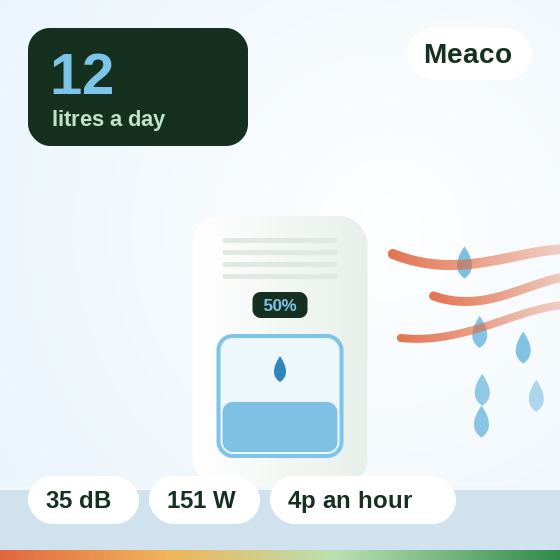
12 litres a day · 35 dB · 151 W · 4p an hour
£179.99 at Meaco (maker shop), checked 14 Nov 2026
See it at Meaco (maker shop)
Meaco
MeacoDry Arete Two 12L Dehumidifier / Air Purifier
12 litres a day · 35 dB · 155 W · 4p an hour
£199.99 at Meaco (maker shop), checked 14 Nov 2026
See it at Meaco (maker shop)
Meaco
MeacoDry Arete Two 20L Dehumidifier / Air Purifier
20 litres a day · 38 dB · 230 W · 6p an hour
£299.99 at Meaco (maker shop), checked 14 Nov 2026
See it at Meaco (maker shop)
Meaco
DD8L Pro Desiccant Dehumidifier
8 litres a day · 40 dB · 231 W · 6p an hour
£259.99 at Meaco (maker shop), checked 14 Nov 2026
See it at Meaco (maker shop)
EcoAir
DD1 Classic MK6 Desiccant Dehumidifier
7.5 litres a day · 46 dB · 580 W · 15p an hour
£229.98 at EcoAir (maker shop), checked 14 Nov 2026
See it at EcoAir (maker shop)
Figures from the maker or retailer listing. Cost an hour is our own, at the price cap of 26.32p a kWh.