Key takeaways
- A dehumidifier is the machine made to remove moisture from a room’s air; an air conditioner is made to cool it and removes some water as a side effect. For damp, condensation or wet washing, use a dehumidifier. For a hot room, use cooling.
- Many air conditioners have a dry mode. Daikin calls it “a dehumidifier that is built into your air conditioner”, but no maker document we read gives litres a day or watts for dry mode.
- Our running-cost figure compares different things, and says so: a Meaco dehumidifier at its 165 W spec-table power (no test condition stated) costs 4.3p an hour; a 780 W Pro Breeze portable air conditioner costs 20.5p an hour in cooling mode, at 26.32p per kWh.
- Dry mode on the Pro Breeze and Meaco portables we read comes with fixed settings, and Meaco’s portable stops drying below 15C.
The short answer
If your problem is condensation on windows, a damp smell or washing that will not dry, a dehumidifier is the tool made for it. Our Pro Breeze dehumidifier guide shows how we read dehumidifier ratings. If your problem is a hot room, a dehumidifier will not cool it; see does a dehumidifier cool a room. An air conditioner does both jobs to different degrees, but we have no maker figure for how much water its dry mode removes. We have not tested any unit.
How each machine removes water
Both use a cold surface. Moisture in the air condenses on a cold coil and drains away; Penn State’s engineering course describes this for air conditioners, whose evaporator coil is cold because refrigerant absorbs heat there. The difference is what happens next. A dehumidifier’s job is the water, so it is built around that coil and passes the air back into the room. An air conditioner’s job is to move heat out of the room, so the heat it collects leaves through a hose or an outdoor unit. For the mechanics, see how a dehumidifier works and how air conditioning works.
What dry mode does and does not tell you
- Daikin (Spain, English page, opened 25 November 2026). Dry mode is “designed for a very specific and useful purpose: to reduce humidity in the air”. The page recommends it on humid days, including in winter. It does not say dry mode lowers the temperature, and it gives no energy figures.
- Daikin’s FTXF-F manual (opened 25 November 2026). The drying setting is described as “The system decreases the humidity in a room”; you cannot adjust the temperature, and you cannot adjust the airflow rate. This applies to that family only.
- Pro Breeze PB-AC08 manual (opened 25 November 2026). “Temperature can only be set when in cooling mode” and “you cannot change the fan speed in dry mode”.
- Meaco’s portable manual (the MeacoCool Pro 12,000 BTU model). As our files record it (checked 14 November 2026; the host refused us this time and we did not try it again), dry mode defaults to low fan speed and cannot be changed, the drain hose must stay attached, and below 15C the compressor stops and so does the drying.
- Not stated by the maker. Litres a day and power for dry mode, on every manual and page we read.
So dry mode is a humidity setting, not a rated drying machine. You cannot size it as you would a dehumidifier.
Which to use for damp, for wet washing, for a hot room
- Damp and condensation. The GOV.UK guidance on damp and mould says condensation “happens when moisture generated inside the home cools and condenses onto colder parts of the buildings” and is “the most common form of damp”. It does not mention dehumidifiers, so we make no health claim. A dehumidifier is the machine with a stated water-removal rating; an air conditioner’s dry mode has none.
- Wet washing. Many dehumidifiers have a laundry mode: Meaco’s ABC range runs at full speed for six hours and then switches off, per its page as our file records. No source we read gives a drying time for an air conditioner.
- A hot room. Use cooling. The guide to cooling a room without air conditioning and does a dehumidifier help in hot weather cover it. The Pro Breeze PB-AC04 manual says “Never leave the appliance unattended while in use” (as our file records, checked 15 November 2026), so we do not suggest running a portable overnight; check your own manual.
Running cost side by side
The two figures below are not like for like, so read them as costs, not as a ranking.
| Meaco ABC 10L dehumidifier | Pro Breeze PB-AC-04 portable air conditioner | |
|---|---|---|
| Power used | 165 W, Meaco’s spec-table power consumption, no test condition stated | 780 W, rated input in cooling mode (its manual) |
| What the figure covers | Dehumidifying; Meaco rates 10 L a day at 30C and 80% RH, measured at 198 W (5.2p an hour) | Cooling mode, not dry mode; 2.05 kW rated cooling |
| Per hour | 4.3p | 20.5p |
| 4-hour wash load | 17.4p | 82.1p |
| 6-hour wash load | 26.1p | £1.23 |
The working: 165 W is 0.165 kW, times 26.32p is 4.3p an hour; 198 W, the power Meaco’s table gives for its 30C and 80% figure, is 5.2p an hour. 780 W is 0.78 kW, times 26.32p is 20.5p an hour. The rate is Ofgem’s Great Britain average for 1 October to 31 December 2026, with no VAT (0%) for this period. These figures use the Great Britain price cap. In Northern Ireland, use the unit rate on your own bill.
For the dehumidifier, Meaco’s table (as our file records, 14 November 2026) also gives 7.32 litres a day at 20C and 80% RH for 159 W measured: 3.816 kWh a day, or about 1.9 litres per kWh at that condition. Both are rated or measured at the maker’s own conditions, and a cooler or drier room removes less. A unit with a humidistat cycles, so rated power is an upper figure for an hour of running. No maker states a tested drying time for washing, so four and six hours are our assumption. The air conditioner has no dry-mode power figure, so we do not compute a dry-mode cost. We are not saying the dehumidifier is “cheaper” than the air conditioner for the same job: its dry-mode job and output are unknown.
Winter and summer use
Daikin’s page recommends dry mode on humid days, including in winter, and the Meaco portable stops drying below 15C. The dehumidifier makers we cover state operating ranges: Meaco’s ABC range is listed from 5C. For summer, see how to cool a room without air conditioning, and for a glossary entry on the setting see dry mode on air conditioning explained. If you want to compare the two jobs further, our dehumidifier against humidifier and desiccant against compressor pages sit alongside this one, and the dehumidifier hub links the rest.
Frequently asked questions
Can an air conditioner replace a dehumidifier?
Not reliably. An air conditioner’s dry mode reduces humidity, but no maker we read states litres a day for it. A dehumidifier has a rated extraction at stated conditions.
Does the dry mode on my air conditioner use less electricity?
We cannot say. No maker document we read gives a power figure for dry mode, so we do not compute one. Check your manual.
Does a dehumidifier cool a room?
No. See does a dehumidifier cool a room for what the makers say about the air it blows out.
Which is better for drying clothes?
A dehumidifier, in the sense that its makers describe a laundry mode and state water removal. We found no air conditioner source that gives a drying time or rate for washing.
Can I use a portable air conditioner as a dehumidifier?
Dry mode exists on portables, with limits: Pro Breeze says you cannot change the fan speed in dry mode, and Meaco says its portable defaults to low fan speed and needs the drain hose attached.
Which is cheaper to run?
A dehumidifier such as the 165 W Meaco ABC 10L is 4.3p an hour; the 780 W Pro Breeze portable in cooling mode is 20.5p an hour. Dry mode is not stated for either.
Sources
- Daikin (Spain, English): dry mode on air conditioning (checked 25 November 2026)
- Daikin: FTXF-F operation manual, 3P511999-9S (checked 25 November 2026)
- Pro Breeze: PB-AC08 instruction manual (UK, December 2022) (checked 25 November 2026)
- Meaco: MeacoCool Pro 12,000 BTU instruction manual (host: Air Conditioning Centre) (could not re-open; as recorded in our files, checked 14 November 2026)
- Penn State EMS: how air conditioners work (checked 25 November 2026)
- GOV.UK: understanding and addressing the health risks of damp and mould in the home (checked 25 November 2026)
- Meaco: MeacoDry ABC 10L (could not re-open; figures as our product file records them, checked 14 November 2026)
- Pro Breeze: PB-AC04 instruction manual (UK and EU) (not re-opened; figures and warning as our product file records them, checked 14 and 15 November 2026)
- Ofgem: changes to the energy price cap, 1 October to 31 December 2026 (checked 25 November 2026)
Products on this page
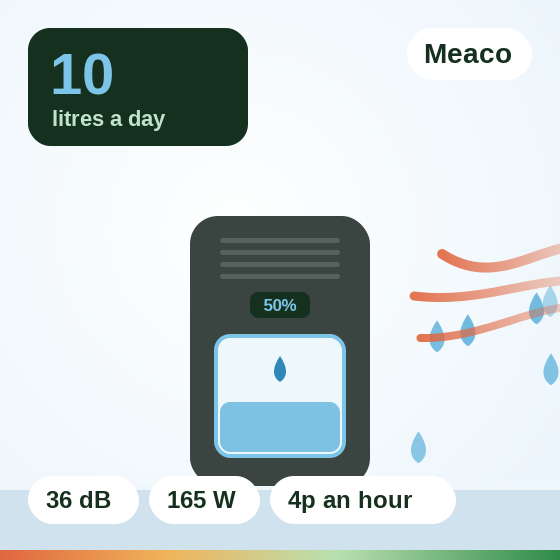
Meaco
MeacoDry ABC 10L Dehumidifier
10 litres a day · 36 dB · 165 W · 4p an hour
£129.99 at Meaco (maker shop), checked 14 Nov 2026
See it at Meaco (maker shop)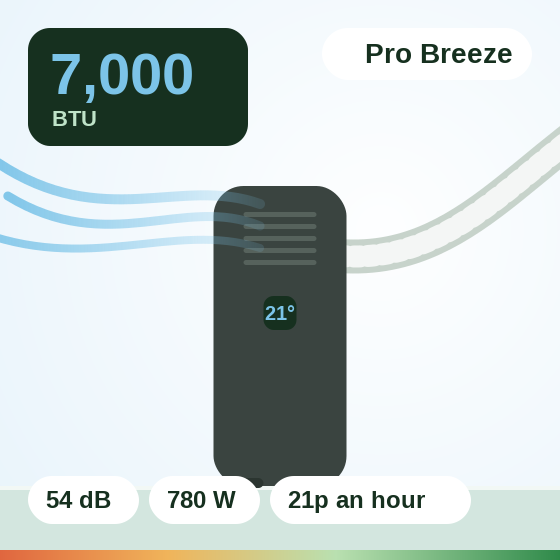
Pro Breeze
7000 BTU 3-in-1 Portable Air Conditioner with Dehumidification Function (PB-AC-04)
7,000 BTU · 54 dB · 780 W · 21p an hour
£279.99 at Pro Breeze (maker shop), checked 13 Nov 2026
See it at Pro Breeze (maker shop)
Figures from the maker or retailer listing. Cost an hour is our own, at the price cap of 26.32p a kWh.