Key takeaways
- How to use a dehumidifier in one line: set a target humidity and let its humidistat switch the compressor on and off. Meaco’s manual sets 55% by default; Pro Breeze’s automatic mode picks 50% to 60% by room temperature.
- Put it in a central spot (a landing or hallway) with internal doors open and outside doors and windows shut to dry the whole home, or in the problem room with the door closed.
- At the Great Britain price cap for 1 October to 31 December 2026 (26.32p per kWh), the seven figures in our table cost from 2.7p to 16.4p an hour at the power their makers give. That is the most an hour could cost: the compressor stops once the room reaches its target.
- Makers disagree on overnight and unattended running. Meaco’s manual says to keep the unit “running 24/7” to dry a whole house; Pro Breeze’s manual says “Never leave the dehumidifier unattended while in use”. Check your own manual.
- A dehumidifier takes water out of the air. It does not fix a leak, rising damp or a ventilation fault, and GOV.UK’s damp and mould guidance for England does not mention dehumidifiers.
The short answer
Stand it upright, plug it into a wall socket, set a target humidity, shut outside doors and windows, and let the humidistat do the rest. Empty the tank or fit a hose, and clean the filter every fortnight. Below, each step names the maker that says so. We have not tested any product; figures come from the makers’ documents. For which model to buy, see the best dehumidifiers and our dehumidifier guide.
What a dehumidifier does and does not do
A dehumidifier draws in room air, takes water out of it and blows the drier air back out, collecting the water in a tank. A compressor unit cools the air over cold coils so the water condenses; a desiccant unit uses an absorbent material and a heater. We explain both in how a dehumidifier works, and compare them in desiccant against compressor dehumidifiers.
It is not an air conditioner. Meaco’s manual says the air it blows out is warm because “The dried air is passed through overheating coils before it is blown into the room”, and that if the air feels cool, “the air may feel cooler because it is moving in the same way as the air from a fan”. If you are wondering about hot, sticky weather, see does a dehumidifier help with heat and does a dehumidifier cool a room.
Before you switch it on
Is it the right size?
No UK body publishes a sizing rule for dehumidifiers. We use Meaco’s bands by home size (1 to 2 bedrooms: 10 to 12 litres a day; 3 to 4 bedrooms: 12 to 20; larger homes or serious damp: 20 to 25), plus one step up the ladder if you dry laundry indoors, have condensation most mornings, live in an older house with solid walls, or have an open-plan layout. Appliances Direct’s buying guide gives bands that agree in outline (it puts 12 to 20 litres at a typical 2 to 3 bedroom house, where Meaco says 3 to 4 bedrooms) and says “if you’re between two sizes, take the bigger one”. Our dehumidifier size calculator walks you through it, and how to choose a dehumidifier covers the other decisions.
One thing confuses many owners: the same unit is sold as “12 litres” and also quoted at 7.5 litres. Makers rate extraction at different conditions. Meaco rates its Arete One 12L at 12 litres a day at 30C and 80% relative humidity, and 7.5 litres a day at 27C and 60%. Meaco’s own table gives 5.23 litres a day at 20C and 60%, which is closer to a heated British room in winter. Compare litres only at the same conditions.
Compressor or desiccant, and the room temperature
Meaco’s Help Centre says compressor models perform best above 10C and desiccant models work better below it (checked 14 November 2026). Appliances Direct’s guide says a “Garage, conservatory, caravan or boat that sits below 15°C, buy desiccant.” Meaco’s Arete One manual gives its working range as 5C to 35C. Pro Breeze’s PB-D-26 manual says that in automatic mode, below 5C “the compressor will automatically turn off”.
First-use steps
- Stand it upright and leave it. Meaco’s manual says to “leave the dehumidifier standing upright for six hours before using it upon receipt”, so refrigerant that moved in transit can settle.
- Check the filter is in place. Pro Breeze says “Do not operate the dehumidifier without the filter.”
- Fit the tank properly. Pro Breeze says the tank light comes on if the tank is missing or placed incorrectly, and Meaco says the unit will not run if the float inside the tank is removed.
- Plug it into a wall socket. Pro Breeze says “Always plug the dehumidifier directly into a wall socket. Avoid using extension leads where possible as they may overheat and cause a risk of fire.”
How to use a dehumidifier, step by step
- Pick the position. Central for the whole home, or in the problem room (see below). Keep it on a flat, stable surface, upright, with the air inlet clear.
- Set the target. Meaco’s smart humidity mode starts at 55%. On a Pro Breeze PB-D-26 you can choose 30% to 90% in 5% steps, or use automatic mode.
- Close outside doors and windows; open internal doors. Meaco’s manual says “Keep all internal doors open” and “Keep external doors and windows closed” when drying the whole home.
- Let the humidistat control it. Meaco’s unit stops at the target less 3% and checks every 30 minutes; Pro Breeze’s compressor turns off at 3% below the target and back on at 3% above.
- Empty the tank or drain it. A full tank stops the unit.
- Clean the dust filter every two weeks (Meaco and Pro Breeze).
- Give it time. Meaco’s manual says a new unit can take “a couple of days, or it could take 4 weeks” to remove the excess moisture, then collects less, which is not a fault.
Whole home or one room?
For the whole home, Meaco’s manual says to “Situate your dehumidifier in a central area (e.g. a landing or hallway)”. Ebac’s FAQ suggests “a central place, such as a hallway, keeping all doors slightly a jar” (Ebac’s spelling), or the room with the problem until it is under control. For one room, Meaco says to use the same settings but put the unit inside the “problem” room “and keep the internal door closed”. Our guide to where to put a dehumidifier compares the makers’ clearance rules.
How close to a wall depends on the maker. Meaco says its Arete One can go “as close to a wall as you wish”, but not so close to “curtains, walls or anything that will restrict the air inlet” that it blocks the intake. Pro Breeze’s PB-D-26 manual says it “must have a minimum 50cm clearance around all sides” and “Do not place the dehumidifier against a wall or other appliances.” Follow your own manual.
What humidity to set
There is no official figure: GOV.UK’s damp and mould guidance gives no humidity target. Meaco’s manual sets 55% for drying a whole home, and its Arete One humidistat runs from 40% to 70%. Pro Breeze’s automatic mode sets 60% between 5C and 20C, 55% between 20C and 27C, and 50% above 27C. The Centre for Sustainable Energy, a charity, says “It is recommended to keep RH levels in the home between 40-60%” and “Set your dehumidifier to under 60% humidity if possible”. Appliances Direct’s guide gives the same 40% to 60% range.
If your room already sits low, little water is normal. Meaco’s manual says “below 45%rh the dehumidifier will not collect much water as there isn’t enough moisture in the environment”.
How long to run it
A unit with a humidistat decides for itself: it runs the compressor when the air is above target and rests when it is not. Ebac’s FAQ says “Running a dehumidifier from early October until the spring is generally sufficient.”
On overnight and continuous running, the makers do not agree. Meaco’s Arete One manual recommends that you “Keep your dehumidifier running 24/7” to dry a whole house, and says continuous drainage “is ideal for customers who wish to leave their dehumidifier unattended in garages or second homes”. Pro Breeze’s PB-D-26 manual says “Never leave the dehumidifier unattended while in use”, and the other Pro Breeze dehumidifier manuals read for our product pages carry the same warning. So before you run any unit overnight, while you are out, or for days at a time, check its manual. If it rules that out, run it while someone is at home.
Pro Breeze’s PB-D-26 has built-in on and off timers of 1 to 24 hours. Do not add a plug-in timer to any unit: Pro Breeze says not to use “an external programmer, timer switch or any other device” unless the maker built it in, and Meaco’s warranty says “Using a third-party switching device that turns the dehumidifier on or off via the mains will invalidate the warranty.”
Emptying and draining
When the tank is full, Pro Breeze says “the indicator light will turn on and the compressor will turn off”; unplug the unit before you take the tank out. Meaco’s manual says the float in the tank tells the unit when to stop, and “If the float is removed from the water tank, the dehumidifier will not run.”
For continuous drainage, Meaco supplies a right-angle adaptor that fits “a standard garden hose (ID: 12.5mm)”; the hose is not included. Meaco says the hose must run “downwards with no kinks, bends, or blockages” so the water drains by gravity. Pro Breeze says “Do not place the continuous drainage hose outside when the temperature falls below 1°C.”
The water is not for drinking. Meaco says it “can be used to water non-edible plants only”; Pro Breeze says “This water is not drinkable.”
Looking after it
- Dust filter: Meaco says it “must be cleaned a minimum of every two weeks (not doing so could invalidate the unit’s warranty)”. Pro Breeze says every two weeks with a damp cloth.
- HEPA filter (Meaco Arete One): replace it “when the color changes from white to grey”; Meaco says roughly every 3 months.
- Storage: Pro Breeze says “Never leave water in the water tank when the appliance is not in use”, and to empty and clean the unit before storing it.
Settings by maker
| Meaco Arete One 10L and 12L | Pro Breeze PB-D-26 (6L compact) | Ebac | |
|---|---|---|---|
| Default target | 55% in smart humidity mode | Continuous mode by default; automatic mode 60%, 55% or 50% by temperature | Not stated in the FAQ |
| Humidity range | 40% to 70% | 30% to 90% in 5% steps | Not stated in the FAQ |
| Laundry | Smart laundry mode: 35% target, high fan, 6 hours, then off | Continuous mode, fan on high, near the laundry “in a well-ventilated room” | Full fan if there is no laundry mode |
| Clearance | Can stand close to a wall; keep the inlet clear of curtains | At least 50 cm on all sides; not against a wall | Not stated in the FAQ |
| Minimum room | 4 m2 (R290) | Floor area larger than 4 m2 (R290) | Not stated in the FAQ |
| Working range | 5C to 35C | Compressor off below 5C in automatic mode | Not stated in the FAQ |
| Source | Meaco manual (EU edition, May 2022) | Pro Breeze UK manual, June 2024 | Ebac FAQs |
The Meaco column comes from Meaco’s Arete One 10L and 12L manual, EU edition (May 2022), which is the edition we quote. The UK edition (February 2023, imported by Meaco (UK) Limited) lists the same power, 163 W and 165 W for the 10L and 12L, and the same “Keep your dehumidifier running 24/7” line; the two editions differ on fault codes E1 and E2, which our Meaco dehumidifier instructions cover. Our costs use the power on Meaco’s product pages (see below). Other Meaco and Pro Breeze models differ: the instructions guide covers more of Meaco’s settings, and Meaco’s range lists its models.
What it costs to run
How we work it out. We take the power the maker states, in watts, divide by 1,000 to get kilowatts, and multiply by the unit rate. For the Meaco Arete One 12L, Meaco’s product page, as our product file records it on 14 November 2026, gives 151 W, which is 0.151 kW. One hour uses 0.151 kWh, which costs 4.0p at 26.32p per kWh, Ofgem’s Great Britain average price cap for 1 October to 31 December 2026, which carries no VAT (0%) for this period. The winter column is 1 October to 31 March (182 days) at eight hours a day, which is 1,456 hours and our own assumption. The compressor stops when the room reaches its target, so every figure here is an upper estimate. The method in full, with costs by load, day and month, is in how much a dehumidifier costs to run.
These figures use the Great Britain price cap. In Northern Ireland, use the unit rate on your own bill. The standing charge is left out because you pay it anyway.
| Model (product file) | Power used | Per hour | 8 hours | 24-hour ceiling | Winter (1,456 h) kWh | Winter cost |
|---|---|---|---|---|---|---|
| Meaco Arete One 6L | 101 W (Meaco’s stated power) | 2.7p | 21.3p | 63.8p | 147.1 | £38.71 |
| Meaco Arete One 12L | 151 W (Meaco’s stated power) | 4.0p | 31.8p | 95.4p | 219.9 | £57.87 |
| Pro Breeze 6L Compact | 150 W (rated, manual) | 3.9p | 31.6p | 94.8p | 218.4 | £57.48 |
| Pro Breeze OmniDry 12L | 200 W (rated, manual) | 5.3p | 42.1p | £1.26 | 291.2 | £76.64 |
| Meaco Arete One 25L | 267 W (Meaco’s stated power) | 7.0p | 56.2p | £1.69 | 388.8 | £102.32 |
| Meaco DD8L Pro (desiccant), lowest setting | 231 W (Meaco’s stated power) | 6.1p | 48.6p | £1.46 | 336.3 | £88.52 |
| Meaco DD8L Pro (desiccant), full power | 623 W (measured by Meaco at fan speed 3, 20C, 60%) | 16.4p | £1.31 | £3.94 | 907.1 | £238.75 |
The Meaco figures are the power on Meaco’s specification tables (for the three Arete One models this matches the power Meaco measured at 20C and 60% humidity; the DD8L Pro’s full-power figure is Meaco’s measurement at fan speed 3); the Pro Breeze figures are rated power from Pro Breeze’s manuals. They are different kinds of figure, so read the table as costs for each unit, not as a ranking. The Meaco Arete Two 12L’s specification gives 155 W (4.1p an hour), and Meaco measured 136 W at 20C and 60% (3.6p an hour). Meaco’s manuals list higher figures for the Arete One than its product pages: 165 W for the 12L (both the UK and the EU edition), which would be 4.3p an hour, and 310 W for the 25L (the 20L and 25L manual), which would be 8.2p an hour. Our table uses the product pages.
A desiccant unit draws more because a heater runs: the DD8L Pro at full power costs about four times as much an hour as the Arete One 12L. Meaco’s blog says its three manual settings are 230, 440 and 630 W.
Is that a lot? Ofgem’s typical medium home uses 2,500 kWh of electricity a year. The Arete One 12L’s assumed winter is 219.9 kWh, 8.8% of that; the DD8L Pro at full power over the same hours would be 907.1 kWh, 36.3%. For more, see do dehumidifiers use a lot of electricity and our dehumidifier running cost calculator. For air conditioning, see air conditioning running costs.
Drying clothes
Meaco’s manual says to put the unit in the room with the laundry, close to it but not so close that water drips onto the unit, with doors and windows shut, and to use smart laundry mode for 6 hours. Ebac’s FAQ says “It takes on average around 8 hours to dry laundry with a dehumidifier”, without saying how big the load or how damp the room. No maker states a tested drying time, so we give the cost per load at 4 and 6 hours as illustrations: 15.9p and 23.8p for the Arete One 12L. More in drying clothes with a dehumidifier.
Damp, mould and your landlord: what GOV.UK says
GOV.UK’s guidance “Understanding and addressing the health risks of damp and mould in the home” (updated 1 April 2026, applies to England) says of condensation: “This is the most common form of damp.” It says “Homes that are insufficiently insulated and heated are more prone to the build-up of moisture and condensation”. Among the small steps it lists for tenants are “leaving a gap between furniture and external walls”, “using extractor fans in kitchens and bathrooms”, “closing internal doors when they cook or shower”, “covering pans when cooking”, “drying laundry outdoors (if possible)” and “opening windows periodically”. It says “landlords are legally responsible for addressing damp and mould”, that “it is totally unreasonable to blame damp and mould in the home on ‘lifestyle choices’”, and that “Simply removing surface mould will not prevent the damp and mould from reappearing.” The words “dehumidifier” and “dehumidification” do not appear in it (we searched its full text on 25 November 2026). The NHS page that used to cover damp and mould now redirects to this guidance.
On windows, the two kinds of advice fit together: GOV.UK lists extractor fans, covering pans, closing internal doors when cooking or showering and opening windows periodically, and Meaco advises keeping windows closed while its unit dries a room. Ventilate when you cook, shower or bathe; keep windows shut while the dehumidifier is working.
If you rent privately in England, GOV.UK’s repairs page says: “Contact your landlord if you think your property needs repairs or has mould.” If the landlord does not act, “Contact the environmental health department at your local council for help.” It adds: “They must take action if they think the problems could harm you or cause a nuisance to others.”
If you rent a social home in England, Awaab’s Law has applied since 27 October 2025 (the Hazards in Social Housing (Prescribed Requirements) (England) Regulations 2025, S.I. 2025/1042). The landlord must deal with an emergency hazard within 24 hours. For a significant damp or mould hazard it must investigate within 10 working days, give you a written summary within 3 working days of the investigation ending, and do the safety work within 5 working days of the investigation ending. Supplementary work must start within 5 working days or, if that is not reasonably practicable, within 12 weeks. GOV.UK’s guidance says long leaseholds, shared ownership and housing occupied under a licence are not covered. The regulations that extend Awaab’s Law to excess heat in social housing in England (S.I. 2026/1195) were made on 13 November 2026, with 30 November 2026 as the date they come into force; the same instrument adds excess cold, domestic hygiene, falls, electrical, explosion and structural collapse hazards, and damp and mould were already covered.
Private renting is not covered by Awaab’s Law. A GOV.UK consultation on extending it to private rented tenancies and licences in England was open when we checked on 25 November 2026, closing at 11:59pm on 18 December 2026. We have not checked the rules in Wales, Scotland or Northern Ireland.
This is general information, not legal advice.
When it is not working
If it collects little water, start with three checks from Meaco’s manual and Ebac’s FAQ:
- The mode. In air purification mode it does not dehumidify. Ebac says to check this first.
- The target and the room. If the target is above the room’s humidity, lower it. Below 45% there is little water to collect. The room must be between 5C and 35C (Meaco).
- The filter and the space. A dirty filter blocks the airflow. Ebac suggests running the unit 24 hours without the filter: if it then collects water, buy a new filter. Meaco says its Arete One can dry “up to a 3-bedroom house”, with windows and external doors shut.
Pro Breeze’s PB-D-26 may also defrost for up to 5 minutes below 23C; the manual says “Do not switch off while the unit is defrosting.” Our dehumidifier not collecting water guide goes through every cause by maker. Contact the maker or retailer if the unit or cord is damaged, or if water gets into the electrics: Meaco says “If in doubt, do not use the dehumidifier”.
Safety
- R290 refrigerant. Meaco’s Arete One manual says it uses about 35 g (10L) or 45 g (12L) of R290, “which is flammable”, and that it “must only be serviced by a trained Meaco engineer”. Pro Breeze’s 6L has 34 g. Both say not to use one in a room under 4 m2.
- Ignition sources. Meaco: not in a room with “open flames, gas fires or hobs, cigarettes, or any other sources of ignition”. Pro Breeze: not “near petrol, paints, flammable gases, ovens, or other heating sources”.
- Water. Pro Breeze: not “in the immediate surroundings of a bath, shower or a swimming pool”. Meaco: never in pooled or standing water, and not outdoors.
- Upright. Keep it upright when you move it (Pro Breeze).
More on using a dehumidifier
Every guide in this set is linked above; four more cover the alternatives to running one. Moisture traps are in dehumidifier bags and moisture absorbers and Unibond Aero 360 refills. For a short job, see dehumidifier hire; to weigh buying, hiring and traps against each other, see are dehumidifiers worth it?. Prices move around the sales: see Black Friday dehumidifier deals.
Frequently asked questions
How long should I run a dehumidifier each day?
Let the humidistat decide: set a target and the compressor stops when the room gets there. Ebac says running one “from early October until the spring is generally sufficient”. Our daily costs assume 8 hours, an assumption, not a measurement.
What humidity should I set my dehumidifier to?
Meaco’s manual sets 55% by default for a whole home. Meaco, Appliances Direct and the Centre for Sustainable Energy (a charity) give 40% to 60% as the range to aim for. GOV.UK gives no figure. Below 45%, Meaco says the unit will collect little water.
Should I leave doors and windows open or closed?
Outside doors and windows closed while it works, internal doors open for the whole home (Meaco, Ebac), or the room’s door shut for one room. Ventilate when you cook or shower, as GOV.UK’s guidance lists.
Can I use a dehumidifier in a cold room?
Yes, but a compressor unit works less well in the cold. Meaco says compressor models perform best above 10C and desiccant models better below it; Appliances Direct says buy a desiccant for a space below 15C.
Does a dehumidifier use a lot of electricity?
It depends on the type. At 26.32p per kWh (Great Britain price cap, 1 October to 31 December 2026), the Meaco Arete One 12L’s stated 151 W costs 4.0p an hour at most. A desiccant such as the Meaco DD8L Pro costs 16.4p an hour at full power.
Where should I put a dehumidifier?
Somewhere central, such as a landing or hallway, to dry the whole home; or in the problem room with the door shut. Keep it on a flat surface, in a room of at least 4 m2, away from flames and heaters. Wall clearance differs by maker.
Can I leave a dehumidifier on overnight?
It depends on your unit’s manual. Meaco’s Arete One manual recommends running it “24/7” for a whole house; Pro Breeze’s PB-D-26 manual says “Never leave the dehumidifier unattended while in use”. Read your own manual before running it overnight or while you are out.
Do I have to empty the tank every day?
Only if it fills, which depends on how damp the room is; a new unit fills faster at first. A full tank stops the unit. To avoid emptying it, fit a hose and run it downwards to a drain.
Sources
- Ofgem: changes to the energy price cap between 1 October and 31 December 2026 (checked 25 November 2026)
- Ofgem: summary of changes to the energy price cap, 1 October to 31 December 2026 (typical consumption 2,500 kWh) (checked 13 November 2026)
- Meaco: MeacoDry Arete One 10L and 12L instruction manual (EU edition, May 2022, hosted by Appliances Direct) (checked 27 November 2026)
- Pro Breeze: PB-D-26 6L compact dehumidifier instruction manual (UK, June 2024) (checked 25 November 2026)
- Pro Breeze: OmniDry 12L instruction manual (EU edition) (checked 14 November 2026)
- Meaco: MeacoDry Arete One 6L (checked 14 November 2026)
- Meaco: MeacoDry Arete One 12L (checked 14 November 2026)
- Meaco: MeacoDry Arete One 25L (checked 14 November 2026)
- Meaco: MeacoDry Arete Two 12L (checked 14 November 2026)
- Meaco: DD8L Pro (checked 14 November 2026)
- Meaco: the DD8L Pro desiccant dehumidifier (blog) (checked 14 November 2026)
- Meaco: Dehumidifier Help Centre (checked 14 November 2026)
- Appliances Direct: dehumidifiers buying guide (checked 25 November 2026)
- Ebac: FAQs (checked 25 November 2026)
- GOV.UK: Understanding and addressing the health risks of damp and mould in the home (checked 25 November 2026)
- GOV.UK: Private renting, repairs (checked 25 November 2026)
- legislation.gov.uk: The Hazards in Social Housing (Prescribed Requirements) (England) Regulations 2025, S.I. 2025/1042 (checked 25 November 2026)
- GOV.UK: Awaab’s Law, guidance for social landlords: timeframes for repairs in the social rented sector (checked 25 November 2026)
- GOV.UK: Awaab’s Law phase 2, guidance for social landlords (checked 25 November 2026)
- legislation.gov.uk: The Hazards in Social Housing (Prescribed Requirements) (England) (Amendment) Regulations 2026, S.I. 2026/1195 (checked 25 November 2026)
- GOV.UK: Extending Awaab’s Law to private rented tenancies and to licences (consultation) (checked 25 November 2026)
- Centre for Sustainable Energy (charity): condensation, damp and mould (checked 25 November 2026)
- Meaco: MeacoDry Arete One 10L and 12L instruction manual (UK edition, February 2023, hosted by Appliances Direct) (checked 27 November 2026)
- Meaco: MeacoDry Arete One 20L and 25L instruction manual (hosted by Appliances Direct) (checked 27 November 2026)
Products on this page
Meaco
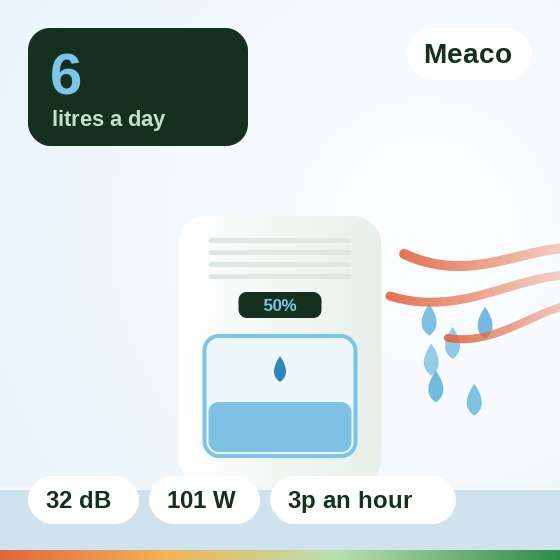
MeacoDry Arete One 6L Compact Dehumidifier / Air Purifier
6 litres a day · 32 dB · 101 W · 3p an hour
£129.99 at Meaco (maker shop), checked 14 Nov 2026
See it at Meaco (maker shop)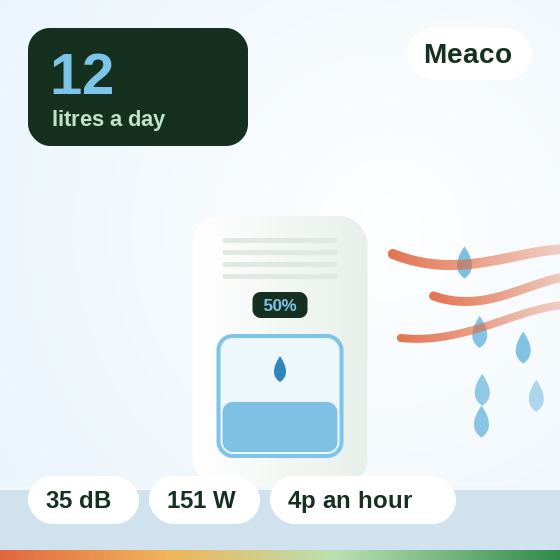
Meaco
MeacoDry Arete One 12L Dehumidifier / Air Purifier
12 litres a day · 35 dB · 151 W · 4p an hour
£179.99 at Meaco (maker shop), checked 14 Nov 2026
See it at Meaco (maker shop)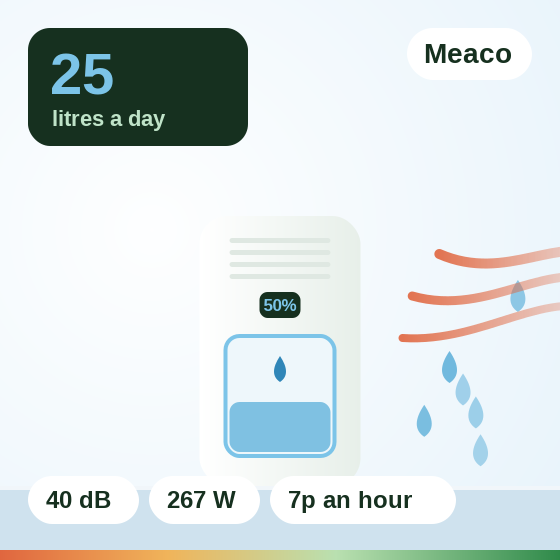
Meaco
MeacoDry Arete One 25L Dehumidifier / Air Purifier
25 litres a day · 40 dB · 267 W · 7p an hour
£299.99 at Meaco (maker shop), checked 14 Nov 2026
See it at Meaco (maker shop)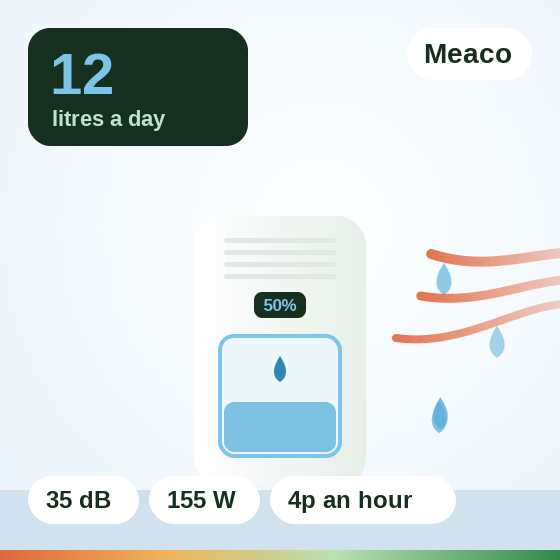
Meaco
MeacoDry Arete Two 12L Dehumidifier / Air Purifier
12 litres a day · 35 dB · 155 W · 4p an hour
£199.99 at Meaco (maker shop), checked 14 Nov 2026
See it at Meaco (maker shop)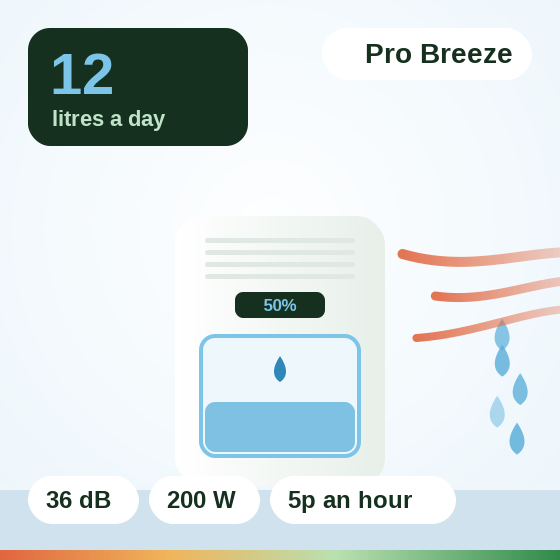
Pro Breeze
OmniDry 12L Quiet Low Energy Dehumidifier (PB-D-18)
12 litres a day · 36 dB · 200 W · 5p an hour
£109.99 at Pro Breeze (maker shop), checked 14 Nov 2026
See it at Pro Breeze (maker shop)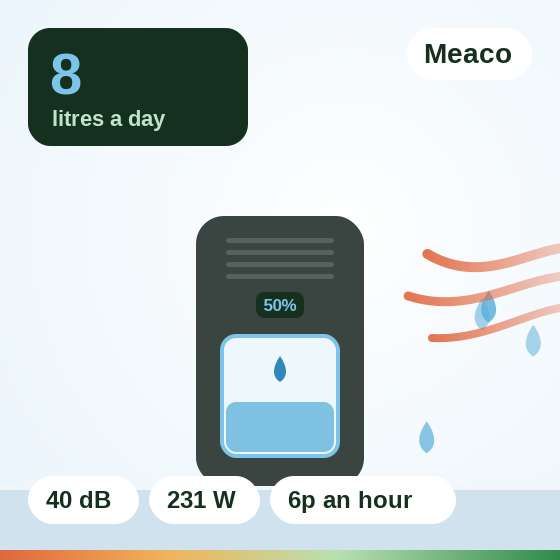
Meaco
DD8L Pro Desiccant Dehumidifier
8 litres a day · 40 dB · 231 W · 6p an hour
£259.99 at Meaco (maker shop), checked 14 Nov 2026
See it at Meaco (maker shop)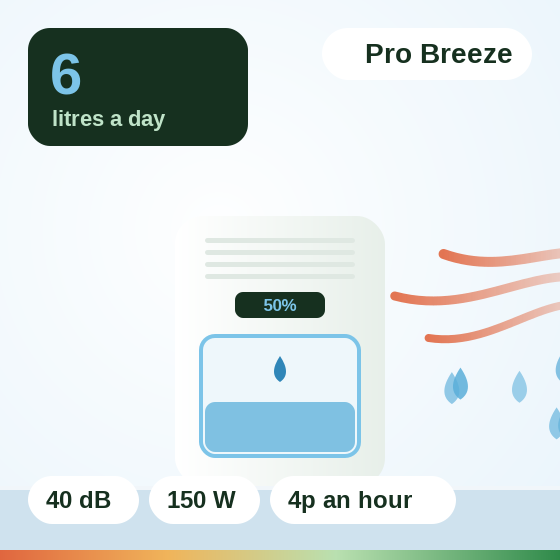
Pro Breeze
6L Compact Dehumidifier (PB-D-26)
6 litres a day · 40 dB · 150 W · 4p an hour
£74.99 at Pro Breeze (maker shop), checked 14 Nov 2026
See it at Pro Breeze (maker shop)
Figures from the maker or retailer listing. Cost an hour is our own, at the price cap of 26.32p a kWh.