Key takeaways
- In the dehumidifier vs humidifier choice, a dehumidifier takes water out of the air and a humidifier puts water in. They do opposite jobs, so too much moisture in the air points to a dehumidifier and dry air points to a humidifier.
- GOV.UK describes condensation damp as the most common form of damp and says tenant habits sit alongside, and do not replace, tackling root causes. It does not mention dehumidifiers or humidifiers.
- Two examples from our product files: the Pro Breeze OmniDry 12L (200 W, manual) costs 5.3p an hour and the Pro Breeze 20L Premium (440 W, manual) 11.6p an hour, at 26.32p per kWh, the Great Britain price cap for 1 October to 31 December 2026. We found no humidifier power rating to compare.
- Running both in one room makes each cancel the other. We found no maker or official document that recommends it.
The short answer
In the dehumidifier vs humidifier choice, a dehumidifier removes moisture from room air and a humidifier adds it. If you are reading this because windows run with condensation, a room smells musty or washing will not dry, the problem is too much moisture, and a dehumidifier is the machine that takes water out of the air; GOV.UK’s guidance on tackling the root causes is below. If the air feels dry, a humidifier adds moisture, and is the only one of the two that does. This page is about choosing between them: for the pillar’s full range of units see our Pro Breeze dehumidifier guide. We have not tested any product, and we make no health claims about either machine, because we found no UK official source to quote for them.
What each machine does
A dehumidifier
Appliances Direct’s buying guide says “A compressor model condenses moisture on a cold coil”, so it needs the room to be warmer than that coil, and “A desiccant model uses a moisture-absorbing wheel instead”. Both collect the water, in a tank or through a drain hose. Pro Breeze’s manual for its 12L Compact says the compressor stops when the humidity reaches the target you set and turns back on when the room is 3% above it; a target can be set between 30% and 90%. De’Longhi’s support page says a working dehumidifier “releases slightly warmer air than the room temperature” and “is not an air conditioner and does not produce coldair” (De’Longhi’s spelling).
Output is quoted in litres a day, always at stated conditions: Pro Breeze’s manual for the OmniDry 12L says “12L per day at 30°C and 80% relative humidity”. Our guide to how a dehumidifier works covers the types, and desiccant against compressor compares them.
A humidifier
The only humidifier whose page we could read in full was the Meaco Deluxe 202 humidifier and air purifier on B&Q (sold and shipped by Meaco UK Limited, £99.99, 25 November 2026). It lists a 5.3 L tank, “Up to 400ml / hour mist capacity”, 35 dB on cool mist and 45 dB on warm mist, rooms up to 65 m2 and a two-year warranty extendable to five. The page says the unit “keeps the air humid and clean”, offers cool and warm mist, and warns that “Running a humidifier in hard water areas can be an issue due to the build up of calcium carbonate deposits.” Output is therefore measured in millilitres an hour, against a dehumidifier’s litres a day. It states no wattage, only a 220 to 240 V supply.
Which problem do you have?
Too much moisture
GOV.UK’s damp and mould guidance (OHID, MHCLG and UKHSA) says: “Condensation damp happens when moisture generated inside the home cools and condenses onto colder parts of the buildings. This is the most common form of damp.” It also says: “If a dwelling is inadequately ventilated, moisture in the air cannot escape the building”. A dehumidifier lowers the moisture in the air; it does not stop a leak or a ventilation fault.
Too little moisture
For dry air we say only what a maker’s document states: the Meaco listing says its humidifier “keeps the air humid and clean”. We found no UK official source on humidifiers, so we make no claim beyond that.
Fix the source first
GOV.UK says working with tenants “must sit alongside - and not be a substitute for - tackling the root causes of the issue”. A machine suits a home where ventilation and heating are already being looked at. For rented homes, see GOV.UK’s guidance, not a product page.
Running cost side by side
Method: watts divided by 1,000, multiplied by 26.32p. This is the Great Britain price cap for 1 October to 31 December 2026, with no VAT (0%) for this period. In Northern Ireland, use the unit rate on your own bill.
| Dehumidifier (rated power) | Per hour | 4 hours | 6 hours |
|---|---|---|---|
| Meaco Arete One 12L, 151 W (Meaco’s UK product page; its manual gives 165 watts) | 4.0p | 15.9p | 23.8p |
| Pro Breeze OmniDry 12L, 200 W (manual) | 5.3p | 21.1p | 31.6p |
| Pro Breeze 20L Premium, 440 W (manual) | 11.6p | 46.3p | 69.5p |
The table is ordered by power. We have left out a humidifier column: no humidifier power rating could be read. The Meaco Deluxe 202’s B&Q page shows only its voltage, and Levoit’s and Dyson’s pages refused or could not be decoded in our research, so a figure would be a guess. A dehumidifier with a humidistat cycles, so these are upper figures for an hour of running. The 4 and 6 hour columns are our assumed length of a wash load.
Meaco’s 151 W is the power in its UK page’s specification table, as our file records it, with no test condition beside it; its manual gives “Nominal Power Consumption” of 165 watts, and its 12 litres a day at 30C and 80% was measured at 198 W, as our file records Meaco’s table. We use the product file’s 151 W. Both Pro Breeze manuals say: “Never leave the appliance unattended while in use.” The Pro Breeze figures are rated power in each manual, so the table mixes makers’ ratings; they are not measured at the same conditions.
Can you use both?
Not in one room at once: one lowers the moisture in the air and the other raises it, so they work against each other. That is our reading of what each does; we found no maker or official document that addresses running both. If you have a damp room and a dry room, use one machine in each.
Combination units
Some products combine functions: the Meaco Deluxe 202 is a humidifier with an air purifier. Combined dehumidifier and purifier units exist, listed on our dehumidifier and air purifier pages, and our air purifier against dehumidifier page covers the difference. For air conditioners with a dry mode, see dehumidifier against air conditioner.
Frequently asked questions
Is a dehumidifier or humidifier better for a damp bedroom?
A dehumidifier, because damp and condensation mean too much moisture and a humidifier adds more. Fix ventilation first; GOV.UK says habits “must sit alongside” tackling root causes. Do not leave a Pro Breeze unit running overnight: the OmniDry 12L and 20L Premium manuals say “Never leave the appliance unattended while in use.”
Can you use a humidifier and a dehumidifier in the same room?
We would not, because they do opposite jobs and cancel each other out. We found no maker or official document that recommends it.
Does a humidifier cause condensation and mould?
We found no official statement either way. GOV.UK describes condensation as moisture inside the home cooling and condensing on colder parts of a building. By what a humidifier does, it adds moisture to the air, so it can add to the supply in a room that already shows condensation. That is our reasoning, not a finding from a source.
What humidity should a home be?
We found no UK official figure to quote, so we give none. Makers set their own targets; Pro Breeze’s 12L Compact manual lets you choose from 30% to 90%.
Which costs more to run?
We cannot say. We found no humidifier power rating, and a dehumidifier costs 4.0p to 11.6p an hour in our three examples. Look for the watts on any unit’s label and use the running cost calculator.
Can an air conditioner act as a dehumidifier?
Some air conditioners have a dry mode. Our dehumidifier against air conditioner page sets out what makers say, and our dehumidifier guide covers the plug-in units.
Sources
- GOV.UK: Understanding and addressing the health risks of damp and mould in the home (checked 25 November 2026)
- B&Q: Meaco Deluxe 202 humidifier and air purifier (checked 25 November 2026)
- Appliances Direct: How to choose a dehumidifier (checked 25 November 2026)
- Pro Breeze: PB-D-27 instruction manual (12L Compact, UK edition) (checked 25 November 2026)
- Pro Breeze: PB-18 instruction manual (OmniDry 12L) (checked 25 November 2026)
- De’Longhi UK: My dehumidifier emits hot air. Is that normal? (checked 25 November 2026)
- Meaco: MeacoDry Arete One 12L (151 W, and 198 W at 30C and 80%, as recorded in our product file, 14 November 2026; not re-opened, because meaco.com rate limits automated requests)
- Pro Breeze: 20L Premium dehumidifier, PB-D-23 manual (440 W as recorded in our product file, 14 November 2026; the pillar writer read it on 25 November 2026)
- Ofgem: Changes to the energy price cap between 1 October and 31 December 2026 (checked 25 November 2026)
- Meaco: MeacoDry Arete One 10/12L instruction manual (PDF, hosted by Appliances Direct) (checked 27 November 2026)
Products on this page
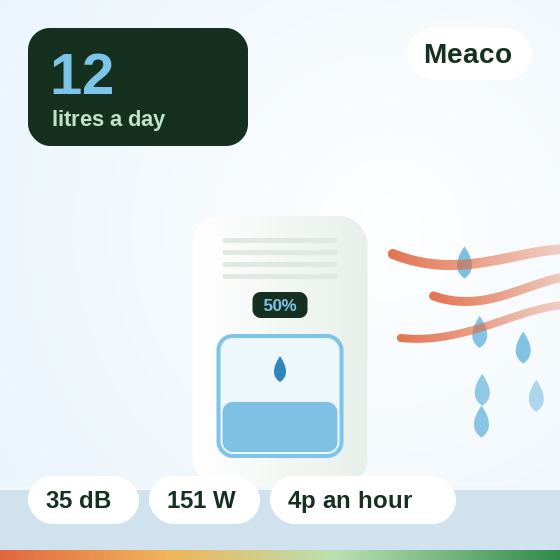
Meaco
MeacoDry Arete One 12L Dehumidifier / Air Purifier
12 litres a day · 35 dB · 151 W · 4p an hour
£179.99 at Meaco (maker shop), checked 14 Nov 2026
See it at Meaco (maker shop)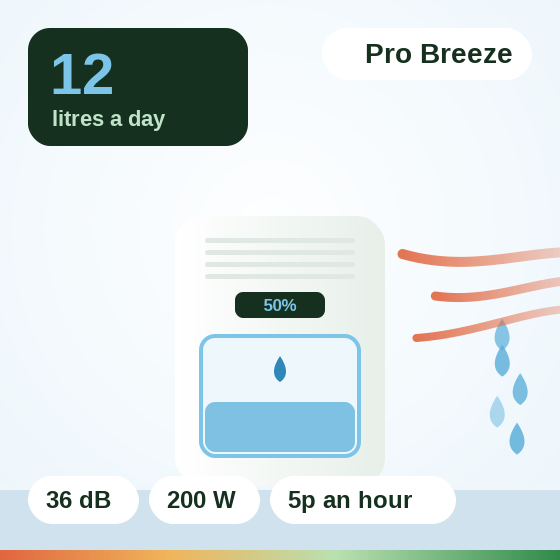
Pro Breeze
OmniDry 12L Quiet Low Energy Dehumidifier (PB-D-18)
12 litres a day · 36 dB · 200 W · 5p an hour
£109.99 at Pro Breeze (maker shop), checked 14 Nov 2026
See it at Pro Breeze (maker shop)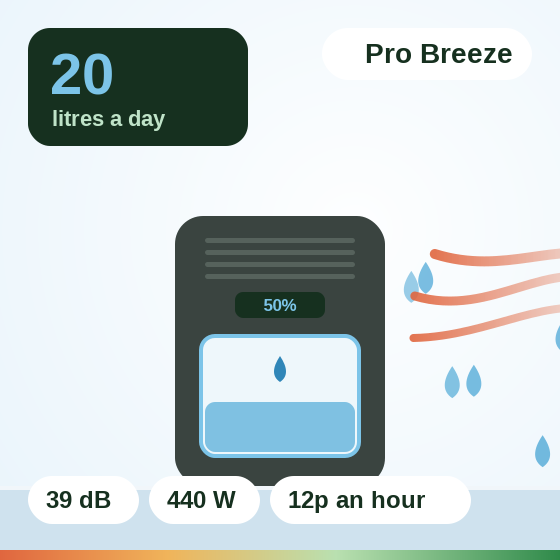
Pro Breeze
20L Premium Dehumidifier with One-Click Laundry Mode (PB-D-23)
20 litres a day · 39 dB · 440 W · 12p an hour
£149.99 at Pro Breeze (maker shop), checked 14 Nov 2026
See it at Pro Breeze (maker shop)
Figures from the maker or retailer listing. Cost an hour is our own, at the price cap of 26.32p a kWh.