Key takeaways
- A UK heatwave weather forecast comes from the Met Office. It gives hourly detail for the first two days, a day by day picture to day five, a broad UK description to day fifteen and only a general outlook to day thirty.
- No forecaster can name a heatwave’s date weeks ahead. The Met Office says “One-off, individual weather charts cannot represent a definitive forecast”.
- In the UK a heatwave is three or more days in a row at or above the local threshold, which is between 25C and 28C depending on the county (Met Office).
- UKHSA Heat-Health Alerts cover England only. Met Office extreme heat warnings cover the whole UK. UKHSA’s Heat-Health Alerts operate from 1 June to 30 September each year, and an out-of-season alert may still be issued.
- We make no forecast of our own. This page explains how to read the Met Office and UKHSA, and links to them.
Latest forecast and alerts
No dated summary is shown here at the moment. When the Met Office forecasts a heatwave, or UKHSA or the Met Office issue a heat alert or warning, we add a dated summary to this section. Until it shows a date and time, treat this section as empty and check the sources directly: the Met Office UK forecast, the Met Office weather warnings and the UKHSA weather health alerts dashboard. UKHSA’s Heat-Health Alerts normally run from 1 June to 30 September each year, and an out-of-season alert may still be issued.
How do I check if a heatwave is forecast?
Three official pages answer it between them. Check them in this order, and look at the time each one shows, because a forecast is only as good as its last update.
Step 1: the Met Office UK forecast
The Met Office says “All basic UK forecast information is gathered together on the UK forecast page.” Its guide to that page says it holds a regional forecast for the first two days, “a UK forecast for the next 5 days” and “an outlook for the next 6-30 days” (Met Office UK forecast guide).
Step 2: the Met Office weather warnings
The Met Office UK weather warnings page shows any warning by colour across a strip of the coming seven days. You can follow warnings in the Met Office app, subscribe to email alerts from the page, or follow the Met Office’s warnings on X.
Step 3: the UKHSA alerts dashboard (England)
The UKHSA weather health alerts dashboard shows any Heat-Health Alert in force by region of England. UKHSA’s alerts are also sent by email to anyone who registers through the form on GOV.UK, and its blog says the system “allows users to specify which area of England they want to receive updates about” (UKHSA blog, 8 January 2026).
How far ahead can a heatwave be forecast?
Beyond about five days the Met Office says it is harder to give local detail, and no forecaster can name a heatwave’s date weeks ahead. The further out the forecast, the broader the area it covers and the less it says about any one place.
What the Met Office gives at each range
| How far ahead | What the Met Office gives, in its own words |
|---|---|
| Days 1 and 2 | Location forecasts “provided in hourly time steps for the first two days” |
| Days 3 to 5 | “A general picture of the weather on a day-by-day basis, with the main regional variations identified.” |
| Days 6 to 15 | “A broad description of the weather likely to be affecting the UK, including significant changes in the type of weather.” The 6 to 15 day text forecast also includes a risk assessment for severe weather. |
| Days 16 to 30 | It “provides an indication of how the weather might change, or be different from normal”. This outlook covers the whole UK and is updated daily. |
| One month to a decade | Long-range forecasts “describe average conditions over a specified period and region” |
Sources: About our forecasts, 14-day forecast guide and What are long range forecasts (Met Office, 10 December 2025).
For forecasts five days ahead and more, the Met Office’s 10-day guide says “it becomes harder to offer local detail to as high a level of accuracy as our shorter range forecasts”, although “we can still forecast the general feel of the weather to a relatively high level of accuracy using Ensemble Forecasting” (Met Office 10-day forecast guide). Its 14-day guide calls forecasts for “periods between 10 and 30-days ahead” extended-range forecasts.
How accurate is it?
For meteorological spring 2026 the Met Office says “1-day maximum temperature forecasts through meteorological spring were 95% accurate, with 77% accuracy at the 5-day range” (Met Office blog, 7 July 2026). A temperature forecast counts as accurate when it is within 2C of the observed temperature.
Our arithmetic on those two figures: 95 minus 77 is 18 percentage points. So in that spring, roughly one five day forecast of the top temperature in four or five missed by more than 2C, against one in twenty a day ahead. These figures are for maximum temperature one to five days ahead. The Met Office publishes no accuracy figure for forecasting a heatwave ten to thirty days ahead, so we do not give one.
The long view is better. The Met Office says “our four-day forecast is now as accurate as our one-day forecast was 30 years ago” (Met Office: accuracy).
Why no one can give an exact date weeks ahead
A headline that names the day a heatwave starts or ends, weeks in advance, goes further than the Met Office does. Its own words, from different years:
- 15 November 2023: “One-off, individual weather charts cannot represent a definitive forecast”, and a Met Office meteorologist said it is “nearly impossible to talk with absolute certainty about the specific conditions expected” on a particular day well ahead (Met Office blog).
- 21 July 2026: “At this range, it is not possible to say exactly where any heatwave conditions would occur” (Met Office blog).
- 18 August 2026, answering headlines about a September heatwave: “confidence decreases significantly beyond the next week or two”, “confidence in any specific hot spell or heatwave remains low at this range”, and a heatwave “is far from certain and is only one of several potential scenarios being considered by forecast guidance” (Met Office blog).
- 10 December 2025, on long-range forecasts: “it’s not possible to predict the exact weather on a particular day months ahead” (Met Office blog).
If a page gives an exact date for a heatwave more than a week or two away, check it against the Met Office UK forecast before planning round it.
What counts as a heatwave in the UK?
The Met Office says a UK heatwave is at least three consecutive days with daily maximum temperatures at or above the local heatwave threshold. The threshold depends on the county: 25C across much of the north and west of the UK, rising to 28C across Greater London and the Home Counties (Met Office: heatwave; Met Office, 16 June 2025).
So the same temperature can be a heatwave in one county and not in another. The Met Office also notes that “Heatwaves can and will often be declared when no other alerts or warnings have been issued” (Met Office blog, 23 June 2026). For the full definition and how the thresholds were set, see heatwave definition and what temperature is a heatwave in the UK.
Heat-Health Alerts and extreme heat warnings: what is the difference?
UKHSA Heat-Health Alerts cover England only. Met Office extreme heat warnings cover the whole UK. They are two separate services, and both can be in force at once.
| UKHSA Heat-Health Alert | Met Office extreme heat warning | |
|---|---|---|
| Who issues it | “The WHA system is provided by the UK Health Security Agency (UKHSA) in partnership with the Met Office.” | The Met Office, through the National Severe Weather Warning Service |
| Where it applies | England only: the Met Office calls it “an England only service” | The whole UK: “The National Severe Weather Warning Service (NSWWS) is a UK wide service” |
| Colours | Yellow, amber or red | Amber or red: “UKHSA’s system includes yellow alerts, while the Met Office’s Extreme Heat warnings begin at amber” |
| Season | “Heat-Health Alerts (HHA) which operate from 1 June to 30 September each year”; “An out-of-season alert may still be issued if impacts from adverse weather on health (heat or cold) are expected.” | The Met Office pages we read do not give a season for extreme heat warnings |
| Where to see it | UKHSA dashboard | Met Office warnings |
Sources: GOV.UK: Weather-Health Alerting system, Met Office blog, 23 June 2026, UKHSA blog, 8 January 2026.
UKHSA says its alerts are “primarily aimed at the health and social care sector and emergency responders”, and that they cover England only because weather and health is “a devolved responsibility in Scotland, Wales and Northern Ireland” (UKHSA). On the colours, UKHSA’s guidance says “an amber alert indicates that weather impacts are likely to be felt across the whole health service, with potential for the whole population to be at risk”, and “a red alert indicates significant risk to life for even the healthy population”. The Met Office says a red Heat-Health Alert “will almost always coincide with an Extreme Heat warning”. What each colour means in practice is on our heatwave alerts page.
What does it cost to keep cool through a heatwave?
The shortest heatwave the Met Office definition allows is three days. We worked out what four common products would cost to run for those three days, at 8 hours a day and round the clock.
| Product | Type | Rated power | 8 hours a day for 3 days (24 hours) | 3 days round the clock (72 hours) |
|---|---|---|---|---|
| Meaco MeacoFan 1056 | Air circulator fan | 24 W | 0.6 kWh, 15.2p | 1.7 kWh, 45.5p |
| Pro Breeze OmniAir 7L | Air cooler | 65 W | 1.6 kWh, 41.1p | 4.7 kWh, £1.23 |
| Pro Breeze 5,000 BTU (PB-AC08) | Portable air conditioner | 563 W | 13.5 kWh, £3.56 | 40.5 kWh, £10.67 |
| MeacoCool MC Series Pro 9,000 BTU | Portable air conditioner | 1,005 W | 24.1 kWh, £6.35 | 72.4 kWh, £19.05 |
How we worked it out, for the 9,000 BTU unit over three days: 1,005 watts is 1.005 kW; 1.005 kW times 72 hours is 72.36 kWh; 72.36 kWh times 26.32p is £19.05. The rate is 26.32p per kWh, Ofgem’s Great Britain average electricity unit rate under the price cap for 1 October to 31 December 2026 (Direct Debit, single-rate meter), which carries no VAT (0%) for that period. These figures use the Great Britain price cap. In Northern Ireland, use the unit rate on your own bill. The standing charge is left out, because you pay it whether or not anything is running.
The figures use each product’s rated power at full output, so they are an upper estimate: fans on low speed and inverter air conditioners use less. The 72 hour column is a measure of cost, not advice to leave anything running unattended. Pro Breeze’s manuals for the PB-AC08 and the OmniAir 7L say “Never leave the appliance unattended while in use.” We have not read the manuals for the MeacoCool MC Series Pro 9000 or the MeacoFan 1056: check each one before leaving the unit running overnight or unattended.
A fan or air cooler does not lower the room’s air temperature the way an air conditioner does; a fan cools people by moving air. A portable air conditioner needs its hose vented out of a window. Fans help while the air is below 35C (NHS, UKHSA). Do not aim one directly at your body.
To compare models, see the best portable air conditioners and best cooling fans, and for more on costs, air conditioning running costs.
Heatwaves in June, August and September
The Met Office publishes no count of heatwaves by month, so we cannot say how often a given month has one. What we can give are the Met Office’s records and dated events. The highest UK temperatures for each summer month are in the Met Office’s UK climate extremes table.
June. The UK June record is 38.0C, at Lingwood, Norfolk, on 26 June 2026, verified by the Met Office. Its release of 29 July 2026 gives “UK and England June highest daily maximum temperature: 38.0°C, Lingwood, 26 June 2026” (Met Office). More on June heatwaves.
August. The UK August record is 38.5C at Faversham, Kent, on 10 August 2003. On 13 August 2026 the Met Office recorded a peak later corrected to 38.2C at Hartpury College, with 40 locations across central and southern England at 36C or more (Met Office, 13 August 2026, updated 17 September 2026). More on August heatwaves.
September. The UK September record is 35.6C at Bawtry, South Yorkshire, on 2 September 1906, a value the Met Office marks with “some reservations”. In September 2023, the Met Office said, “For the first time there was a run of seven consecutive days recording 30°C or higher in September”, beating runs of five days in 1929 and 1911 (Met Office blog, 19 September 2023). More on September heatwaves.
The all-time UK record is 40.3C at Coningsby, Lincolnshire, on 19 July 2022. For how past summers compare, see the 1976 heatwave.
What to do when a heatwave is forecast
Our heatwave guides cover this, with the NHS’s and UKHSA’s own advice:
- What to do before and during hot weather, and when to get help: heatwave advice.
- The whole picture, from who is most at risk to keeping your home cool: UK heatwave guide.
- Sleeping in the heat: how to keep cool at night.
- Cooling a room: how to cool down a room and how to keep your house cool in a heatwave.
Most NHS and UKHSA advice linked here is written for England. In Wales, Scotland and Northern Ireland, use your own nation’s NHS service.
Every heatwave forecast page
- Is another heatwave coming? How the Met Office signals whether more hot spells are possible, and what its wording means.
- When is the next UK heatwave? How far ahead a start date can be known, and how to read the Met Office’s lead-time wording.
- When will the heatwave end? How hot spells break down, and when alerts and warnings end.
- Heatwave alerts What yellow, amber and red mean, and where to see any alert in force.
- June heatwaves Records and dated June heatwaves from Met Office pages.
- August heatwaves Records and dated August heatwaves from Met Office pages.
- September heatwaves Records and dated September heatwaves from Met Office pages.
Frequently asked questions
Is a heatwave forecast for the UK?
The Met Office UK forecast is the place to find out: its five day UK forecast and its outlook for days 6 to 30 say whether heatwave conditions are possible. The forecast and alerts section near the top of this page shows a dated summary when we have one; if it shows no date and time, check the Met Office UK forecast, the Met Office warnings and the UKHSA dashboard directly.
How far ahead can the Met Office forecast a heatwave?
It gives a broad UK description up to day 15 and a general outlook to day 30, but not an exact date. Beyond about five days the Met Office says it is harder to give local detail, and on 18 August 2026 it said “confidence decreases significantly beyond the next week or two”.
How accurate are Met Office temperature forecasts?
For spring 2026, the Met Office says its one day maximum temperature forecasts were 95% accurate and its five day forecasts 77% accurate, where accurate means within 2C. That is 18 percentage points lower at five days. It gives no accuracy figure for heatwave forecasts ten to thirty days ahead.
What temperature counts as a heatwave in the UK?
It depends on the county. In the UK a heatwave is three or more days in a row at or above the local threshold, which is between 25C and 28C depending on the county (Met Office): 25C across much of the north and west, 28C across Greater London and the Home Counties.
What is the difference between a heat health alert and an extreme heat warning?
A Heat-Health Alert comes from UKHSA, covers England only and can be yellow, amber or red. An extreme heat warning comes from the Met Office, covers the whole UK and is amber or red only. Both can be in force at the same time.
When does the heat health alert season start and end?
UKHSA’s Heat-Health Alerts operate from 1 June to 30 September each year, and an out-of-season alert may still be issued. GOV.UK says that happens “if impacts from adverse weather on health (heat or cold) are expected.” That season is 122 days, about a third of the year (our arithmetic).
Where can I see current heat alerts and warnings?
UKHSA’s Heat-Health Alerts are on the UKHSA weather health alerts dashboard, and Met Office extreme heat warnings are on its UK weather warnings page. You can register for UKHSA’s alerts by email on GOV.UK, and get Met Office warnings by app, email or on X.
Sources
- Met Office: Heatwave (checked 27 November 2026)
- Met Office: About our forecasts (checked 27 November 2026)
- Met Office: UK forecast guide (checked 27 November 2026)
- Met Office: How to use our 10-day weather forecasts (checked 27 November 2026)
- Met Office: How to use our 14-day weather forecasts (checked 28 November 2026)
- Met Office blog: How accurate was the Met Office forecast during a record-laden spring (7 July 2026) (checked 27 November 2026)
- Met Office: How accurate are our public forecasts (checked 27 November 2026)
- Met Office blog: What are long range forecasts (10 December 2025) (checked 27 November 2026)
- Met Office blog: Why an exact date weather forecast headline isn’t what it seems (15 November 2023) (checked 27 November 2026)
- Met Office blog: September heatwave, cold snap, weather headline review (18 August 2026) (checked 27 November 2026)
- Met Office blog: Will the heat return (21 July 2026) (checked 27 November 2026)
- Met Office: UK heatwave likely (16 June 2025) (checked 27 November 2026)
- Met Office blog: Heat alerts explained as Europe faces extreme temperatures (23 June 2026) (checked 27 November 2026)
- GOV.UK (UKHSA): Weather-Health Alerting (WHA) system (checked 28 November 2026)
- UKHSA data dashboard: Weather health alerts (checked 27 November 2026)
- UKHSA blog: What is the difference between weather-health alerts and severe weather warnings? (8 January 2026) (checked 27 November 2026)
- Met Office: UK weather warnings (checked 27 November 2026)
- Met Office: UK climate extremes (checked 27 November 2026)
- Met Office: New June daily temperature records heading into the record books (29 July 2026) (checked 27 November 2026)
- Met Office: Latest heatwave peaks with 38.1C recorded (13 August 2026, updated 17 September 2026) (checked 27 November 2026)
- Met Office blog: Unprecedented September heatwave summary (19 September 2023) (checked 27 November 2026)
- Ofgem: Changes to energy price cap between 1 October and 31 December 2026 (checked 27 November 2026)
- NHS: Heatwave, how to cope in hot weather (checked 27 November 2026)
- UKHSA: Beat the heat, staying safe in hot weather (checked 27 November 2026)
- Pro Breeze: PB-AC08 5000 BTU portable air conditioner instruction manual (checked 27 November 2026)
- Pro Breeze: OmniAir 7L (PB-AC06) instruction manual (checked 27 November 2026)
- Meaco: MeacoFan 1056 Air Circulator product page (checked 14 November 2026)
- Meaco: MeacoCool MC Series Pro 9000 product page (checked 13 November 2026)
Products on this page
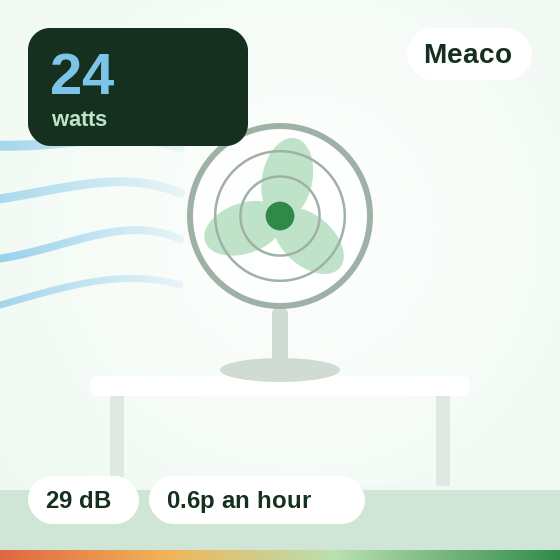
Meaco
MeacoFan 1056 Air Circulator
24 watts · 29 dB · 0.6p an hour
£99.99 at Meaco (maker shop), checked 14 Nov 2026
See it at Meaco (maker shop)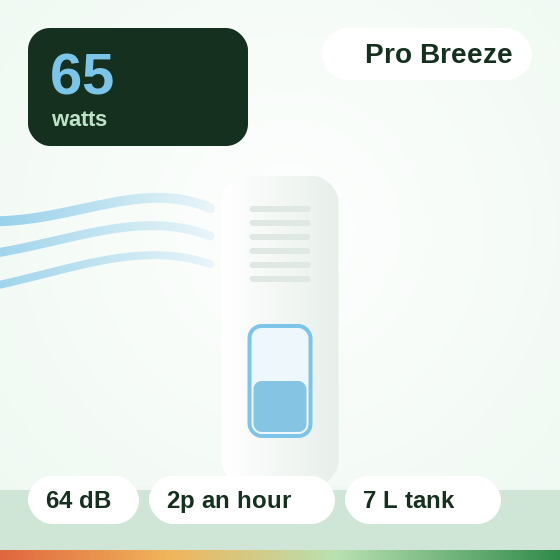
Pro Breeze
OmniAir 7L Evaporative Air Cooler (PB-AC06)
65 watts · 64 dB · 2p an hour · 7 L tank
£149.99 at Pro Breeze (maker shop), checked 14 Nov 2026
See it at Pro Breeze (maker shop)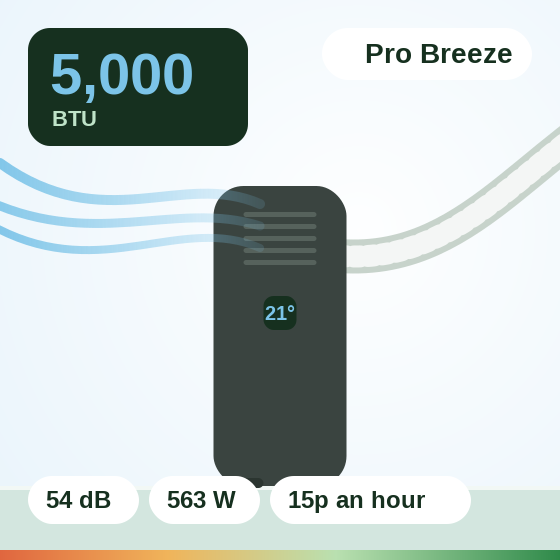
Pro Breeze
5000 BTU 3-in-1 Portable Air Conditioner with Dehumidification Function, Smart Wifi App (PB-AC-08)
5,000 BTU · 54 dB · 563 W · 15p an hour
£224.99 at Pro Breeze (maker shop), checked 13 Nov 2026
See it at Pro Breeze (maker shop)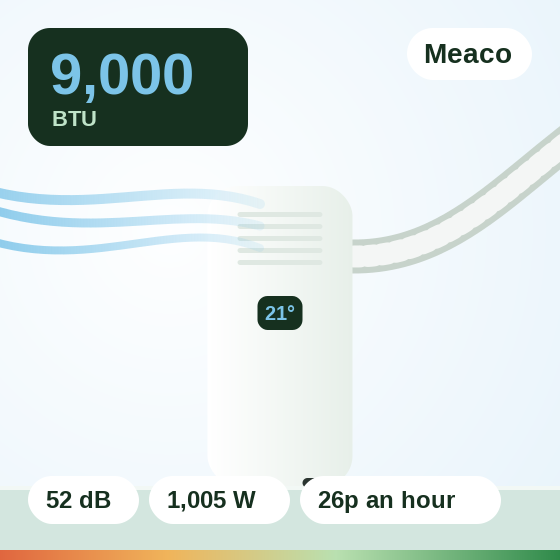
Meaco
MeacoCool MC Series Pro 9000 CH BTU Portable Air Conditioner & Heater (MC9000CHRPRO)
9,000 BTU · 52 dB · 1,005 W · 26p an hour
£399.99 at Meaco (maker shop), checked 13 Nov 2026
See it at Meaco (maker shop)
Figures from the maker or retailer listing. Cost an hour is our own, at the price cap of 26.32p a kWh.