Key takeaways
- The Met Office’s day by day forecast for your place, for the next five days, is where the end of a hot spell shows first. Its 6 to 15 day text gives a broad picture, not a date.
- Beyond about five days the Met Office says it is harder to give local detail, and no forecaster can name a heatwave’s date weeks ahead.
- By the Met Office’s definition a heatwave needs three or more days at or above the local threshold, so a day below that threshold breaks the run of days at or above it.
- A heat alert has its own end time and can outlast the hottest days.
- Our UK heatwave forecast page sets out every forecast range.
Short answer: where to find the end of the heat
Look at the Met Office UK forecast for your town: it gives a day by day picture for the next five days, and a broad description of the UK for days 6 to 15. Beyond about five days the Met Office says it is harder to give local detail, and no forecaster can name a heatwave’s date weeks ahead.
Latest forecast and alerts
No dated summary is shown here at the moment. When the Met Office forecasts a heatwave, or UKHSA or the Met Office issue a heat alert or warning, we add a dated summary to this section. Until it shows a date and time, treat this section as empty and check the sources directly: the Met Office UK forecast, the Met Office weather warnings and the UKHSA weather health alerts dashboard. UKHSA’s Heat-Health Alerts normally run from 1 June to 30 September each year, and an out-of-season alert may still be issued.
How do heatwaves end?
The two examples below are history, with dates. They show the wording the Met Office uses when a break in the heat is days away.
Cold fronts and thundery breakdowns
On 7 September 2023 the Met Office wrote of a “Thundery breakdown on the way”. Its forecaster said: “A cold front will begin to influence things as it arrives from the northwest over the weekend”, with “a return to westerly weather regime, with a mix of sunshine and showers is most likely” (Met Office, 7 September 2023).
On 13 August 2026 the Met Office said “A cold front will gradually introduce fresher air, with conditions feeling far less humid by Saturday”, and its Chief Forecaster spoke of “a gradual return to average over the next few days” (Met Office, 13 August 2026).
Why the south can stay hot after the north cools
The same August 2026 page quotes the Chief Forecaster: “Into the weekend temperatures could still hover over 30°C in the south.” A heatwave is judged place by place, so it can end in one county while it continues in another.
How to read the Met Office forecast for the end
Days 1 to 5: day by day
For the first two days the Met Office gives location forecasts in hourly steps. For days three to five it gives “A general picture of the weather on a day-by-day basis, with the main regional variations identified” (Met Office: About our forecasts). Compare each day’s maximum with your county’s threshold, which is between 25C and 28C. When the maximums drop below it, the run of hot days is broken.
Days 6 to 15: a broad picture, not a date
The 6 to 15 day text forecast gives “a broad description of the weather likely to be affecting the UK” (Met Office: 14-day forecast guide). It is written for the whole UK. It is a guide to the type of weather, so do not plan round a date in it. The Met Office’s 10-day guide says its forecasts “for 5 days and beyond are written on the scale of the UK as a whole” (Met Office: 10-day forecast guide).
Wording to watch for
The Met Office’s own hedges tell you how sure it is. In dated examples: “further heatwaves are possible but not guaranteed” (21 July 2026) and “confidence in any specific hot spell or heatwave remains low at this range” (18 August 2026) (Met Office blog; Met Office blog). On 16 September 2026 it said “it remains to be seen whether official heatwave thresholds will be met” (Met Office blog). Words like these mean an end date is not known.
When is a heatwave over?
The Met Office says a UK heatwave threshold “is met when a location records a period of at least three consecutive days” at or above the threshold (Met Office: Heatwave). In the UK a heatwave is three or more days in a row at or above the local threshold, which is between 25C and 28C depending on the county (Met Office). See heatwave definition. Hot weather that stays below the threshold is not a heatwave by this definition, but it can still be uncomfortable.
When does a heat alert end?
UKHSA Heat-Health Alerts cover England only. Met Office extreme heat warnings cover the whole UK. Each carries its own times, and neither is switched off by the definition of a heatwave. In June 2026:
- UKHSA’s 24 June entry set its red alerts for the South West, South East, London, East of England, West Midlands and East Midlands “from 1am on Wednesday 24 June until 11pm on Friday 26 June”; on 26 June those regions went “from red to amber”, extended “until 9am on Sunday 28 June” (GOV.UK, UKHSA).
- The Met Office’s red extreme heat warning “came into force at 0900 on Wednesday morning and will now last through to late on Thursday night” (Met Office, 24 June 2026).
The two ended at different times. Read the end time on the alert itself: the Met Office warnings page and the UKHSA dashboard show it. More on heatwave alerts.
How much does each extra day of cooling cost?
We worked out the cost of each extra day of running four products, at 26.32p per kWh. An extra day is 24 hours; an 8 hour period is a third of that.
| Product | Rated power | One extra day (24 hours) | 8 hours a day |
|---|---|---|---|
| Meaco MeacoFan 1056 (fan) | 24 W | 0.576 kWh, 15.2p | 5.1p |
| Pro Breeze OmniAir 7L (air cooler) | 65 W | 1.56 kWh, 41.1p | 13.7p |
| Pro Breeze 5,000 BTU (PB-AC08) (portable air conditioner) | 563 W | 13.512 kWh, £3.56 | £1.19 |
| MeacoCool MC Series Pro 9,000 BTU (portable air conditioner) | 1,005 W | 24.12 kWh, £6.35 | £2.12 |
The working for the 9,000 BTU unit: 1.005 kW times 24 hours is 24.12 kWh, times 26.32p is £6.35; for 8 hours, 1.005 times 8 is 8.04 kWh, times 26.32p is £2.12. The rate is Ofgem’s Great Britain average unit rate under the price cap for 1 October to 31 December 2026, with no VAT (0%) for that period (Ofgem). These figures use the Great Britain price cap. In Northern Ireland, use the unit rate on your own bill. They use rated power at full output, so they are an upper estimate, and leave out the standing charge.
These are costs, not advice to run a unit all night. Pro Breeze’s manuals for the PB-AC08 and the OmniAir 7L say “Never leave the appliance unattended while in use.” We have not read the manuals for the MeacoCool MC Series Pro 9000 or the MeacoFan 1056: check each one before leaving the unit running overnight or unattended. Fans help while the air is below 35C (NHS, UKHSA). Do not aim one directly at your body.
Coping until it breaks
Our heatwave advice page gives the NHS’s and UKHSA’s own guidance. For sleeping, see how to keep cool at night; for the bigger picture, the UK heatwave guide. To compare products, see the best cooling fans and best portable air conditioners.
Frequently asked questions
When will the heatwave end?
Check the Met Office UK forecast for your town: it shows the next five days day by day. Beyond about five days the Met Office says it is harder to give local detail, and no forecaster can name a heatwave’s date weeks ahead.
How long does a UK heatwave last?
The definition sets only a minimum: three or more days in a row at or above the local threshold, which is between 25C and 28C depending on the county (Met Office). There is no set maximum. See when is the next heatwave in the UK for how far ahead any spell can be seen.
How do I find out when the hot weather will break?
Read the day by day maximums in the Met Office forecast and watch for its change wording, such as a cold front bringing “fresher air”. The 6 to 15 day text is a broad picture and does not give a date.
Does a heat health alert end when the heatwave ends?
Not necessarily. UKHSA’s alerts are based on likely health impact and carry their own end times. In June 2026 UKHSA’s red alerts began at 1am on Wednesday 24 June; its entry of 26 June says those regions were moved “from red to amber” and the alert was extended “until 9am on Sunday 28 June” (GOV.UK).
Will thunderstorms end the heatwave?
Sometimes they come with the break. In September 2023 the Met Office headed its forecast “Thundery breakdown on the way”. A storm in one place does not end the heat everywhere, so check your own forecast.
What is the longest run of hot days in the UK?
The Met Office gives different measures, so we do not name a record. In September 2023 it recorded “a run of seven consecutive days recording 30°C or higher in September”, a first for that month. For the summer of 1976 it says at least twenty stations recorded 32C or more for six consecutive days. These are not the same measure and are not ranked against each other.
Sources
- Met Office: Heatwave (checked 27 November 2026)
- Met Office: About our forecasts (checked 27 November 2026)
- Met Office: UK forecast guide (checked 27 November 2026)
- Met Office: How to use our 10-day weather forecasts (checked 27 November 2026)
- Met Office: How to use our 14-day weather forecasts (checked 27 November 2026)
- Met Office blog: Will the heat return (21 July 2026) (checked 27 November 2026)
- Met Office blog: September heatwave, cold snap, weather headline review (18 August 2026) (checked 27 November 2026)
- Met Office blog: Will we see one last heatwave (16 September 2026) (checked 27 November 2026)
- Met Office: Heatwave continues but a change is on the way (7 September 2023) (checked 27 November 2026)
- Met Office: Red Extreme Heat Warning in force (24 June 2026) (checked 27 November 2026)
- Met Office: Latest heatwave peaks with 38.1C recorded (13 August 2026, updated 17 September 2026) (checked 27 November 2026)
- Met Office blog: Unprecedented September heatwave summary (19 September 2023) (checked 27 November 2026)
- Met Office: UK and global extreme events, heatwaves (checked 27 November 2026)
- GOV.UK: UKHSA issues red heat-health alerts across England (checked 28 November 2026; alerts dated 22, 24 and 26 June 2026)
- Met Office: UK weather warnings (checked 27 November 2026)
- UKHSA data dashboard: Weather health alerts (checked 27 November 2026)
- Ofgem: Changes to energy price cap between 1 October and 31 December 2026 (checked 27 November 2026)
- NHS: Heatwave, how to cope in hot weather (checked 27 November 2026)
- UKHSA: Beat the heat, staying safe in hot weather (checked 27 November 2026)
- Pro Breeze: PB-AC08 5000 BTU portable air conditioner instruction manual (checked 27 November 2026)
- Pro Breeze: OmniAir 7L (PB-AC06) instruction manual (checked 27 November 2026)
- Rated power for the four products: our product files, taken from the makers’ pages (Meaco, checked 13 and 14 November 2026; meaco.com did not open on 27 November 2026).
Products on this page
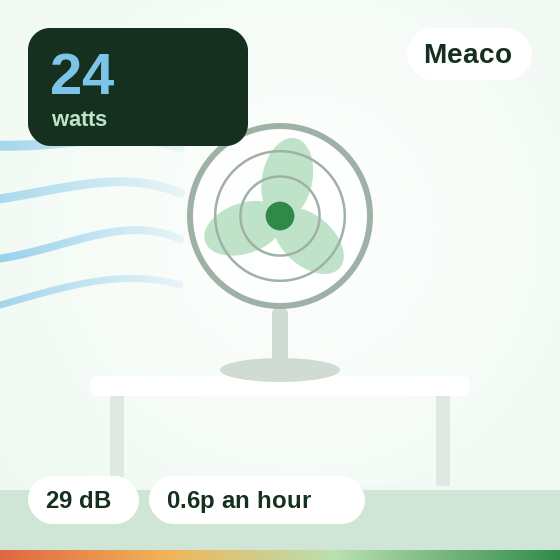
Meaco
MeacoFan 1056 Air Circulator
24 watts · 29 dB · 0.6p an hour
£99.99 at Meaco (maker shop), checked 14 Nov 2026
See it at Meaco (maker shop)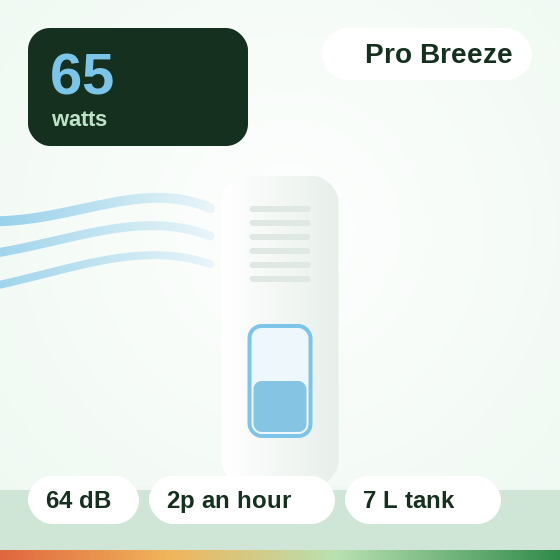
Pro Breeze
OmniAir 7L Evaporative Air Cooler (PB-AC06)
65 watts · 64 dB · 2p an hour · 7 L tank
£149.99 at Pro Breeze (maker shop), checked 14 Nov 2026
See it at Pro Breeze (maker shop)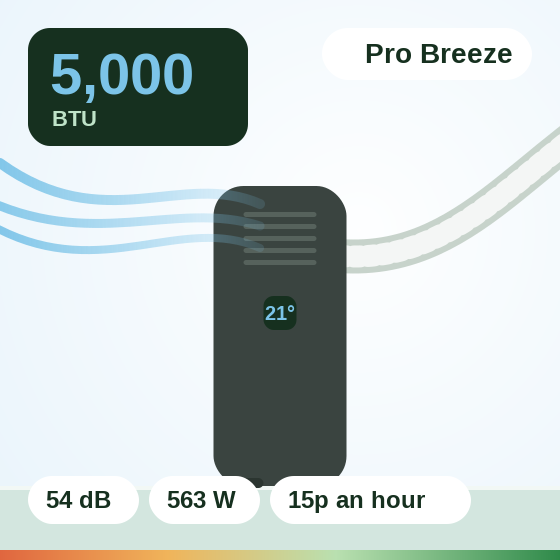
Pro Breeze
5000 BTU 3-in-1 Portable Air Conditioner with Dehumidification Function, Smart Wifi App (PB-AC-08)
5,000 BTU · 54 dB · 563 W · 15p an hour
£224.99 at Pro Breeze (maker shop), checked 13 Nov 2026
See it at Pro Breeze (maker shop)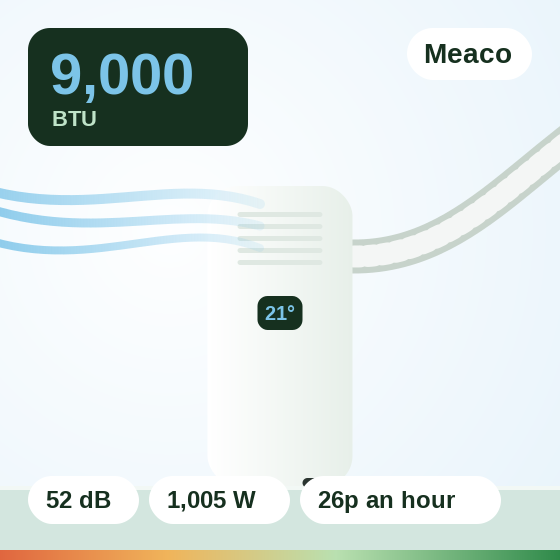
Meaco
MeacoCool MC Series Pro 9000 CH BTU Portable Air Conditioner & Heater (MC9000CHRPRO)
9,000 BTU · 52 dB · 1,005 W · 26p an hour
£399.99 at Meaco (maker shop), checked 13 Nov 2026
See it at Meaco (maker shop)
Figures from the maker or retailer listing. Cost an hour is our own, at the price cap of 26.32p a kWh.