Key takeaways
- A Dyson hot and cool fan (the Hot+Cool range) is a bladeless fan that is also a heater. This page covers two of them: the HF1 (£329 at John Lewis on 25 November 2026, down from £399) and the Purifier Hot+Cool HP1 (£539.98 at Marks Electrical, £549 at John Lewis).
- On heat the HF1 is rated at a maximum of 2,250 W (Marks Electrical), which costs 59.2p an hour at 26.32p per kWh (1 October to 31 December 2026). That is a heating cost, never a cooling cost.
- We found no fan-only power for the HF1 or the HP1 on any listing we could read, so we show no cooling cost for either. Marks Electrical’s 2,362 W for the HP1 is fan and heater together.
- Noise figures come from retailers and are not all the same kind: 26 dB in sleep mode for the HF1 (three retailers), 57 dB for it with no conditions stated, and 63 dB for the HP1 (Marks Electrical).
- A Hot+Cool suits someone who wants one machine for winter heat and a summer breeze. It does not cool the air.
A Dyson hot and cool fan is a fan that heats in winter and moves air in summer, which makes it a different buy from a fan alone. This page covers the HF1 and HP1, what each costs to buy and to run in each mode, and who each suits. For the full Dyson range, see the Dyson fan guide. Dyson’s own UK site refuses automated requests, so every figure comes from a UK retailer listing (John Lewis, Euronics or Marks Electrical) that we opened on 25 November 2026. We have not tested these machines. The older AM05 and AM09 are not covered.
The short answer
A Hot+Cool suits someone who wants one appliance for a cold room in winter and a breeze in summer, and has the space and money for it. If you only want a fan, a plain fan costs less to buy and to run; if you only want a heater, a dedicated heater with a stated power may do. In a bedroom, check the manual first: see the noise section.
Who a Hot+Cool suits, and who is better with two machines
- It suits a small room or study where you want a quiet heater and a fan in one tidy tower, and you will use both modes.
- Two separate machines suit you if you need to see a clear fan wattage and a clear heater wattage. The Hot+Cool’s listings give a heater figure but no fan-only figure.
The Hot+Cool range
HF1: fan heater, 2,250 W maximum
- Price and stock, 25 November 2026: £329 at John Lewis (reduced from £399, no stock message), £329.99 at Euronics (reduced from £399.99; no stock near the postcode we entered) and £329.99 at Marks Electrical (in stock).
- What it does: a bladeless fan with a ceramic heater and a thermostat. Euronics gives 10 speeds. John Lewis gives one-touch oscillation of 15, 40 or 70 degrees plus a 10 degree tilt; Euronics lists 0, 15, 40 and 70 degrees; Marks Electrical gives 70 degrees.
- Controls: a magnetic remote; pre-heat from 12 to 32°C; control by the MyDyson app over Wi-Fi (Euronics also says Bluetooth). Marks Electrical also lists Alexa and Google compatibility.
- Timer: John Lewis gives a sleep timer from 15 minutes to 9 hours. Euronics says 30 minutes to 8 hours, and Marks Electrical lists both ranges in different places, so the listings disagree.
- Size and weight: 585 x 152 x 115 mm and 2.59 kg (Euronics and Marks Electrical).
- Power: Marks Electrical lists “maximum consumption 2250 W” and standby 0.5 W. John Lewis’s “2250W” is a footnote baseline for an energy comparison, not a rating, so we do not cite it. No listing gives the fan-only power, and Euronics gives no power rating.
- Guarantee: 2 years on all three listings.
Purifier Hot+Cool HP1: a purifying tower with a heater
- Price and stock, 25 November 2026: £539.98 at Marks Electrical (in stock; Marks also showed a member price) and £549 at John Lewis (no stock message).
- What it does: 10 speeds and, per John Lewis, 350 degree oscillation, with ceramic heater plates that stop heating once the set temperature is reached. It connects to the MyDyson app (John Lewis).
- Filter: John Lewis says “The HEPA H13 filter captures 99.95% of pollutants as small as 0.1 microns”, with a layer of activated carbon for odours and gases. Marks Electrical lists a maximum filter life of 12 months. We have not priced replacement filters.
- Size and weight: the listings differ: John Lewis gives 756 x 205 x 131 mm and 5.29 kg, Marks Electrical 765 x 205 x 131 mm and 5.92 kg. Check the box.
- Power: Marks Electrical gives 2,362 W maximum and 1 W standby. John Lewis gives no power figure. Neither gives a fan-only figure.
- A caution from Marks Electrical: its page says the product “is only suitable for well-insulated spaces or occasional use”.
- Guarantee: 2 years (John Lewis, Marks Electrical).
Other models
John Lewis’s fans category on 25 November 2026 also listed the Pure Hot+Cool HP00 (£379.99), the Purifier Hot+Cool HP2 De-Nox (£549.99) and the Humidify+Cool PH2 De-Nox (£549, reduced from £699). We have not covered them here.
What it costs to run in each mode
We work every cost out the same way: rated power in watts, divided by 1,000, times the unit rate of 26.32p per kWh. That is Ofgem’s Great Britain price cap for 1 October to 31 December 2026 (Direct Debit, single-rate meter), and it carries no VAT (0%) for this period. These figures use the Great Britain price cap. In Northern Ireland, use the unit rate on your own bill. We leave out the standing charge, which you pay anyway.
Fan mode: no confirmed wattage
No listing we read gives the HF1’s or HP1’s fan-only power, so we show no cost. The rating label or manual gives it: divide the watts by 1,000 and multiply by 26.32 to get pence per hour. For reference, a 1,000 W portable air conditioner costs 26.3p an hour at the same rate.
Heater mode: HF1
Here is the working once. Marks Electrical gives the HF1 a maximum power of 2,250 W, which is 2.25 kW. An hour at that power uses 2.25 kWh, which costs 59.2p. Eight hours costs 473.8p, or £4.74.
This is the cost at full power. A heater with a thermostat switches off when the room reaches the set temperature, so a real hour is often less; we have no figure for how much. The HP1’s 2,362 W is fan and heater together; at that figure an hour would cost 62.2p, but that is the maximum, and the split is not stated.
A heating figure is never a cooling figure
The 2,250 W and 2,362 W figures are what the machine draws on full heat. They say nothing about what it uses as a fan.
Noise
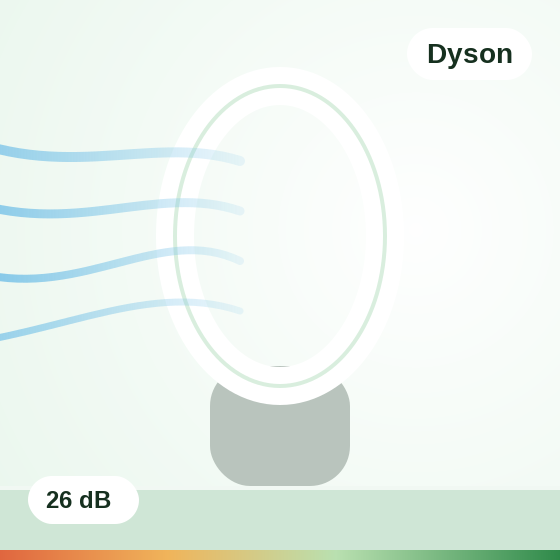
All three retailers give the HF1 a quiet-mode figure of 26 dB in sleep (night) mode: Euronics, Marks Electrical and John Lewis (“Whisper-quiet at 26bB”, as John Lewis prints it). Marks Electrical also lists 57 dB for it with no conditions stated. For the HP1, Marks Electrical gives 63 dB with no conditions, and John Lewis gives none. No retailer says whether these are sound power or sound pressure, so the type is not stated. They are different measures, and a figure of one kind cannot be set against the other.
A sleep-mode figure is for the quietest setting only. We have not read the Dyson manual for either model, so check it before you leave one running overnight or unattended; a heater adds its own cautions. See also the best hot and cold fans.
Hot+Cool against a separate fan and heater
The cost of heating depends on the rated power, not the brand. The HF1 is rated at up to 2,250 W (59.2p an hour); Shark’s TurboBlade Cool + Heat TH200UK is listed at 2,200 W in total (57.9p an hour), also with no fan-only figure; a separate 2,000 W heater, as an example only, would cost 52.6p an hour at the same rate. A separate fan, such as the Dyson Cool CF1 (30 W on Euronics’ listing, 0.8p an hour), adds very little. Whether the Hot+Cool saves money depends on what you would otherwise buy, and we have not found a published figure that shows it does. See the best heating and cooling tower fans.
Purifying claims: only what a listing states
On the HP1, John Lewis and Marks Electrical quote the filter wording above. We add no claim about air quality or health. John Lewis’s HF1 page makes no mention of purification.
Where to buy and the guarantee
We opened John Lewis, Euronics and Marks Electrical on 25 November 2026. Each gave a 2-year guarantee. John Lewis and Euronics both showed the HF1 £70 below its earlier price, so the price may move. For the full range at one retailer, see fans at John Lewis. We could not read Dyson’s own guarantee terms.
Frequently asked questions
Is the Dyson Hot+Cool good for cooling?
It moves air across you like any fan, but it does not lower the room’s temperature. Fans help while the air is below 35C. The NHS says “Electric fans can help if the temperature is below 35 degrees”; UKHSA says use them “if the air temperature is below 35°C” and not to aim them directly at your body. More in our heatwave guide. We found no confirmed fan-only power, so we cannot give its cooling running cost. For a fan that is just a fan, see the Dyson Cool CF1.
How much does the Dyson Hot+Cool cost to run on heat?
The HF1’s maximum of 2,250 W costs 59.2p an hour, or £4.74 for eight hours at full power, at 26.32p per kWh. A thermostat switches the heater off when the room is warm enough, so a real hour is often less. These figures use the Great Britain price cap. In Northern Ireland, use the unit rate on your own bill.
What is the difference between the HF1 and HP1?
The HF1 is a fan heater. The HP1 adds a HEPA H13 filter and activated carbon, 350 degree oscillation, a higher price (£539.98 to £549 against £329 to £329.99) and a higher listed maximum power of 2,362 W. The HP1 is taller and about twice the weight.
Does the Dyson Hot+Cool purify the air?
The HP1 has a filter, which John Lewis describes as HEPA H13 with activated carbon. The HF1’s John Lewis page does not mention purification. We make no health claim.
Is it quiet enough for a bedroom?
Retailers give the HF1 26 dB in sleep mode, but also 57 dB with no conditions, and the type of figure is not stated. We have not read the manual, so check it before leaving one on overnight or unattended. UKHSA says not to aim a fan directly at your body.
Is it cheaper than a normal fan heater?
We found no published figure that shows it is. The running cost follows rated power: the HF1 is rated at up to 2,250 W. Compare the watts of any heater you are considering with the 59.2p-an-hour figure above.
How many speeds does the Dyson HF1 have?
Ten, according to Euronics and Marks Electrical. John Lewis’s page did not give a speed count.
Sources
- John Lewis: Dyson Hot+Cool HF1 Remote Link (checked 25 November 2026)
- Euronics: Dyson HF1 Hot+Cool Remote Link (checked 25 November 2026)
- Marks Electrical: Dyson HF1 Hot+Cool Remote Link (checked 25 November 2026)
- John Lewis: Dyson Hot+Cool HP1 Air Purifier (checked 25 November 2026)
- Marks Electrical: Dyson HP11 Hot and Cool Purifier (HP1) (checked 25 November 2026)
- John Lewis: Fans category (checked 25 November 2026)
- Euronics: Dyson Cool CF1 Cooling Fan (checked 25 November 2026)
- SharkNinja UK: Shark TurboBlade Cool + Heat TH200UK (checked 25 November 2026)
- UKHSA: Beat the heat: staying safe in hot weather (checked 25 November 2026)
- NHS: Heatwave: how to cope in hot weather (checked 25 November 2026)
- Ofgem: Changes to energy price cap between 1 October and 31 December 2026 (checked 25 November 2026)
Other products mentioned
Dyson
Hot+Cool HF1 (White/Silver)
26 dB
£339.66 at Marks Electrical, checked 14 Nov 2026
See it at Marks Electrical
Shark
TurboBlade Cool + Heat TH200UK
£214.99 at SharkNinja UK (maker shop), checked 14 Nov 2026
See it at SharkNinja UK (maker shop)
Figures from the maker or retailer listing. Cost an hour is our own, at the price cap of 26.32p a kWh.