Key takeaways
- Loft conversion air conditioning costs more than a ground floor job (see our air conditioning installation guide for the basics): iHeat adds £100 for an upstairs room, £50 for a high outdoor unit and £120 to £150 for each extra 5 m of pipe, all including VAT.
- By our worked example, a split for a loft bedroom from iHeat comes to about £2,765 to £2,795 including VAT, against £2,495 for its ground floor package.
- Not every installer goes that high: British Gas fits ground and first floor rooms only, and Appliances Direct needs a powered access platform for second and third floor jobs (no price given).
- Lofts need more cooling for their size: our sizing rule adds 20% for a loft or top floor room, and 15% more if it gets direct sun.
- A portable air conditioner, vented through a window, is the option with no installation.
Can you fit air conditioning in a loft conversion?
Yes. A loft conversion can take a split air conditioner like any other room, but the job is usually dearer than a ground floor one because of the height, the longer pipe run and access for the engineer. Some installers do not fit rooms that high at all.
- British Gas says “ground floor and first floor rooms are possible, but not anything higher”, so it will not fit a loft room on the second floor. More in British Gas air conditioning.
- Appliances Direct quotes installation from £800 at 0% VAT for home use on a ground or first floor; on a second or third floor its engineers use a powered access platform, and it gives no price for that.
- iHeat fits upstairs rooms for an extra charge (below).
- Molesey Air’s listed prices are for a single storey back-to-back job, so a loft is a quote after its site inspection.
For the full process and who may fit a system, see our guide to air conditioning installation.
What does loft air conditioning cost?
No source we found publishes a price for a loft room as such. The starting point is a single split. OVO puts one room at £1,500 to £2,500 in its table and £1,500 to £3,500 in its summary (16 June 2026); neither range says whether VAT is included. Then add the extras for height and distance. iHeat is the only installer that lists them, all including VAT. It does not state whether each extra is charged per room, per indoor unit or once per installation:
| Extra (iHeat) | Price | Why it applies to a loft |
|---|---|---|
| Upstairs room | £100 | The room is not on the ground floor |
| Outdoor unit high on a wall | £50 | If the outdoor unit goes on a bracket instead of the ground |
| Extra 5 m of indoor pipework | £120 to £150 | A longer run from the top floor to the outdoor unit |
| Extra 5 m of cable to the fuse box | £50 to £100 | If the fuse box is more than 5 m away |
| Indoor unit on an internal wall | £250 | If the unit cannot go on an outside wall |
Specialist access is quoted separately at iHeat, and no source we read prices scaffolding or a powered access platform.
Our figure: a loft bedroom at iHeat
Take iHeat’s Daikin Sensira 3.5 kW package at £2,495 including VAT, the smallest Sensira it lists. Add an upstairs room (£100), a high outdoor wall mounting (£50) and one extra 5 m of pipe (£120 to £150): £2,495 + £100 + £50 + £120 to £150 = £2,765 to £2,795. Its Bosch Climate 3200i 2.6 kW package, at £2,715 on the same page, is closer to the size a loft bedroom needs (below); with the same extras it comes to £2,985 to £3,015. Neither figure includes extra electrical work or specialist access.
What size does a loft need?
Loft rooms sit under the roof, so they need more cooling than a room of the same size downstairs. Electric Point, an electrical retailer, says to add 10 to 20% for top floor rooms and loft conversions, because poorly insulated roof spaces can be 5 to 10°C hotter than ground floor rooms. Our sizing rule takes 20%, on top of Daikin UK’s starting point of about 0.1 kW per square metre at a 2.4 m ceiling, and adds 15% for a room with large south- or west-facing windows (Daikin gives 10 to 20%).
Worked example. A loft bedroom 4 m x 4 m, with an average ceiling height of 2.4 m and roof windows that get the sun: 4 x 4 x 2.4 = 38.4 m³, which needs 38.4 x 100 ÷ 2.4 = 1,600 W before adjustments. Add 20% for the loft and 15% for the sun: 1,600 x 1.35 = 2,160 W, or about 7,370 BTU per hour. Rounding up to a size that is sold gives 8,000 BTU (2.34 kW), which in split terms means a 2.5 kW unit. Try your own room in our BTU calculator, and see 8,000 BTU air conditioners.
Where does the outdoor unit go?
There are two usual places:
- On the ground, with a longer pipe run down the outside of the house. That costs more pipe (iHeat: £120 to £150 for each extra 5 m), and the run has to stay within the maker’s and installer’s limits, so ask for them.
- On a wall bracket. Costco’s packages allow brackets up to a maximum height of 3 metres, which may not reach a loft; iHeat charges £50 for a high wall mounting.
None of the sources we read covers putting the outdoor unit on a roof. In England, permitted development does not allow an air source heat pump on a pitched roof, and on a flat roof every part must be at least 1 metre from the roof’s outer edge; see planning below.
Portable and no-installation options
A portable air conditioner needs no installer, which avoids every access question above. It vents through a hose, so a loft needs a window the hose can reach: see how to vent a portable air conditioner. For the 8,000 BTU room in our example, the Pro Breeze 9000 BTU (£309.99 at Pro Breeze, maker’s room size 22 m²) and the Meaco MC Pro 9000 (£399.99 at Meaco, 16 to 26 m²) are listed at sizes that cover it; both were out of stock at the maker’s shop on 13 November 2026. A single-hose portable cools less than its rated figure suggests, so do not undersize one for a hot loft. Prices for every size are in portable air conditioner prices.
Planning and building rules
In England, an outdoor unit that heats, or heats and cools, can usually go up without a planning application under permitted development if it meets the limits, which include not being on a pitched roof and, on a wall facing a highway outside a conservation area, not above the ground floor. A unit used only for cooling is not covered and needs planning permission. Flats, listed buildings and conservation areas have tighter rules. See air conditioning planning permission.
A split containing F-gas such as R32 must be fitted by an F-gas qualified engineer (F-gas rules). Most fitted systems that also heat are zero-rated for VAT until 31 March 2027; ask your installer to confirm the VAT basis in writing (VAT on air conditioning).
Frequently asked questions
Can you put air conditioning in a loft conversion?
Yes. A split system can be fitted in a loft room, but some firms will not do it: British Gas fits ground and first floor rooms only. iHeat fits upstairs rooms for an extra £100, and Appliances Direct uses a powered access platform for second and third floor jobs.
How much does loft air conditioning cost?
No source publishes a loft price. Start from a single split (OVO: £1,500 to £2,500 in its table) and add the extras for height and pipe. Our worked example at iHeat comes to £2,765 to £2,795 including VAT for a Daikin Sensira 3.5 kW in a loft bedroom.
What size air conditioner do I need for a loft room?
For a 4 m x 4 m loft bedroom with sun, our rule gives about 7,370 BTU per hour, so an 8,000 BTU unit, or a 2.5 kW split. Our rule adds 20% for a loft or top floor room and 15% for a sunny room.
Where does the outdoor unit go for a loft?
Usually on the ground with a longer pipe run, or on a wall bracket. Costco’s packages allow brackets up to 3 metres high. In England, permitted development rules out a pitched roof.
Will British Gas fit air conditioning in a loft?
No, if the loft is above the first floor. British Gas says ground and first floor rooms are possible, “but not anything higher”.
Is a portable air conditioner enough for a loft?
It can be, if it is sized for the room and the hose can reach a window. A single-hose portable cools less than its rating suggests, so choose one whose maker’s room size covers the loft with room to spare.
Sources
- iHeat: air conditioning packages and extras (checked 14 November 2026)
- British Gas: air conditioning (checked 14 November 2026)
- Appliances Direct: air conditioner installation (checked 14 November 2026)
- Molesey Air: prices (checked 14 November 2026)
- OVO: air conditioning installation cost (16 June 2026) (checked 14 November 2026)
- Costco: installed Daikin Sensira 3.5 kW, domestic (checked 14 November 2026)
- Electric Point: portable air conditioning units, UK buying guide (checked 14 November 2026)
- Daikin UK: air conditioner size guide (checked 14 November 2026)
- Pro Breeze: 9000 BTU 3-in-1 smart portable air conditioner (checked 13 November 2026)
- Meaco: MeacoCool MC Pro 9000 CH (checked 13 November 2026)
- legislation.gov.uk: General Permitted Development Order 2015, Schedule 2, Part 14, Class G (air source heat pumps) (checked 14 November 2026)
- GOV.UK: qualifications required to work on equipment containing F gas (updated 3 March 2026) (checked 14 November 2026)
- HMRC: VAT on energy-saving materials and heating equipment, Notice 708/6 (updated 31 January 2024) (checked 14 November 2026)
Products on this page
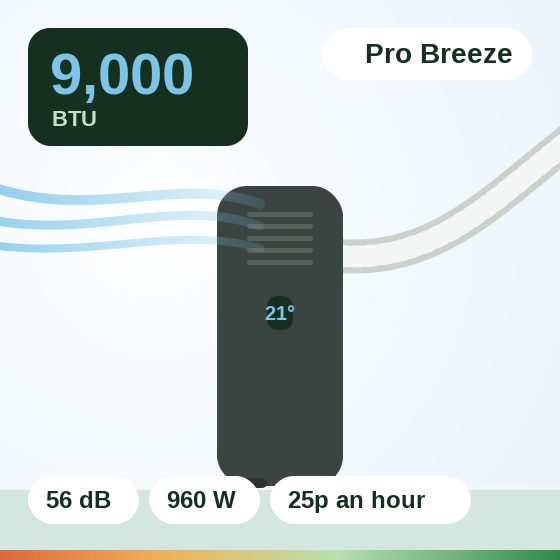
Pro Breeze
9000 BTU 3-in-1 Portable Air Conditioner with Dehumidification Function, Smart Wifi App (PB-AC-01)
9,000 BTU · 56 dB · 960 W · 25p an hour
£309.99 at Pro Breeze (maker shop), checked 13 Nov 2026
See it at Pro Breeze (maker shop)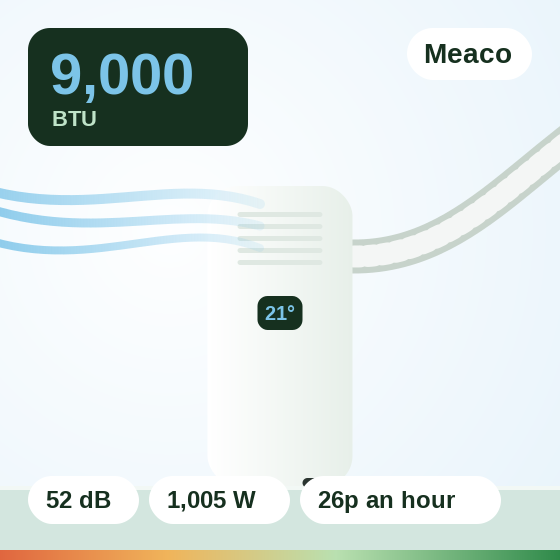
Meaco
MeacoCool MC Series Pro 9000 CH BTU Portable Air Conditioner & Heater (MC9000CHRPRO)
9,000 BTU · 52 dB · 1,005 W · 26p an hour
£399.99 at Meaco (maker shop), checked 13 Nov 2026
See it at Meaco (maker shop)
Figures from the maker or retailer listing. Cost an hour is our own, at the price cap of 26.32p a kWh.