Key takeaways
- A mini dehumidifier uses a thermoelectric (Peltier) plate instead of a compressor. It is light, quiet and cheap to run, but it removes about a cupful of water a day: Pro Breeze’s manuals give 250 ml and 500 ml a day at 30C and 80% humidity. Our dehumidifier guide compares the types.
- The makers’ minis work only from 15C, so they are no help in a cold room.
- They suit a wardrobe, cupboard or small storage room, but both Pro Breeze manuals say “Never leave the appliance unattended while in use”, so switch one off when you go out or to bed. For a damp bedroom, a small compressor unit removes several litres a day.
- At the same 30C and 80% test conditions, the Meaco Arete One 6L removes about four times as much water for each unit of electricity as the Pro Breeze 1500ml Mini (on Meaco’s measured power, and a 40 W we read from Pro Breeze’s page figure of 0.04 kWh, since Pro Breeze gives no rated power in watts).
- We chose on makers’ documents and have not tested any unit.
A mini dehumidifier is a small plug-in box (the two here weigh about 1 to 2 kg) that draws air over a cold electronic plate and collects the water in a small tank. It costs very little to run, and it removes very little water. For the full range of types, see our dehumidifier guide.
What is on this list and in what order: every Peltier (thermoelectric) dehumidifier in our product data whose maker states how much it removes and at what conditions, with a UK price on 14 November 2026, listed by that stated extraction, highest first. That order is not a ranking by us. Two units meet it, both from Pro Breeze. Below the list, a short table shows when a small compressor unit is the better buy.
The list
| Unit | Extraction (maker’s conditions) | Tank | Power | Per hour | Lowest noise | Works from | Weight | Price |
|---|---|---|---|---|---|---|---|---|
| Pro Breeze 1500ml Mini | about 0.5 L a day (30C, 80%) | 1.5 L | 40 W (page figure: 0.04 kWh, read as an hour) | 1.1p | 40 dB | 15C | 1.85 kg | from £40.99 at Pro Breeze, checked 14 November 2026 |
| Pro Breeze 500ml Mini | about 0.25 L a day (30C, 80%) | 0.5 L | Not stated in watts | Not worked out | 33 dB | 15C | 1.04 kg | from £39.99 at Pro Breeze, checked 14 November 2026 (out of stock that day) |
Costs use Ofgem’s average unit rate for Great Britain, 26.32p per kWh for 1 October to 31 December 2026 (no VAT is charged on electricity in that period). These figures use the Great Britain price cap. In Northern Ireland, use the unit rate on your own bill.
How we chose
- The maker states the extraction and its conditions. Many minis sold online give a tank size but no daily figure, or none of the test conditions. A tank size is not an extraction rate: the 1500ml Mini’s tank holds 1.5 litres but the unit removes about 0.5 litres a day.
- Power from the maker, and a cost per hour only where a power figure is stated, at Ofgem’s average unit rate for Great Britain, 26.32p per kWh for 1 October to 31 December 2026.
- On sale in the UK on the day checked, with the price and date.
- We have not tested these units. Only two minis met these rules on the day; we would rather list two with stated figures than pad the list.
How a Peltier mini dehumidifier works
Pro Breeze’s manuals describe the cooling element as a “Thermo-Electric Peltier Module” with a brushless fan, and say the units use “Peltier Technology (no compressor) making it lightweight and quiet”. A Peltier module is a solid-state plate that goes cold on one side when current flows. Air blown over the cold side drops its moisture as condensation, which drips into the tank. When the tank is full, the 1500ml Mini’s manual says, the light turns yellow and the unit switches off.
With no compressor, there is far less cooling power, which is why the water removed is measured in millilitres, not litres. Pro Breeze’s own manuals describe these minis as suited to small rooms and poorly ventilated areas “such as wardrobes, cabinets and storage rooms”. Our guide to how a dehumidifier works compares the mechanisms.
Pro Breeze 1500ml Mini
Who it suits: a wardrobe, a cupboard under the stairs or a small storage room in a heated home, run while you are in.
Key specs (Pro Breeze manual and product page):
- About 500 ml a day at 30C and 80% humidity (manual)
- 1.5 litre tank; switches off when full
- 40 W, our reading of the page’s “Energy Consumption 0.04 kWh” as the use in an hour; Pro Breeze gives no rated power in watts
- 40 dB; 40 m3 an hour of airflow
- Works from 15C to 35C; 1.85 kg (manual)
Running cost: 40 W is 0.04 kW, so an hour uses 0.04 kWh, which costs 1.1p at 26.32p per kWh. As a ceiling, a full 24 hours would use 0.96 kWh and costs 25.3p, for up to half a litre of water at the maker’s warm, humid test conditions.
What to watch for: its manual says “Never leave the appliance unattended while in use”, so do not leave it running in a wardrobe while you are out or asleep; that also holds for the 500ml Mini below and every other Pro Breeze dehumidifier manual we have read. Pro Breeze’s page gives a room size of up to 20 m2 and a “Capacity 12L” row that does not match the unit; we use the manual’s 500 ml a day. In a room cooler and drier than 30C and 80%, it will remove less. One-year warranty.
Where to buy: from £40.99 at Pro Breeze , checked 14 November 2026 (in stock that day). See all Pro Breeze dehumidifiers.
Pro Breeze 500ml Mini
Who it suits: one wardrobe or cabinet where silence matters more than capacity. It is the quieter of the two, at 33 dB.
Key specs (Pro Breeze manual and product page):
- About 250 ml a day at 30C and 80% humidity (manual)
- 0.5 litre tank
- Power: a 9 V, 2.5 A adaptor; no rated power in watts is given
- 33 dB; works from 15C to 30C; 1.04 kg (manual)
Running cost: not worked out, because Pro Breeze gives no rated power in watts. Its page says it costs “less than 1p an hour”.
What to watch for: its manual (PB-02) carries the same “Never leave the appliance unattended while in use” line. It was out of stock at Pro Breeze on 14 November 2026. The page’s “up to 20 m2” room size is the maker’s claim for a unit that removes about a quarter of a litre a day at 30C and 80%; do not expect it to dry a room of that size. One-year warranty.
Where to buy: from £39.99 at Pro Breeze , checked 14 November 2026 (out of stock that day).
When to buy a small compressor unit instead
If the problem is a damp bedroom, condensation on the windows each morning or washing drying indoors, a mini will not keep up. A small compressor unit removes litres a day:
| Unit | Water removed (maker’s conditions) | Power | Per hour | Per 24 hours | Price |
|---|---|---|---|---|---|
| Pro Breeze 1500ml Mini | about 0.5 L (30C, 80%) | 40 W (page figure) | 1.1p | 25.3p | £40.99 |
| Meaco Arete One 6L | 6.52 L (30C, 80%, measured at 121 W); 2.63 L (20C, 60%, at 101 W) | 121 W measured at 30C, 80%; 101 W rated | 3.2p at 121 W; 2.7p at 101 W | 76.4p at 121 W; 63.8p at 101 W | £129.99 |
| Pro Breeze 6L Compact | 6 L (conditions not stated) | 150 W | 3.9p | 94.8p | £74.99 |
Prices are from Meaco and Pro Breeze, checked 14 November 2026. The power figures are of different kinds: Meaco’s 121 W was measured at 30C and 80%, its 101 W is the rated figure, and Pro Breeze’s are a manual’s rated power (6L Compact) or our reading of a page figure (1500ml Mini). The 24-hour figures are ceilings: a compressor unit with a humidistat switches off when the room is dry enough.
Litres per kWh at the same conditions. At 30C and 80%, the 1500ml Mini removes about 0.5 litres for 0.96 kWh a day on Pro Breeze’s page figure, which is 0.52 litres per kWh. Meaco’s table for the Arete One 6L gives 6.52 litres a day at 30C and 80% for 121 W measured, which is 2.904 kWh a day and 2.25 litres per kWh. The power figures are of different kinds (one measured by Meaco, one read from Pro Breeze’s page), so treat the gap as a rough guide: the compressor unit removes about four times as much water for each unit of electricity, and about thirteen times as much water a day.
The Meaco Arete One 6L, from £129.99 at Meaco , also works from 5C, where the minis stop at 15C. The Pro Breeze 6L Compact, from £74.99 at Pro Breeze , is the cheapest compressor unit in our library. Both are on our small dehumidifiers list, and the quietest bedroom options are on the best dehumidifiers for a bedroom. If price is the main concern, see cheap dehumidifiers.
When a moisture trap is enough
For a cupboard, a wardrobe or a caravan in storage with no socket, a moisture trap uses no electricity at all. Unibond says one Aero 360 tab absorbs up to 1 litre of moisture and lasts 1 to 3 months in a room of 20 m2. That is slower than a mini running all day, but it is silent and needs no plug. See disposable dehumidifiers and moisture traps and do dehumidifier bags work?
Frequently asked questions
Do mini dehumidifiers work?
They do remove water, but not much. Pro Breeze’s manuals give about 250 ml and 500 ml a day at 30C and 80% humidity, a warm, very humid test room. That suits a wardrobe or cupboard; it will not dry a damp bedroom.
How much water does a mini dehumidifier collect?
On the makers’ figures, a quarter to half a litre a day at 30C and 80%, and less in a cooler, drier room. The tank size, such as 1.5 litres, is how much it holds, not how much it collects in a day.
Can a mini dehumidifier stop mould?
We make no such claim. A mini removes a small amount of water from the air, and GOV.UK’s damp and mould guidance does not mention dehumidifiers. It says simply removing surface mould will not stop it coming back. If you rent and have persistent damp or mould, raise it with your landlord.
Are mini dehumidifiers cheap to run?
Per hour, yes: the Pro Breeze 1500ml Mini costs 1.1p an hour at the 40 W we read from its page, at the price cap. Per litre of water removed it is poor value next to a compressor unit, which removes about four times as much for each unit of electricity at the same test conditions (on our reading of the Mini’s power).
Can I use a mini dehumidifier in a cold room?
Not below 15C, which is where Pro Breeze says its minis start working. For a cold room, look at a desiccant unit, which the makers rate to work from 1C: see desiccant dehumidifiers.
Mini dehumidifier or moisture trap?
A mini needs a socket and a room above 15C, and removes up to about half a litre a day at its test conditions. A moisture trap needs no power and absorbs up to about a litre over 1 to 3 months, by Unibond’s figures. For a wardrobe with a socket nearby that you can run while you are at home, a mini works faster (Pro Breeze’s manuals say never to leave its minis unattended while in use); for a space with no power, or one you want treated while you are away, a trap.
Sources
- Pro Breeze: 1500ml Mini dehumidifier (checked 14 November 2026)
- Pro Breeze: 1500ml Mini (PB-03) instruction manual (checked 15 November 2026)
- Pro Breeze: 500ml Mini dehumidifier (checked 14 November 2026)
- Pro Breeze: 500ml Mini (PB-02) instruction manual (checked 15 November 2026)
- Pro Breeze: 6L Compact dehumidifier (checked 14 November 2026)
- Pro Breeze: Warranty policy (checked 14 November 2026)
- Meaco: MeacoDry Arete One 6L (checked 14 November 2026)
- Unibond: Aero 360 device (checked 14 November 2026)
- GOV.UK: Understanding and addressing the health risks of damp and mould in the home (checked 14 November 2026)
- Ofgem: Changes to energy price cap between 1 October and 31 December 2026 (checked 14 November 2026)
Other products mentioned
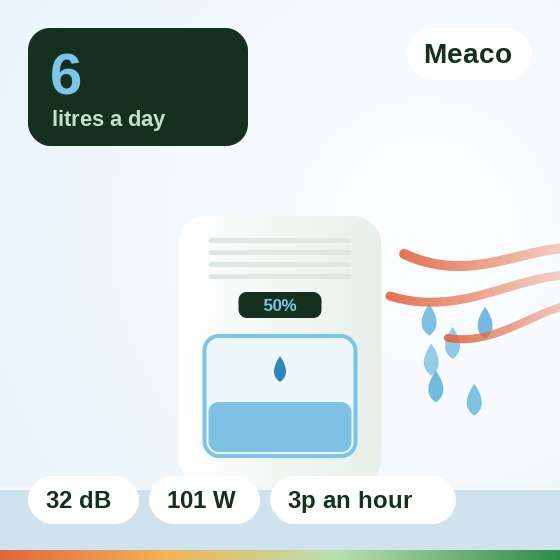
Meaco
MeacoDry Arete One 6L Compact Dehumidifier / Air Purifier
6 litres a day · 32 dB · 101 W · 3p an hour
£129.99 at Meaco (maker shop), checked 14 Nov 2026
See it at Meaco (maker shop)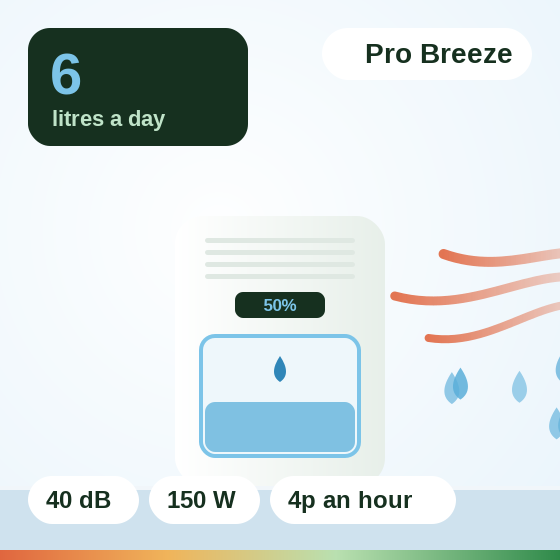
Pro Breeze
6L Compact Dehumidifier (PB-D-26)
6 litres a day · 40 dB · 150 W · 4p an hour
£74.99 at Pro Breeze (maker shop), checked 14 Nov 2026
See it at Pro Breeze (maker shop)
Unibond
Aero 360 Moisture Absorber with Refill Tab (450g)
20 m²
No current UK price found
Figures from the maker or retailer listing. Cost an hour is our own, at the price cap of 26.32p a kWh.