Key takeaways
- Before you buy an air conditioner, check five things: the type, the size in BTU, the running cost, where the hose or pipes go, and the warranty and returns terms.
- Size comes first: a 5 x 4 m living room with a 2.4 m ceiling, sun-facing windows and four people needs about 9,076 BTU, so you would buy 10,000 BTU.
- Running cost is watts divided by 1,000, times your unit rate: the 1,120 W Meaco MeacoCool MC Pro 10000 costs 29.5p an hour at the 26.32p price cap.
- Compare noise as sound pressure with sound pressure, and note which mode the maker’s figure is for.
- Stock is seasonal, so a price is only meaningful with its date.
Buying an air conditioner goes wrong in predictable ways: a unit too small for the room, a hose with nowhere to go, or a noise figure measured in a mode you will never use. Work through the eight steps below, then use the checklist at the end. This guide sits under our portable air conditioner guide; for the choice between types, see air conditioning units: every type explained. We have not tested any unit; figures come from makers’ and retailers’ own pages.
Step 1: choose the type
- Portable. Plugs into a socket and vents a hose through a window. No installer, no outdoor unit, the easiest to buy and the dearest to run. See portable air conditioners.
- Portable split. An indoor unit with a small outdoor unit joined by a pre-filled line, and no hose. The Midea PortaSplit is the example on UK sale; whether the GB F-gas rules treat it as a movable unit or a split is something we could not confirm, so ask the seller before you buy.
- Fitted split. Indoor and outdoor units installed by an F-gas certified company. The cheapest to run and the quietest indoors, with an installation cost on top. See split air conditioners.
If you are unsure, the unit guide has a decision table.
Step 2: work out the size
Our rule: multiply the room’s volume in cubic metres by 100 and divide by 2.4 to get watts of cooling, add for sun, a loft, a kitchen or a conservatory and for people beyond two, multiply by 3.412 for BTU per hour, and round up to the next size sold. The rule comes from Daikin UK’s guidance of about 0.1 kW per square metre at a 2.4 m ceiling.
Worked example: a living room of 5 x 4 m with a 2.4 m ceiling is 48 cubic metres. 48 x 100 / 2.4 = 2,000 W. Sun-facing windows add 15%, giving 2,300 W, and two people beyond the first two add 360 W, giving 2,660 W, which is 9,076 BTU. Round up and you buy 10,000 BTU.
Check the maker’s own room size as well. Single-hose portables cool less than their rated BTU suggests, and makers’ room figures are often smaller than ours: Meaco gives 18 to 28 m2 for its 10,000 BTU MC Pro, where our rule gives 29.3 m2 with no adjustments. If the maker’s figure does not cover your room, go up a size. The BTU calculator does the sums, and how many BTU do I need? explains each adjustment.
Step 3: check the running cost
Cost per hour is the rated input power in kilowatts times the unit rate. For the Meaco MeacoCool MC Series Pro 10000 CH: 1,120 W is 1.12 kW, which costs 29.5p an hour at the October to December 2026 price cap of 26.32p per kWh. Eight hours is £2.36. Our standard summer of 350 hours (an assumption, not a forecast) is 392 kWh, or £103.17.
These figures use the Great Britain price cap. In Northern Ireland, use the unit rate on your own bill. The standing charge is left out, and a unit with an inverter compressor usually draws less than its rated power once the room is cool, so a figure from watts is an upper estimate for it. Air conditioning running costs covers every type.
Energy labels. Portables are labelled by EER, measured at one test point: class A is 2.60 to under 3.10, A+ is 3.10 to under 3.60, A++ 3.60 to under 4.10 and A+++ 4.10 or more. Splits are labelled by SEER, a seasonal figure on a different scale: A++ is 6.10 to under 8.50 and A+++ is 8.50 or more. Never compare the letters across the two types: a portable’s A is not a split’s A.
Step 4: check where the hose goes
A portable needs somewhere to send its hot air, and the window is the easy answer. Look for the hose length (Meaco lists 1.8 m on its MC Pro and Cirro models, Woods 1.5 m on the Cortina Silent), the window type the kit suits, and whether you have a window near a socket at all. Keep the hose short and straight, and seal every gap. For no window, read how to vent a portable air conditioner; a unit sold as needing no hose and no outdoor part may be an air cooler, which has no compressor, so check which it is.
Step 5: check the noise figure and its mode
Makers quote two different numbers. Sound pressure in dB(A) is roughly what you hear about a metre away, and the lowest figure is usually a quiet or sleep mode. Sound power in dB is the energy label figure and is always higher. For example, the Meaco Cirro 12000 gives 45 dB in Super Quiet mode (sound pressure) and 51 dB sound power on its energy fiche. The Woods Cortina Silent lists 49.2 to 64 dB on its retailer listing, depending on fan speed. De’Longhi gives 47 to 50 for the PAC EL110 without printing a unit. When two units quote different things, do not rank them against each other.
Step 6: warranty, returns and support
| Unit | Warranty | Source |
|---|---|---|
| Meaco (MC Pro 10000, Cirro 12000) | Two years parts and labour, extendable to five | Meaco product pages, 13 November 2026 |
| Woods Cortina Silent WAC12G | Three years on the listing (the brand text also says “up to 10 years with product registration”) | Appliances Direct listing, 14 November 2026 |
| De’Longhi Pinguino PAC EL110 | Two years | De’Longhi UK page, 14 November 2026 |
| Pro Breeze portables | Not stated on the product pages or in the manuals’ specification tables we read |
Returns depend on the seller, not the maker. Appliances Direct, for example, says you can return an order within 30 days from the day after delivery and that you arrange and pay for the courier (faulty items excepted); Homebase says online purchases must be reported within 14 days of receipt. Read the seller’s returns page before you pay, and check whether a large item can go back to a shop. Our where to buy guide compares what each seller says.
Step 7: stock and timing
Portable air conditioners are seasonal stock. Most of the units we checked in mid-November 2026 were listed as out of stock, so a price on this site always carries the date we read it. Check stock on the day, and see our air conditioner deals and sales page and the where to buy a portable guide. Thinking of a used or refurbished unit? Read the second hand guide first.
Step 8: for fitted systems, get quotes
A split must be installed by a company that holds F-gas certification, and the outdoor unit may need planning permission if it is used only for cooling. Ask for at least two written quotes that name the unit, the pipe run and what is included; see how to get an air conditioning quote, the planning permission guide and what installation costs. For the price of the unit itself, see how much an air conditioning unit costs.
Checklist
- Pick the type: portable, portable split or fitted split.
- Size by the rule, round up, and check the maker’s own room figure.
- Multiply the watts by your unit rate, and read the energy label on its own scale.
- Confirm the hose length, the window and the socket.
- Note the noise figure and its mode.
- Read the warranty and the seller’s returns terms.
- Check stock and the date of the price.
- For a split, get written quotes from an F-gas certified company.
For the models themselves, see the best portable air conditioners.
Frequently asked questions
What should I look for when buying an air conditioner?
Check the type, the size in BTU for your room, the running cost in pence per hour, where the hose or pipes will go, the noise figure and its mode, and the warranty and returns terms. The checklist above puts them in order.
How do I know what size air conditioner to buy?
Multiply the room’s volume in cubic metres by 100 and divide by 2.4 to get watts, add for sun, loft, kitchen or extra people, convert to BTU and round up. A 5 x 4 m sun-facing living room with four people comes to 9,076 BTU, so you would buy 10,000 BTU.
Is it better to buy a portable or a split air conditioner?
A split is cheaper to run and quieter indoors but needs an installer; a portable costs nothing to install but is less efficient. If you rent or cannot drill a wall, a portable is usually the practical choice. See the unit guide.
What does the energy label on an air conditioner mean?
It shows an efficiency class. Portables are labelled by EER (class A is 2.60 to under 3.10) and splits by SEER (class A++ is 6.10 to under 8.50), which are different scales, so a portable’s A and a split’s A++ are not comparable.
How long is the warranty on an air conditioner?
It varies by maker: two years for Meaco, Midea and De’Longhi on the pages we read, and three years for the Woods Cortina Silent on its retailer listing. Appliances Direct says all new goods it sells have at least 12 months’ warranty. Pro Breeze does not state a term in the places we looked.
When is the cheapest time to buy an air conditioner?
We cannot say from our data: stock is seasonal, and when we checked in mid-November 2026 most portables were listed as out of stock, so there was little price to compare. Check our deals page and the date on any price before you buy.
Sources
- Ofgem: Changes to energy price cap between 1 October and 31 December 2026 (checked 14 November 2026)
- legislation.gov.uk: Regulation (EU) No 626/2011, Annex II, energy efficiency classes (checked 14 November 2026)
- Daikin UK: Air conditioner size guide (checked 14 November 2026)
- Meaco: MeacoCool MC Series Pro 10000 CH (checked 13 November 2026)
- Meaco: Cirro 12000 BTU Super Quiet Smart (checked 13 November 2026)
- EPREL product fiche 2756020, Meaco Cirro 12000 (checked 14 November 2026)
- De’Longhi UK: Pinguino PAC EL110 ERF WiFi (checked 14 November 2026)
- Appliances Direct: Woods Cortina Silent WAC12G (checked 14 November 2026)
- Appliances Direct: customer service (checked 14 November 2026)
- Homebase: returns and refunds (checked 14 November 2026)
- Midea UK: PortaSplit (checked 14 November 2026)
- GOV.UK: Certification for companies working on equipment containing F gas (checked 14 November 2026)
- Planning Portal: air source heat pump permitted development (England) (checked 14 November 2026)
Products on this page
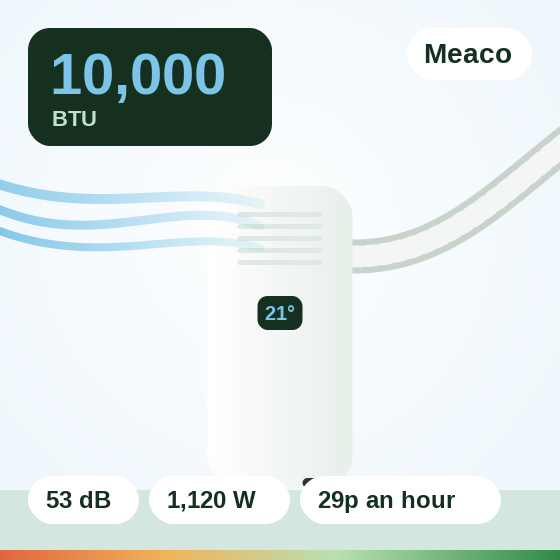
Meaco
MeacoCool MC Series Pro 10000 CH BTU Portable Air Conditioner & Heater (MC10000CHRPRO)
10,000 BTU · 53 dB · 1,120 W · 29p an hour
£429.99 at Meaco (maker shop), checked 13 Nov 2026
See it at Meaco (maker shop)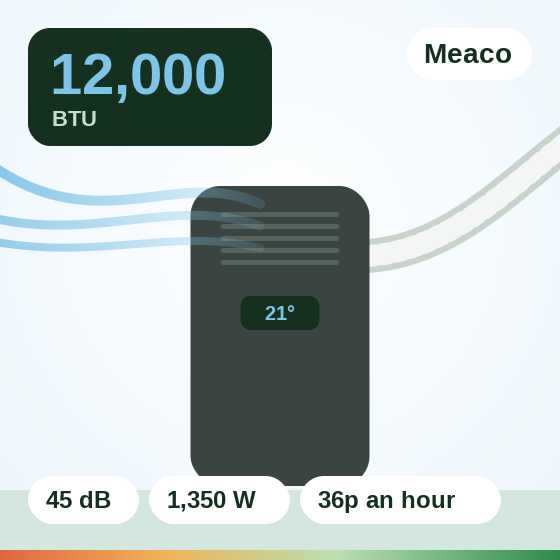
Meaco
Cirro 12000 BTU Super Quiet Smart Portable Air Conditioner & Heater (A-Cirro-12K-CH)
12,000 BTU · 45 dB · 1,350 W · 36p an hour
£539.99 at Meaco (maker shop), checked 13 Nov 2026
See it at Meaco (maker shop)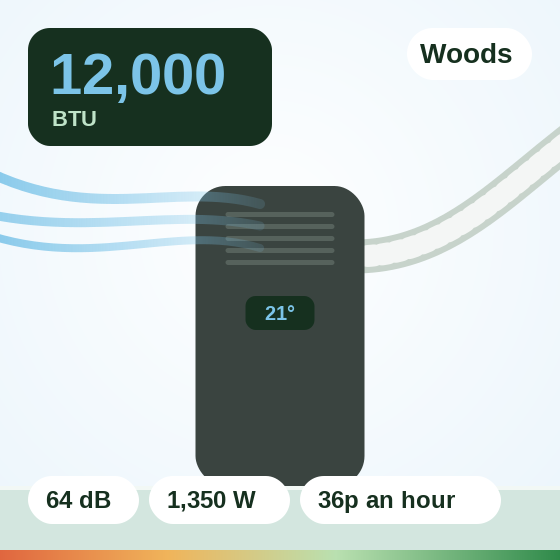
Woods
Cortina Silent 12000 BTU Quiet Portable Air Conditioner (WAC12G)
12,000 BTU · 64 dB · 1,350 W · 36p an hour
£499.97 at Appliances Direct, checked 13 Nov 2026
See it at Appliances Direct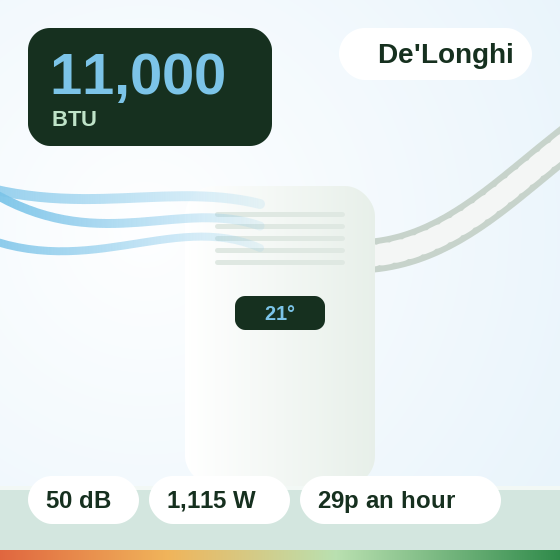
De'Longhi
Pinguino PAC EL110 ERF WiFi
11,000 BTU · 50 dB · 1,115 W · 29p an hour
£799.99 at De'Longhi UK (maker shop), checked 14 Nov 2026
See it at De'Longhi UK (maker shop)
Figures from the maker or retailer listing. Cost an hour is our own, at the price cap of 26.32p a kWh.