Key takeaways
- An air circulator is a fan built to move air around a whole room rather than to blow a broad breeze at one person. It is one type of cooling fan, not a different technology.
- Like any fan, it moves air and cools you, not the room. It does not lower the air temperature.
- The four circulators on this page draw 24 to 32 W at full speed, which is 0.6p to 0.8p an hour at 26.32p per kWh.
- Several Meaco circulators publish a lowest-speed power, as low as 8 to 9.5 W, so a night on the lowest setting costs 1.7p to 2.0p.
- Fans help while the air is below 35C: this is NHS and UKHSA advice, covered below.
An air circulator fan is a fan designed to push air in a tight, fast stream so that it travels across a room and keeps all the air moving, instead of giving a wide, gentle breeze at close range. This page explains what that means, how circulators differ from the tower, pedestal, desk and floor fans you already know, and what the ones on this page cost to run. We have not tested any fan: the figures come from makers’ published pages and manuals, with sources at the end. For every fan type side by side, see electric fans: every type explained.
What is an air circulator?
The name describes the job. An ordinary fan is aimed at you. An air circulator is aimed at the room: you point it at a wall, a ceiling or a far corner, and the moving air carries on around the room and back. The ones on this page swing both from side to side and up and down. Meaco’s manual for the MeacoFan 1056 gives swing angles of 60 degrees vertically and 80 degrees horizontally, and its product page gives the Sefte 10” up to 120 degrees horizontally and up to 65 degrees vertically.
There is no legal or technical definition of an “air circulator” that separates it from a fan. Makers use the word for fans designed around that job. In the eyes of GB ecodesign rules they are all comfort fans, so makers must publish the same set of figures for them: maximum airflow, power input, a service value (airflow per watt), standby power, sound power and maximum air velocity (Regulation (EU) No 206/2012 as it applies in Great Britain, Annex I). Higher service value means more air per watt.
The description above is ours, based on the makers’ published oscillation and airflow figures.
Air circulator or ordinary fan: the difference
| Air circulator | Ordinary desk, pedestal or tower fan | |
|---|---|---|
| Aim | At a wall, ceiling or into the room | At you |
| Airflow | A narrower, faster jet that travels further | A wider, gentler breeze at close range |
| Oscillation | Often both side to side and up and down | Side to side on many models; check the listing |
| Best for | Keeping the air moving across a whole room | Cooling one person who is sitting or lying in front of it |
| Price | £59.99 to £179.99 for the four on this page | From £16.99 (Daewoo’s 16 inch pedestal) on our hub pages |
| Running cost | 24 to 32 W (full speed) on this page | 20 to 50 W on our hub pages |
The practical difference is where you point it. If you want a breeze on your face at a desk, either works. If you want the air in a bedroom or living room to stop sitting still, a circulator pointed at a wall gives it a better chance. Our tower fan vs pedestal fan page covers the other deciding factors between everyday types.
Does an air circulator cool a room better?
No fan cools the air. The US Department of Energy says ceiling fans “cool by creating a wind chill effect” (a US government source about ceiling fans, but any fan works this way): moving air takes heat from your skin faster. What changes is how warm you feel, not the room temperature.
So an air circulator is not a cheaper air conditioner. What it can do better than a basic fan is spread that wind chill: because the air keeps moving, you feel it wherever you sit, not only in a narrow cone. Fans help while the air is below 35C. The NHS says “Electric fans can help if the temperature is below 35 degrees”; UKHSA says use them “if the air temperature is below 35°C” and not to aim them directly at your body. Heat-health advice belongs on our UK heatwave guide; for a fan against air conditioning, see fan vs air conditioner.
What does an air circulator cost to run?
Here is the working once, for the MeacoFan 1056: the fan is rated at 24 W, which is 0.024 kW. An hour uses 0.024 kWh, which costs 0.6p at 26.32p per kWh. Eight hours costs 5.1p. A 1,000 W portable air conditioner costs 26.3p for one hour, the same as about 42 hours of this fan.
Meaco’s manual for the 1056 gives a power consumption of 9.5 to 23.5 W, so at its lowest speed it draws 9.5 W. That is 0.0095 kW, so an eight-hour night costs 2.0p.
| Air circulator | Rated power | Per hour | Per 8-hour night | Hours for the cost of 1 hour of a 1,000 W portable air conditioner |
|---|---|---|---|---|
| MeacoFan 1056 (desk) | 24 W (lowest 9.5 W) | 0.6p | 5.1p (lowest 2.0p) | 41.7 |
| Meaco Sefte 10” (pedestal) | 26 W (lowest 8 W) | 0.7p | 5.5p (lowest 1.7p) | 38.5 |
| Pro Breeze AirFlo Mini 11” (desk) | 28 W | 0.7p | 5.9p | 35.7 |
| Pro Breeze AirFlo Plus 44” (pedestal) | 32 W | 0.8p | 6.7p | 31.3 |
The figures are at the maker’s stated power, normally top speed; most fans use less on a lower setting. The unit rate is Ofgem’s Great Britain average for 1 October to 31 December 2026 and leaves out the standing charge. These figures use the Great Britain price cap. In Northern Ireland, use the unit rate on your own bill. Pro Breeze states “Energy Consumption 0.032 kWh” for the AirFlo Plus, which is per hour of use, so 32 W; its AirFlo Mini states 0.028 kWh, so 28 W.
Examples to look at
These four are examples, not a ranking: two desk and two pedestal circulators from our product library, each a current model sold as a circulator with a power figure published by its maker. Prices are as listed on 14 November 2026. Many fans were listed out of stock that day, so check the listing.
MeacoFan 1056. A desk circulator with 12 speeds, remote, 12-hour timer, 1,056 m3/h airflow. Warranty: two years, on the product page (read 14 November 2026) and in the manual, which says “a two-year manufacturer’s warranty on your air circulator from the date of purchase” (checked 15 November 2026). Meaco quotes noise “from 29 dB”, the quietest setting, and gives no distance or type. From £99.99 at Meaco , listed in stock on 14 November 2026. There is also a pedestal version, covered in our MeacoFan 1056P review and our MeacoFan 1056 review.
Meaco Sefte 10” pedestal. Height adjustable between 591 mm (table), 820 mm and 1,100 mm, 12 speeds, 1,150 m3/h, Normal, Eco and Night modes, remote, 12-hour timer, noise “from 25 dB” (type not stated). Warranty: Meaco’s manual says a “three-year manufacturer’s warranty on your air circulator from the date of delivery” (checked 15 November 2026); its product page showed two years when we read it on 14 November 2026; check which applies when you buy. From £179.99 at Meaco , listed in stock on 14 November 2026.
Pro Breeze AirFlo Plus 44”. A pedestal circulator that converts to desk height, remote, 9-hour timer, maker’s noise figure 50 dB (a single figure, setting not stated), room size “up to 30 m2” (the maker’s claim, untested). From £169.99 at Pro Breeze , out of stock on 14 November 2026.
Pro Breeze AirFlo Mini 11”. A desk circulator, three speeds, maker’s noise figure 54 dB. From £59.99 at Pro Breeze , out of stock on 14 November 2026.
For all the Meaco and Pro Breeze fans we list, see our Meaco fans and Pro Breeze fans pages. Noise figures from different makers are different kinds of measurement: “from 25 dB” is the quietest setting with its type not stated, Pro Breeze’s are single figures with no setting, and Meaco’s manuals give sound power. Sound power and sound pressure are different measures, and a figure of one kind cannot be set against a figure of the other, so do not rank circulators by them. Quiet claims are the makers’ own.
Where to put an air circulator
Put it low or at mid height across the room from where you sit, and aim it at a wall or the ceiling rather than at yourself. Keep the cable out of walkways and use the maker’s manual for safety rules: for example, Pro Breeze’s manual for its 30” tower says not to use the appliance while sleeping or near a sleeping person, so read the manual of any fan you plan to run in a bedroom.
Frequently asked questions
Is an air circulator better than a fan?
It depends on the job. A circulator is better at keeping the air moving across a whole room; an ordinary fan aimed at you is just as good for cooling one person at a desk. Neither lowers the air temperature, and the circulators on this page cost more to buy than a budget fan.
Can an air circulator replace air conditioning?
No. A circulator moves air and cools you through wind chill; an air conditioner removes heat from the room. At 24 to 32 W a circulator costs under 1p an hour, against 26.3p for a 1,000 W portable air conditioner. See fan vs air conditioner.
Where should you put an air circulator?
Aim it at a wall, the ceiling or a far corner so the air carries around the room, rather than directly at your body. UKHSA says not to aim a fan directly at your body as this can lead to dehydration.
Are air circulators quiet?
Makers say some are: Meaco quotes “from 25 dB” for the Sefte 10” and “from 29 dB” for the MeacoFan 1056, while Pro Breeze gives 50 dB and 54 dB for its two. These are different kinds of figure, so we cannot rank them against each other. Quiet claims are the maker’s own, and noise rises with speed.
Sources
- Ofgem: changes to the energy price cap, 1 October to 31 December 2026 (checked 14 November 2026)
- UKHSA: Beat the heat, staying safe in hot weather (updated 21 July 2026) (checked 14 November 2026)
- NHS: Heatwave, how to cope in hot weather (reviewed 12 June 2026) (checked 14 November 2026)
- US Department of Energy: Energy Saver Guide 2022 (a US government source; checked 14 November 2026)
- Regulation (EU) No 206/2012 as it applies in Great Britain, Annex I (checked 14 November 2026)
- Pro Breeze: PB-F-23 30” tower fan instruction manual (checked 14 November 2026)
- Meaco: MeacoFan 1056 instruction manual (Nov 2022) (power 9.5 to 23.5 W, service value 0.62, swing angles, warranty; checked 15 November 2026)
- Meaco: Sefte pedestal instruction manual (UK03, May 2024) (power 8 to 26 W, service value 0.7, warranty; checked 15 November 2026)
- Meaco: MeacoFan 1056 air circulator and Sefte 10” pedestal air circulator product pages (could not be re-opened on 14 November 2026; price, stock, noise and oscillation as recorded in our product files, checked 14 November 2026)
- Pro Breeze: AirFlo Plus 44” hybrid pedestal fan and AirFlo Mini 11” turbo fan: recorded in our product files, checked 14 November 2026
Products on this page
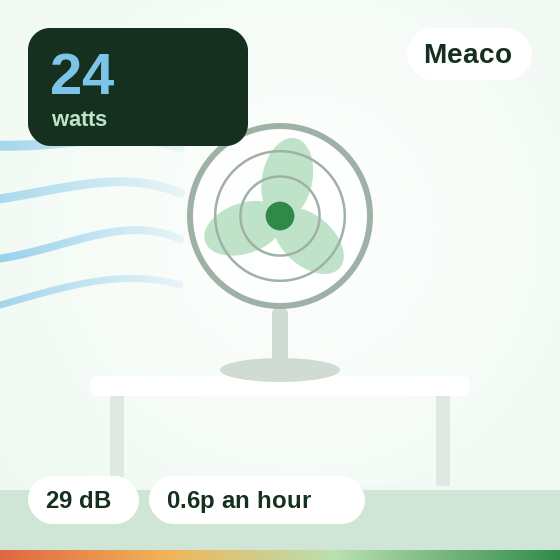
Meaco
MeacoFan 1056 Air Circulator
24 watts · 29 dB · 0.6p an hour
£99.99 at Meaco (maker shop), checked 14 Nov 2026
See it at Meaco (maker shop)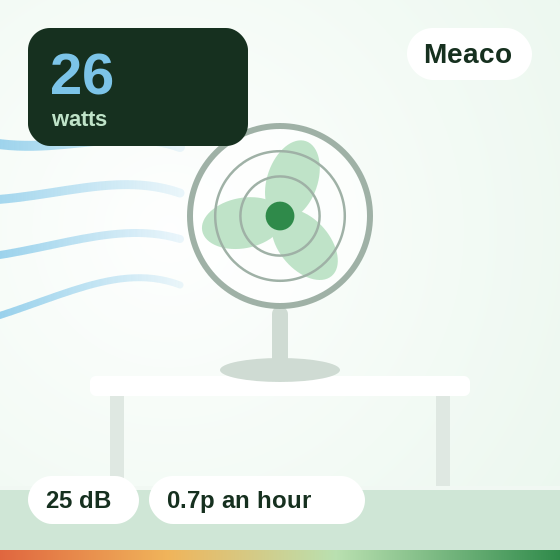
Meaco
MeacoFan Sefte 10" Pedestal Air Circulator
26 watts · 25 dB · 0.7p an hour
£179.99 at Meaco (maker shop), checked 14 Nov 2026
See it at Meaco (maker shop)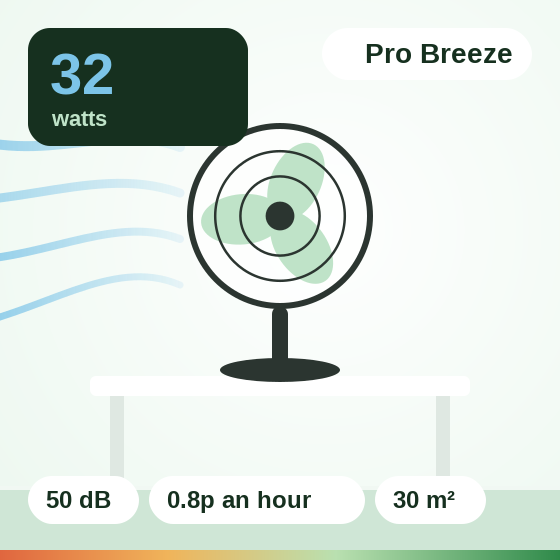
Pro Breeze
AirFlo Plus 44" Hybrid Pedestal Fan (PB-F-27)
32 watts · 50 dB · 0.8p an hour · 30 m²
£169.99 at Pro Breeze (maker shop, White/Black), checked 14 Nov 2026
See it at Pro Breeze (maker shop, White/Black)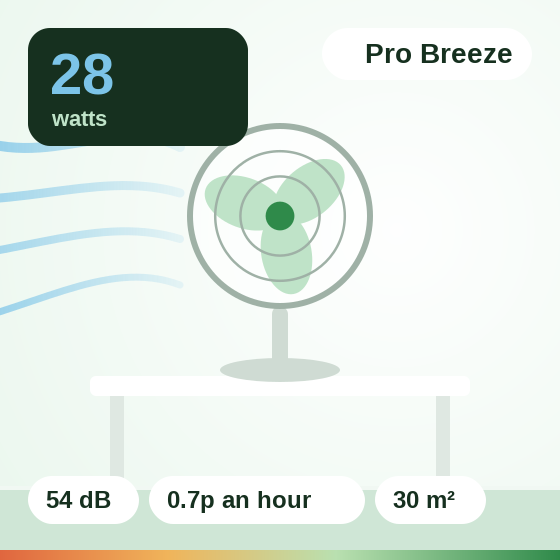
Pro Breeze
AirFlo Mini 11" Turbo Fan (PB-F-28)
28 watts · 54 dB · 0.7p an hour · 30 m²
£59.99 at Pro Breeze (maker shop, White), checked 14 Nov 2026
See it at Pro Breeze (maker shop, White)
Figures from the maker or retailer listing. Cost an hour is our own, at the price cap of 26.32p a kWh.